
 Matzav
NASA Boss Announces Three Moon Base Missions Scheduled For Later This Year, At Least 12 To Come
NASA Administrator Jared Isaacman announced Monday that the agency will begin laying the foundation for a permanent lunar base later this year through a series of major moon missions, with more than a dozen additional launches expected to follow.
The first wave of missions will be carried out by Blue Origin, Astrobotic, and Intuitive Machines, each delivering critical cargo and equipment designed to support future construction efforts on the moon.
“These represent the first of more than a dozen missions we expect to announce through the balance of this year as we return, build the base, and never give up the moon again,” Isaacman told reporters Tuesday. “And as mentioned, just like in decades past, we are taking the world along with us.”
The opening mission will feature Blue Origin’s Blue Moon Mark 1 lunar lander, which is scheduled to transport payloads to the moon’s south pole in what NASA described as “the first privately funded lunar lander mission in history.”
The second mission, led by Astrobotic’s Griffin Mission One, is expected to deliver what NASA called “the largest commercial payload delivered to the lunar surface ever.”
A third mission will focus on studying the mysterious Reiner Gamma swirl on the moon while also transporting scientific equipment from both the European Space Agency and the Korea Astronomy and Space Science Institute.
NASA also unveiled a new Moon Base website Tuesday aimed at providing regular updates to the public as the massive lunar project advances.
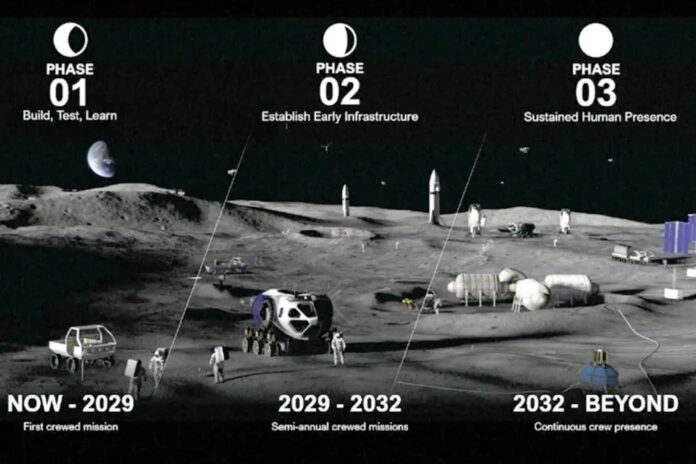
According to the agency, construction of the Moon Base will unfold in three major stages: learning, building, and testing; early habitation; and finally establishing a sustained long-term human presence.
NASA hopes to enter the “early habitation” phase by early 2029.
Moon Base Program Executive Carlos Garcia Galan said the finished lunar outpost could eventually span “hundreds of square miles” and may require major infrastructure systems including electrical grids, communication towers, and other technologies necessary to support permanent human life.
“The endeavor of building a moon base is going to be extremely hard, and it dawns on us every day how little we know of the lunar surface,” said Galan.
Isaacman emphasized that NASA intends to avoid relying solely on a small number of highly specialized government-built systems and instead wants to stimulate broader private-sector participation in lunar development.
As part of that effort, Blue Origin — founded by Jeff Bezos — received a $188 million contract to transport Lunar Terrain Vehicles to the moon.
NASA separately awarded contracts worth $219 million and $220 million to AstroLab and Lunar Outpost for development of the vehicles themselves.
Meanwhile, Firefly Aerospace has been selected to transport drones to the moon by 2028. The drones are expected to capture detailed imagery, identify landing zones, and scout potential locations for future Moon Base facilities.
“We will not sit on our hands and wait for industry to deliver,” Isaacman told reporters. “In the time since Artemis II, we have been extremely active.”
“We’ve been reviewing feedback from the ignition events, speaking to industry, addressing supply chain challenges, having the tough conversations with those failing to meet expectations, and offering NASA’s assistance to solve problems.”
The Artemis II lunar flyby mission was completed last month, while NASA is targeting next year for the launch of Artemis III, which will further test the Orion spacecraft.
Artemis IV — the mission expected to place astronauts on the moon for the first time since 1972 — is currently scheduled for 2028.