
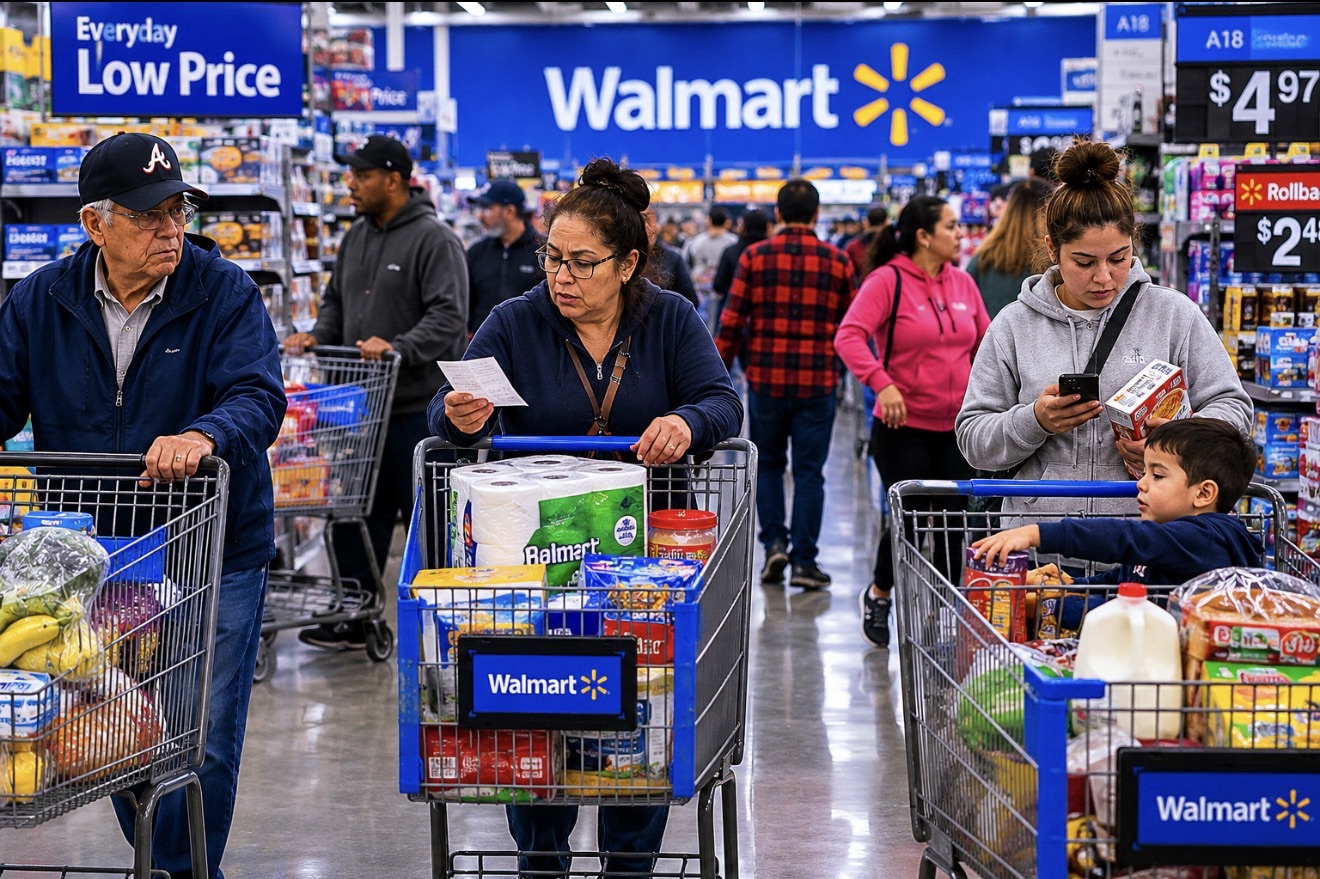

Walmart is warning that rising gasoline prices are beginning to pressure even the lower-income shoppers who have historically formed the backbone of the retailer’s customer base.
The warning came from Walmart executives during recent earnings discussions and signals growing strain across large segments of the American consumer economy as fuel and food costs continue climbing.
John David Rainey, Walmart’s chief financial officer, said wealthier consumers continue spending steadily, but lower-income households are becoming increasingly cautious and financially stressed.
“The high-income consumer is spending with confidence in many categories, whereas the low-income consumer, we can tell, is more budget-conscious,” Rainey said.
One number stood out sharply.
Walmart executives said many customers are now purchasing fewer than 10 gallons of gasoline per visit at Walmart fuel stations — something the company says it has not seen consistently since 2022.
That shift may sound small, but retailers view it as a major economic signal.
Consumers are increasingly buying only enough gas to get through the immediate week rather than filling their tanks completely, a behavior often associated with tighter household cash flow.
The backdrop is rising fuel costs tied to global energy disruptions.
According to AAA, the national average for regular gasoline has climbed above $4.50 per gallon following months of volatility linked to the Middle East conflict and ongoing disruptions tied to the Strait of Hormuz, one of the world’s most important oil shipping routes.
Higher fuel costs are now filtering through nearly every part of household spending.
Walmart’s U.S. chief executive, John Furner, said elevated fuel costs reduced company profit by roughly $175 million during the most recent quarter alone.
The retailer still posted strong sales growth.
Comparable U.S. sales excluding fuel rose 4.1%, while e-commerce growth remained robust.
But Walmart’s forward guidance came in weaker than some analysts expected, reflecting concerns that consumers are becoming more selective with discretionary spending.
Executives also warned that if elevated transportation and fuel costs continue, shoppers could begin seeing additional retail price inflation during the second half of the year.
That matters because Walmart has increasingly become one of the country’s primary economic barometers.
Over the past several years, middle-income consumers increasingly shifted spending toward Walmart in search of lower prices as inflation pressured household budgets.
That trade-down trend helped Walmart outperform many competitors across the retail sector.
Now the company is signaling that financial stress is moving deeper into lower-income households as well.
The pressure extends beyond gasoline.
The U.S. Department of Agriculture forecasts overall food prices will continue rising during 2026, with categories like beef and fresh produce seeing particularly sharp increases.
For many Walmart shoppers, groceries and gasoline make up the largest portions of monthly spending.
When both rise simultaneously, households often reduce restaurant visits, discretionary shopping, travel, and entertainment first.
Other companies are already seeing similar patterns.
Fast-food chains, discount retailers, and consumer lenders have all recently pointed to softer spending trends among lower-income consumers.
Federal retail data still shows headline consumer spending remaining positive overall, but much of the increase is being driven by higher prices rather than significantly larger purchasing volumes.
Walmart says it is attempting to offset some of the pressure through aggressive pricing initiatives, including thousands of rollback promotions across stores nationwide.
The retailer may also benefit from tariff-related refunds tied to recent court rulings overturning portions of earlier trade tariffs, potentially giving the company additional flexibility on pricing later this year.
Even so, Walmart’s broader message to Wall Street was clear:
American consumers are becoming more financially selective as inflation continues weighing on household budgets.
Importantly, Walmart itself is not struggling financially.
The company maintained full-year guidance and continues expanding delivery capabilities, e-commerce infrastructure, and logistics operations nationwide.
But the behavior of the shoppers walking through Walmart stores is changing.
When the nation’s largest retailer starts warning that its core lower-income customers are buying smaller amounts of gas, eating out less frequently, and watching every dollar more carefully, investors across the broader economy tend to pay attention.
As summer travel season begins, Walmart is signaling that many American families may be preparing for a more cautious spending environment than Wall Street had expected only a few months ago.
JBizNews Desk — New York
© 2026 JBizNews. All Rights Reserved. Reproduction or distribution without written permission is prohibited.