
 JBizNews
Putin’s Expanding War Threat Is Now Reshaping European Budgets, Bond Markets and Defense Stocks
By JBizNews Desk
Europe’s financial markets are no longer treating the war in Ukraine as a regional conflict. They are treating it as the opening phase of a broader security and economic realignment that could redefine the continent’s budgets, debt markets and industrial priorities for the next decade.
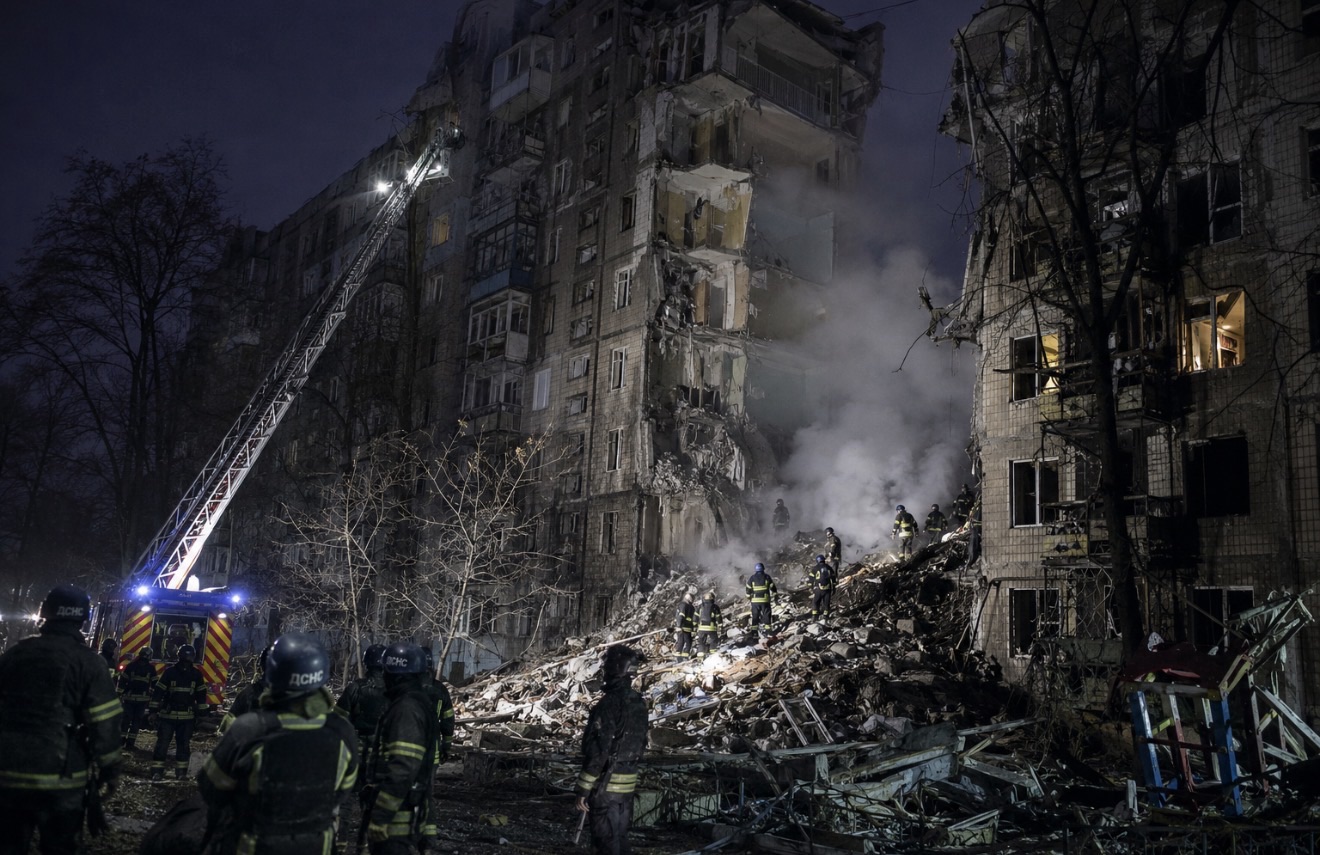
That shift became more visible Sunday after Russia launched one of its largest aerial attacks on Kyiv this year, firing roughly 600 drones and 90 missiles overnight, including the nuclear-capable Oreshnik hypersonic missile. Ukrainian President Volodymyr Zelensky said Kyiv absorbed the heaviest strikes, while Mayor Vitali Klitschko reported damage across every district of the capital. European Union foreign policy chief Kaja Kallas described Moscow’s use of the Oreshnik as reckless nuclear brinkmanship intended to intimidate Europe politically as much as militarily.
The strike came just days after Moscow announced plans to file a case at the International Court of Justice accusing Estonia, Latvia and Lithuania of discriminating against Russian-speaking minorities — language European officials immediately recognized from the Kremlin’s playbook before the annexation of Crimea in 2014 and before Russia’s full-scale invasion of Ukraine in 2022.
For European governments, the issue is no longer whether Russia poses a threat. The question now is how much economic capacity Europe must permanently dedicate to deterring it.
That answer is already showing up in defense budgets.
Estonian Defense Minister Hanno Pevkur said this month that Estonia plans to allocate roughly 5.4% of GDP annually to defense between 2026 and 2029, while Lithuanian President Gitanas Nausėda announced plans to push Lithuanian defense spending toward 5% to 6% of GDP. Poland is already spending roughly 4.5% of GDP on defense, one of the highest levels in NATO.
The broader trend is striking. European Union defense spending has climbed from approximately €218 billion in 2021 to a projected €381 billion in 2025. At NATO’s summit in The Hague, alliance members — with the exception of Spain — backed a framework targeting 3.5% of GDP for core military spending plus another 1.5% for security-related investment.
If fully implemented, Europe’s combined defense spending could approach €800 billion annually by the end of the decade.
That figure is extraordinary when compared to Europe’s own central budget. The EU’s annual institutional budget remains under €200 billion. In practical terms, Europe is preparing to spend roughly four times its collective administrative budget on defense every year because policymakers increasingly believe the Ukraine war may not remain geographically contained.
Financial markets have been pricing in that possibility for months.
German defense giant Rheinmetall AG has become one of Europe’s biggest market winners since Russia’s invasion of Ukraine, with shares rising more than twelvefold. The company expects 2026 sales growth of 40% to 45% after reporting a massive €64 billion order backlog. Rheinmetall is now expanding artillery shell production from roughly 70,000 units in 2022 toward a targeted 1.5 million annually by 2030.
Investors are treating Europe’s defense sector less like a cyclical trade and more like a long-duration structural growth industry.
The STOXX Europe Aerospace and Defense Index now trades at roughly 43 times projected 2026 earnings, more than double the broader STOXX Europe 600 valuation. Norway’s Kongsberg Gruppen is projected to post annual growth above 20%, while Britain’s BAE Systems continues forecasting sustained multi-year expansion tied to NATO rearmament.
But despite the spending surge, analysts warn Europe still faces major structural weaknesses.
A February defense assessment from McKinsey found that European NATO countries remain below pre-2021 military equipment stockpile levels even after NATO Europe and Canada spent more than $482 billion on defense in 2024. One major reason is fragmentation. European NATO members currently operate 12 separate main battle tank platforms, compared with just one used by the United States military.
That fragmentation increases procurement costs, slows scaling and limits interoperability during an actual conflict scenario.
The strategic concern underlying much of the spending is the Baltic region.
A recent Harvard Belfer Center scenario study examined the risk of a Russian move aimed at isolating Estonia, Latvia and Lithuania through the Suwałki Gap — the narrow corridor between Belarus and the Russian enclave of Kaliningrad that connects the Baltic states to the rest of NATO territory.
While European officials publicly insist they do not view war with NATO as imminent, defense planning assumptions across the continent increasingly reflect the possibility that Moscow could eventually test alliance cohesion through hybrid operations, limited territorial incursions or coercive pressure against NATO’s eastern flank.
That fear is now embedded not only in military planning, but in sovereign borrowing costs, industrial policy and equity markets.
The bond spreads, the weapons orders and the emergency defense appropriations are all pointing toward the same conclusion: Europe is preparing financially for a world in which deterrence may become a permanent economic sector.
If Russia never expands the conflict beyond Ukraine, Europe will have built one of the largest defense spending programs in modern peacetime history. If Moscow eventually tests NATO directly, policymakers increasingly believe the current spending wave may only represent the beginning.
Europe’s markets appear to have already made their bet.
Europe — JBizNews Desk
© JBizNews.com All Rights Reserved. Reproduction or distribution without written permission is prohibited.