
 JBizNews
Warsh Channels Greenspan in Debut as Fed Chair, Signals Lighter Touch and Patience on Rates
By JBizNews Desk
WASHINGTON, May 26, 2026 — Newly sworn-in Federal Reserve Chair Kevin Warsh signaled at his East Room swearing-in ceremony on Friday that he intends to model his leadership of the central bank after former Fed Chair Alan Greenspan, invoking the architect of the 1990s economic boom as he laid out a vision for a more restrained, less talkative and more discretionary Federal Reserve.
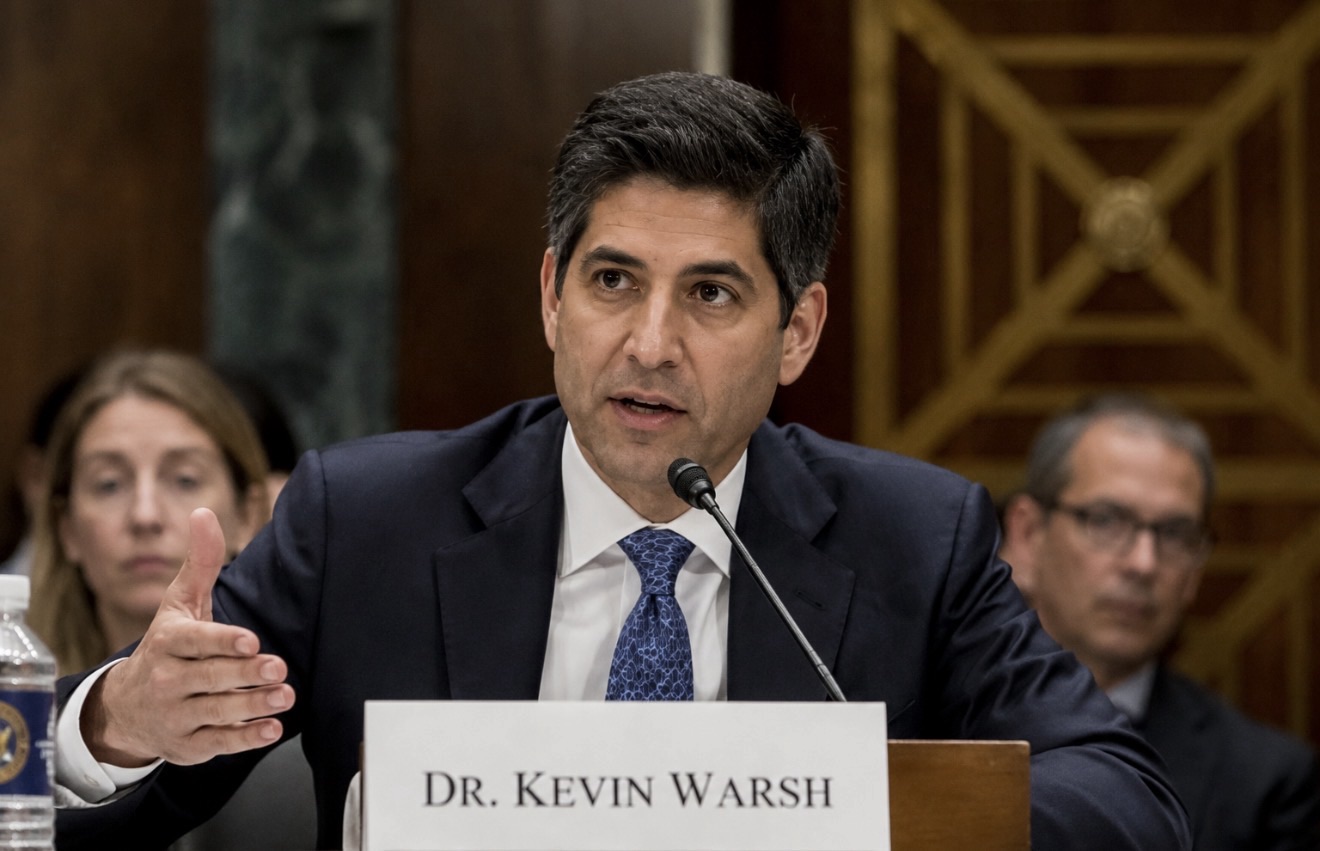
Warsh, who officially became the 17th chair of the Federal Reserve after taking the oath from Supreme Court Associate Justice Clarence Thomas, told guests that Greenspan was the first Fed chair to show him “what this role demands” and pledged to fill the office “with energy and purpose, just the way Chairman Greenspan did.” Standing alongside his wife, Jane Lauder, Warsh formally succeeded Jerome Powell, ending Powell’s eight-year run atop the central bank.
The reference to Greenspan was not simply ceremonial. Warsh assumes control of the Fed at a moment when inflation has remained above the central bank’s 2% target for more than five years, oil prices have surged following the Iran conflict, and the White House has openly pressured the Fed to lower interest rates. By repeatedly invoking Greenspan’s 1990s-era approach — when the Fed largely held rates steady during the technology boom on the belief that productivity gains were containing inflation — Warsh offered markets their clearest indication yet of how he intends to govern monetary policy.
President Donald Trump, hosting the ceremony at the White House, praised Warsh as a future “great chairman” and renewed his argument that lower borrowing costs would allow the U.S. economy to expand faster without reigniting inflation while simultaneously reducing federal debt-servicing costs. Trump also publicly encouraged Warsh to “do his own thing,” a line widely interpreted as an attempt to calm investor fears that the new Fed chair would operate under direct political pressure from the administration.
Treasury Secretary Scott Bessent, one of Warsh’s strongest backers inside the administration, has spent months building the intellectual case for a Greenspan-style Fed. In a January speech, Bessent described Greenspan as “the open-minded maestro” and argued that central banks should avoid prematurely tightening policy during periods of major technological transformation. He repeatedly pointed to the late 1990s as evidence that productivity booms can absorb inflationary pressures without requiring aggressive rate hikes.
Warsh himself has been laying out a similar framework for more than a year. He has argued publicly that artificial intelligence and automation will lift productivity, reduce structural inflationary pressures and eventually create room for lower rates. During his Senate Banking Committee confirmation hearing in April, Warsh also signaled that he wants the Fed to communicate less frequently, scale back forward guidance and stop telegraphing policy moves months in advance.
Most notably, Warsh declined to commit to holding a press conference after every Federal Open Market Committee meeting — a practice institutionalized by Powell that turned Fed communication into one of Wall Street’s primary policy signals.
That potential shift matters enormously for markets. Under Powell, the Fed used communication itself as a policy tool, conditioning investors through speeches, forecasts and repeated signaling. Under Warsh, the institution appears headed toward a more opaque model where fewer public remarks carry greater weight — echoing Greenspan’s famously cryptic approach, when markets often dissected every sentence from the chair for clues about future policy.
The economic backdrop, however, is far more complicated than the one Greenspan managed during the 1990s expansion.
Minutes from the Federal Reserve’s most recent meeting show that many policymakers remain deeply concerned about persistent inflation pressures tied to elevated oil prices, tariffs and supply-chain disruption. Several Fed officials indicated they now expect rates to remain elevated longer than anticipated earlier this year, while some suggested additional tightening could become necessary if inflation fails to ease.
Fed Governor Christopher Waller, widely viewed as one of the central bank’s more dovish members and another Trump appointee, said Friday that while he currently supports holding rates steady, he would not rule out hikes if rising oil prices create a longer-lasting inflation shock.
Markets are now pricing in the likelihood that the Fed will remain on hold through much of 2026, with some traders increasingly assigning probability to possible hikes in early 2027 — a stance that clashes both with Trump’s push for lower rates and with Warsh’s own optimism that technological productivity gains will ultimately suppress inflation.
In his prepared remarks Friday, Warsh framed the Fed’s mission in straightforward terms.
“Our mandate at the Fed is to promote price stability and maximum employment,” Warsh said. “When we pursue those aims with wisdom and clarity, independence and resolve, inflation can be lower, growth stronger, real take-home pay higher.”
He also pledged to oversee what he called a “reform-oriented Federal Reserve” capable of moving beyond “static frameworks and models” — language that aligns closely with his push for a more flexible and less communication-heavy central bank.
The symbolism of the ceremony itself also stood out. The East Room audience included Cabinet officials, Supreme Court Justices Clarence Thomas and Brett Kavanaugh, House Speaker Mike Johnson, National Economic Council Director Kevin Hassett, and Treasury Secretary Bessent. Federal Reserve chairs are traditionally sworn in at the Fed’s Eccles Building in Washington. The last chair to take the oath at the White House was Greenspan himself — a detail Warsh deliberately highlighted.
For businesses and investors, the message from Friday’s ceremony was increasingly clear: a Warsh-led Federal Reserve is likely to speak less, reveal less and rely more heavily on discretion than the Powell Fed that preceded it.
If Warsh’s thesis about artificial intelligence-driven productivity proves correct, that approach could allow inflation to cool without requiring another painful tightening cycle. But if energy costs, tariffs and geopolitical disruptions keep inflation stubbornly elevated, the same communication-light strategy may leave markets with less warning before future rate increases.
JBizNews Desk
© 2026 JBizNews. All Rights Reserved. Reproduction or distribution without written permission is prohibited.