
 JBizNews
Oil, Gold Jump as Iran Ceasefire Frays Following IRGC Base Strike and Kuwait Missile Alerts
By JBIZ News Desk | May 28, 2026 — Early Morning Edition
Updated with IRGC confirmation, official Kuwait Army statement, and market data
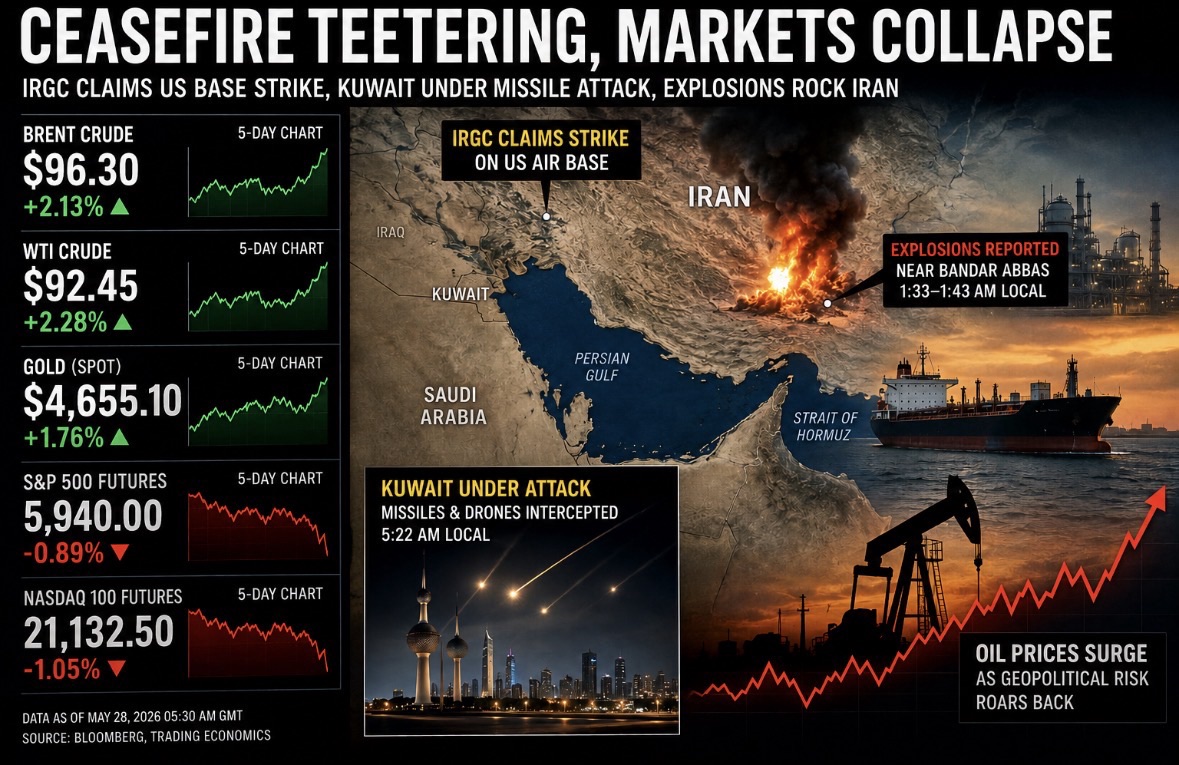
The fragile Iran war ceasefire appeared to be unraveling overnight, sending fresh shockwaves through global energy and financial markets after Iran’s Islamic Revolutionary Guard Corps publicly claimed responsibility for striking a US air base, explosions rocked Bandar Abbas, and Kuwait confirmed active missile and drone interceptions over its territory.
The developments sharply raised the risk of renewed disruption across the Strait of Hormuz — one of the world’s most critical oil shipping corridors — reversing a recent wave of market optimism that had pushed crude prices lower on expectations of a lasting diplomatic settlement between Washington and Tehran.
Iranian state-linked Tasnim News Agency reported that the IRGC launched retaliatory strikes against a US air base following what Tehran described as an American attack outside Bandar Abbas airport. The statement marks the first explicit public acknowledgment by Tehran of a direct strike on a US installation since the April 8 ceasefire brokered by Pakistan.
The escalation unfolded within hours of renewed diplomatic talks in Doha, where US and Iranian negotiators were attempting to formalize a permanent end to nearly three months of conflict. Instead, investors were confronted with a rapid sequence of military incidents stretching from southern Iran to Kuwait, reigniting fears of broader regional instability and renewed threats to Gulf energy infrastructure.
Explosions were reported east of Bandar Abbas between approximately 1:33 AM and 1:43 AM local time, according to Iran’s semi-official Fars News Agency, which said air defense systems were activated during the incident. Bandar Abbas hosts Iran’s principal naval facilities along the Strait of Hormuz and has become a central flashpoint in the conflict after US Central Command conducted strikes there earlier this week targeting IRGC mine-laying vessels and missile infrastructure.
Capt. Tim Hawkins spokesperson US Central Command said Monday that American forces had carried out “self-defense strikes” to protect US personnel from Iranian threats in southern Iran. Tehran has since accused Washington of violating ceasefire terms.
Military aviation tracking data cited by regional monitoring channels indicated heightened US surveillance and aerial refueling activity over the Persian Gulf during the overnight incidents, including AWACS surveillance aircraft, tanker operations, and maritime patrol flights.
The most immediate market concern centered on Kuwait after the country’s General Staff confirmed that air defense systems were actively intercepting incoming missiles and drones following air raid sirens heard across the country at approximately 5:22 AM local time.
In a statement posted to X, the Kuwaiti Army urged residents to follow security instructions and said explosion sounds heard across the capital area were linked to defensive interceptions. Kuwait hosts major US military facilities, including Camp Arifjan, which was previously targeted earlier in the conflict.
The renewed instability hit markets at a particularly sensitive moment. Brent crude had fallen more than 4.5% on Wednesday amid expectations that a diplomatic breakthrough could restore normalized shipping flows through the Strait of Hormuz. Prices briefly dipped below $95 per barrel before rebounding to roughly $96.30 ahead of Thursday trading.
Energy analysts now expect renewed upward pressure on oil prices as Asian and European markets absorb the implications of the overnight escalation.
Analysts Goldman Sachs Group and Analysts ING Group have previously warned that any renewed disruption to Hormuz shipping lanes could quickly drive Brent crude back above the $100 threshold. Roughly one-fifth of global oil consumption moves through the narrow waterway.
Safe-haven assets also appeared poised for reversal. Spot gold had weakened earlier in the week on easing geopolitical fears, but renewed military activity involving US assets and Gulf states is expected to increase demand for defensive assets when markets reopen.
Equity investors are also facing heightened volatility risks after US stock indexes recently reached record highs driven largely by artificial intelligence enthusiasm and resilient corporate earnings. Analysts at UBS warned earlier this week that elevated bond yields combined with Middle East instability could challenge the broader global equity rally.
The April ceasefire had already shown signs of strain in recent days. Iranian officials accused Washington of repeated violations following earlier US strikes near Bandar Abbas, while US officials maintained the operations were defensive and limited in scope.
Marco Rubio Secretary of State United States Department of State acknowledged this week that negotiations remained deadlocked over unresolved language in the proposed framework agreement. Meanwhile, Iran’s Supreme Leader Mojtaba Khamenei Supreme Leader Islamic Republic of Iran warned regional governments against serving as “shields for US bases,” while the IRGC issued statements saying its forces were “lying in wait” for further American military action.
Against that backdrop, Tehran’s decision to publicly claim responsibility for a strike on a US installation represents a major escalation signal to both Washington and global markets. Investors are now likely to focus less on ceasefire diplomacy and more on whether the conflict is entering another cycle of retaliation capable of threatening Gulf oil exports, shipping insurance markets, and broader global risk sentiment.
Whether negotiations in Doha can survive the latest overnight escalation remains uncertain. Market participants will now closely monitor any formal response from US Central Command, further statements from Tehran, and early commodity trading reactions as global exchanges reopen.
This is a developing story. JBIZ will update as CENTCOM issues a formal statement and market opens are confirmed.
JBizNews Desk