
 JBizNews
Ford’s Big AI Battery Bet Sends Shares Soaring as Wall Street Revalues the Automaker
By JBizNews Desk
When Ford Motor Co. shares surged roughly 21% in two trading sessions earlier this month, the catalyst was not a new truck launch, not quarterly earnings, and not anything happening inside a dealership showroom.
It was a battery announcement.
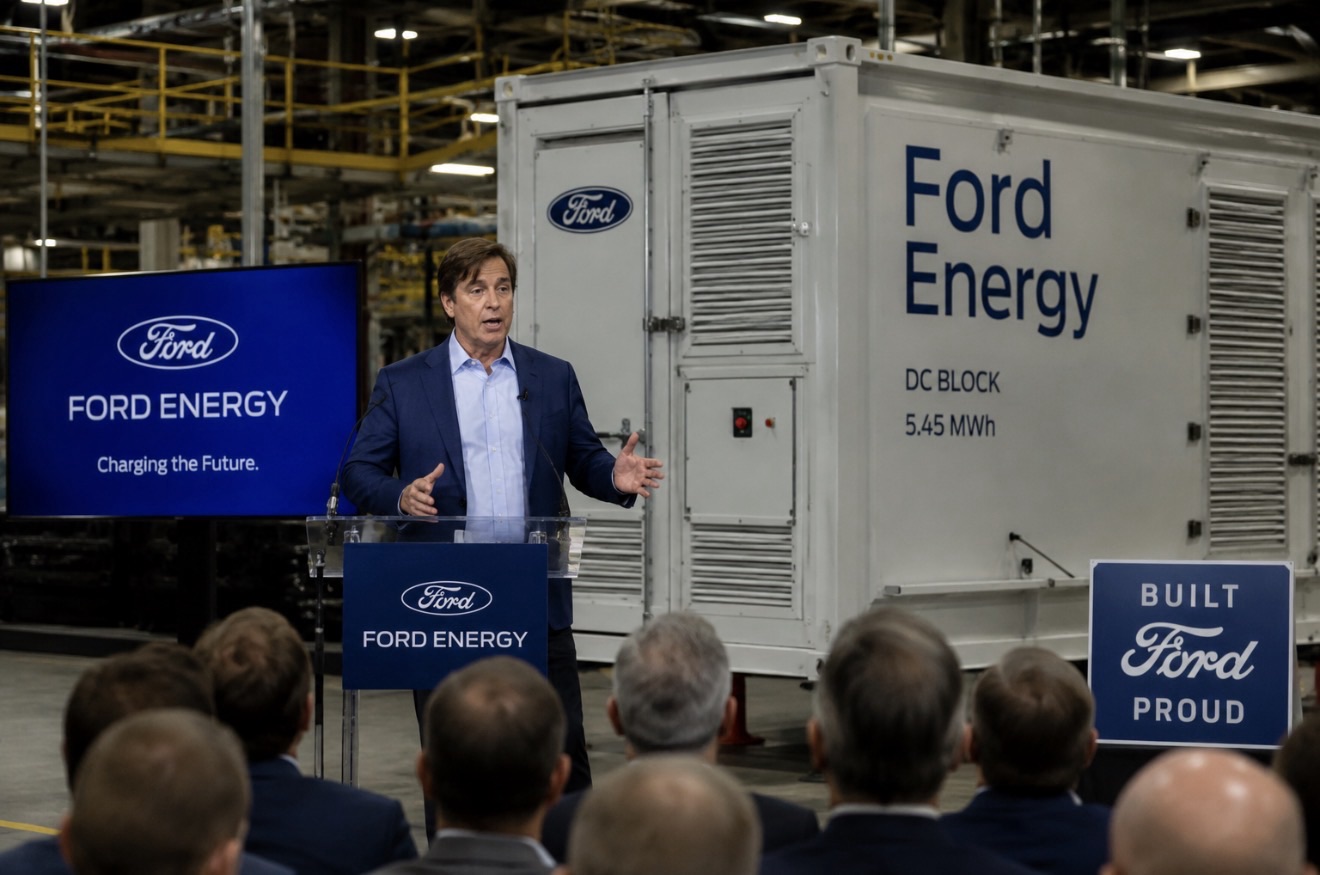
The 122-year-old Dearborn automaker quietly launched a wholly owned subsidiary called Ford Energy, a business designed to build large-scale battery storage systems for utilities, industrial operators and the exploding artificial-intelligence data-center market — instantly giving Wall Street a new way to value Ford beyond cars.
The market reaction was immediate because investors increasingly believe the next phase of the AI boom will not be driven only by chips and software, but by the physical infrastructure required to power it.
Training and operating large language models such as ChatGPT, Gemini and enterprise AI systems consumes electricity at levels the U.S. power grid was never built to handle. New hyperscale data centers are being announced faster than utilities can bring new generation capacity online. The gap is increasingly being filled by one critical piece of infrastructure: large-scale stationary battery storage.
And Ford suddenly owns one of the country’s largest planned manufacturing footprints for it.
Ford Energy launched in mid-May as a wholly owned subsidiary focused on battery energy storage systems for utilities, data centers and industrial customers. Jim Farley, Ford’s chief executive, described the business as a “high-growth, high-margin, anti-cyclical” opportunity capable of diversifying Ford’s revenue away from the volatility of vehicle sales.
Within days of launching the subsidiary, Ford announced its first major deal.
Ford Energy and EDF Power Solutions North America, the U.S. arm of France’s EDF Group, signed a five-year framework agreement allowing EDF to procure up to 4 gigawatt-hours annually of Ford’s DC Block battery storage systems — representing as much as 20 GWh over the life of the agreement.
Deliveries are expected to begin in 2028.
“We are not simply delivering hardware,” said Lisa Drake, president of Ford Energy. “We are delivering the kind of predictable quality and long-term operational confidence that grid operators and large-scale developers require.”
Tristan Grimbert, CEO of EDF Power Solutions North America, said Ford’s domestic manufacturing strategy and supply-chain traceability standards aligned with EDF’s long-term infrastructure goals.
That was the moment Wall Street stopped viewing Ford purely as an automaker.
Shares jumped 13% the day of the announcement and added another 6.7% the following session as trading volume exploded to nearly 187 million shares, pushing Ford to its highest valuation since mid-2023 and lifting its market capitalization toward $58 billion.
The analyst note that intensified the rally came from Morgan Stanley.
Clean-tech and power analyst Andrew Percoco argued that Ford Energy alone could eventually be worth roughly $10 billion as a standalone infrastructure business — a valuation framework rarely applied to traditional auto manufacturers. Percoco projected roughly $588 million in EBIT at scale and suggested Ford Energy could soon sign contracts with hyperscalers — the cloud-computing giants operating the AI economy’s largest data centers.
The physical hardware behind the strategy is already being built in Kentucky.
Ford is converting part of its BlueOval Battery Park facility in Glendale — originally designed for electric-vehicle battery production — into a manufacturing hub for stationary energy-storage systems. Its flagship product, the DC Block, is a standardized 20-foot containerized battery unit capable of storing approximately 5.45 megawatt-hours of electricity using lithium iron phosphate chemistry favored by utilities for safety and long-duration cycling.
Ford Energy is targeting roughly 20 gigawatt-hours of annual production capacity by 2027.
The move also solves a growing business problem inside Ford.
Electric-vehicle demand has softened materially across much of the U.S. market, leaving several automakers with battery-production capacity planned for growth levels that never fully materialized. Redirecting those factories toward AI-linked grid storage potentially gives Ford a higher-margin and more stable industrial business than mass-market EV manufacturing alone.
Ford has already said its money-losing Model E electric-vehicle division is now targeted to reach profitability by 2029, with Ford Energy expected to contribute directly to that turnaround strategy.
There is, however, one geopolitical complication hanging over the story.
The battery-cell technology underlying Ford’s DC Block systems is licensed from Chinese battery giant CATL, formally known as Contemporary Amperex Technology Co. The same licensing arrangement previously drew scrutiny from U.S. lawmakers when Ford announced its multibillion-dollar Michigan battery project several years ago.
For now, political pressure appears temporarily reduced following recent diplomatic engagement between President Donald Trump and Chinese President Xi Jinping, which eased immediate tensions surrounding U.S.-China industrial cooperation. But analysts continue to identify the CATL relationship as one of the primary execution risks behind Ford Energy’s long-term outlook.
The broader significance of the move extends far beyond one automaker.
The AI investment cycle is rapidly spreading into traditional industrial sectors that manufacture the physical systems required to power and cool data centers. Caterpillar has benefited from demand tied to backup power infrastructure. Vertiv Holdings has surged on AI-driven cooling systems. Utilities, nuclear operators and grid-equipment suppliers have all been revalued by investors searching for secondary beneficiaries of AI expansion.
Ford has now joined that list through batteries.
For a company that has spent years battling electric-vehicle losses, supply-chain disruptions and shrinking margins in its core vehicle business, the question “What is Ford worth?” suddenly depends less on how many F-150s leave the factory and more on how many gigawatt-hours leave Glendale, Kentucky.
The company is still selling cars.
But the stock is no longer being priced like a car company.
Detroit — JBizNews Desk
© JBizNews.com All Rights Reserved. Reproduction or distribution without written permission is prohibited.