

EASTERN OUTER PORT LIMITS, off Malaysia — As of May 28, 2026, a stretch of open water roughly 45 miles off Malaysia’s southern coast has become one of the most important loopholes in America’s campaign to choke off Iran’s oil money. The Malaysian Maritime Enforcement Agency confirmed this month that aging tankers carrying sanctioned Iranian crude are gathering there to quietly hand off their cargo to other ships bound for China, exploiting what agency director-general Mohamad Rosli Abdullah described as gaps in maritime law that place many of the transfers beyond the reach of local enforcers.
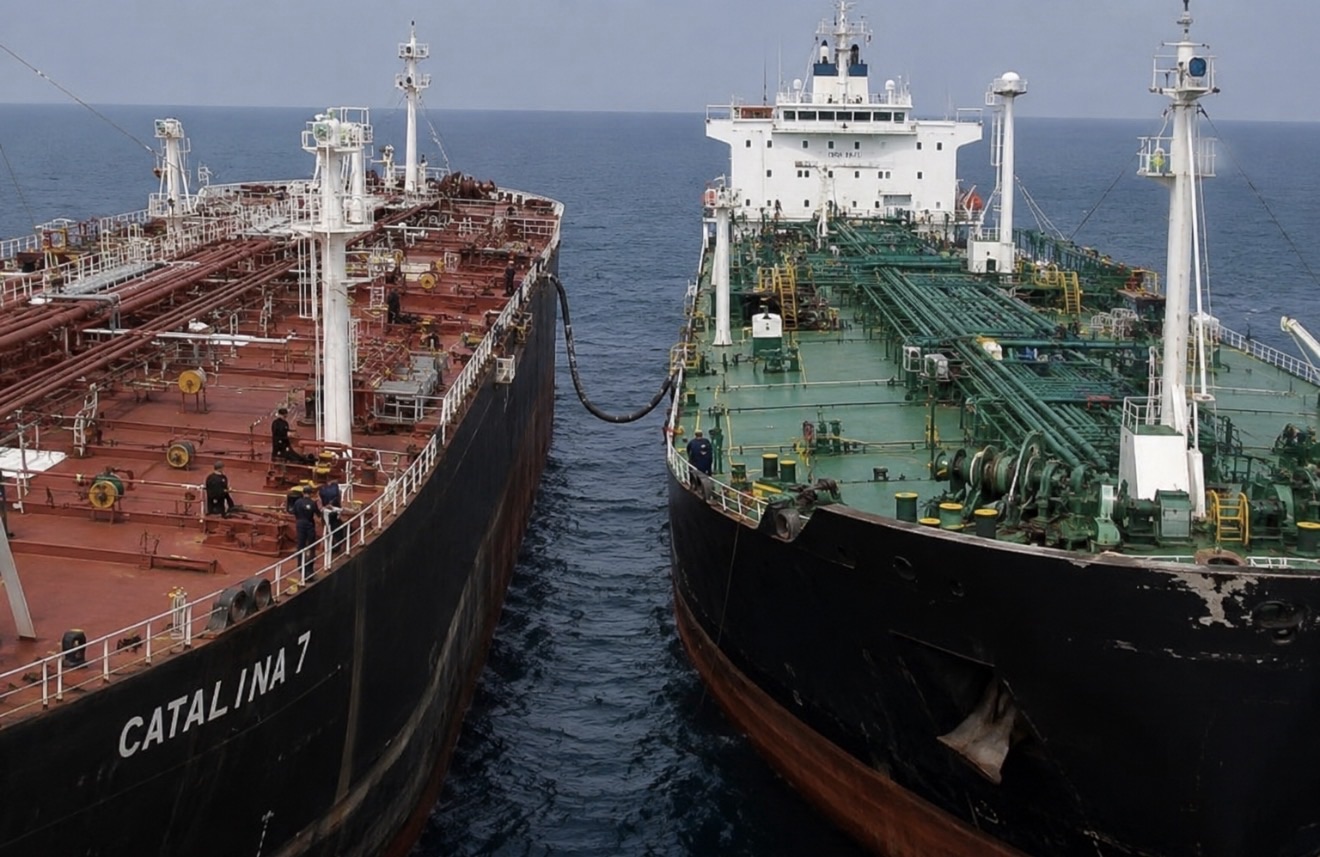
The handoffs are the entire business model. One vessel unloads sanctioned crude onto another ship to blur the oil’s origin before it continues toward China, Iran’s biggest customer. Reporters who reached the area by boat on May 8 observed the Catalina 7, an aging tanker sanctioned by the United States for transporting Iranian crude, pumping oil through a thick transfer hose into another vessel whose name had been painted over in black. The scene underscored one of Tehran’s core economic advantages in its confrontation with Washington: despite sanctions, naval pressure, and diplomatic isolation, Iran can still sell oil and generate hard currency.
The location was chosen carefully. The Eastern Outer Port Limits lies roughly 70 kilometers off Malaysia’s Johor state, near one of the world’s busiest maritime corridors connecting the Middle East and East Asia. Many of the ship-to-ship transfers occur beyond Malaysia’s territorial waters and outside effective radar monitoring. Abdullah told reporters the area was deliberately selected to exploit jurisdictional gaps and complicate direct enforcement efforts.
The mechanics form a sprawling maritime deception network stretching thousands of miles. One group of tankers loads crude at Iran’s export facilities on Kharg Island, crosses the Indian Ocean, navigates through the Malacca and Singapore straits, and anchors offshore near Malaysia. A second group of ships then receives the oil through ship-to-ship transfers and carries it onward to China, primarily to the independent “teapot” refineries in Shandong province, which have become major buyers of sanctioned crude.
To disguise the trade, vessels frequently disable tracking transponders, obscure hull markings, repaint identification numbers, and alter registry details. Ying Cong Loh, a crude analyst at Kpler, said China often relabels Iranian oil as Malaysian-origin crude, allowing shipments to move through supply chains with limited scrutiny despite Beijing officially reporting no Iranian oil imports since 2022.
The scale is massive — and directly undermines the effectiveness of the U.S. pressure campaign. An Associated Press investigation tracked dozens of Iranian-linked oil transfers off Johor since the U.S.-Iran conflict intensified on February 28, even as Iran faced heightened naval scrutiny around the Strait of Hormuz. Advocacy group United Against Nuclear Iran said satellite imagery documented at least 42 transfers in the area during that period.
Despite the sanctions regime, the money continues flowing. The U.S.-China Economic and Security Review Commission estimates Iran has generated roughly $31 billion in oil revenue from China even without officially recorded imports. That revenue is precisely what Washington is attempting to cut off.
John Hurley, the Treasury undersecretary for terrorism and financial intelligence, said the United States remains committed to depriving Tehran of petroleum revenue used to finance military operations and weapons programs. Since returning to office, President Donald Trump has sanctioned more than 180 vessels connected to Iranian petroleum shipping, including 19 additional ships designated in May under what the administration calls its “Economic Fury” campaign.
But the fleet continues adapting faster than enforcement systems can respond.
Maritime intelligence firm Windward estimates roughly 430 tankers are currently involved in Iran-linked oil trade activity. Of those vessels, approximately 62% operate under false flags while 87% have already been sanctioned by Western authorities. Operators repeatedly restructure ownership chains, switch registries, rename ships, and acquire replacement vessels through intermediary companies faster than regulators can blacklist them.
China plays a central role in sustaining the network. Many tanker ownership entities are registered in Chinese cities, while crews are frequently Chinese nationals recruited specifically for higher-risk sanctioned trade routes. Shipping management firms openly advertise the elevated compensation tied to the work.
For global oil markets, the shadow network has become an essential pressure valve. Tanker-tracking firms estimate Chinese imports of Iranian crude averaged roughly 1.38 million barrels per day during 2025 before slipping to between 1.13 million and 1.2 million barrels daily in early 2026 as sanctions enforcement intensified. Roughly one-third of Iranian-linked tankers are now idling offshore, operating without active tracking systems, or conducting evasive maritime maneuvers.
Yet the oil continues moving.
That reality is shaping the broader negotiations surrounding Iran sanctions policy. Washington has so far resisted lifting oil restrictions during talks, viewing Tehran’s petroleum exports as the regime’s primary economic lifeline. But as long as Chinese refiners continue purchasing discounted crude and the offshore transfer system near Malaysia remains operational, Iran retains access to billions in hard currency despite escalating U.S. enforcement.
The result is a floating black market sitting in plain sight along one of the busiest trade arteries on Earth — a parallel oil economy that has so far proven resilient enough to survive sanctions, naval pressure, and one of the most aggressive financial enforcement campaigns ever mounted against an energy exporter.
Middle East — JBizNews Desk
© JBizNews.com All Rights Reserved. Reproduction or distribution without written permission is prohibited.