
 JBizNews
Stocks Fall as Inflation, Iran Oil Shock and Fed Fears Collide; Snowflake’s 37% Surge Shows AI Trade Still Alive
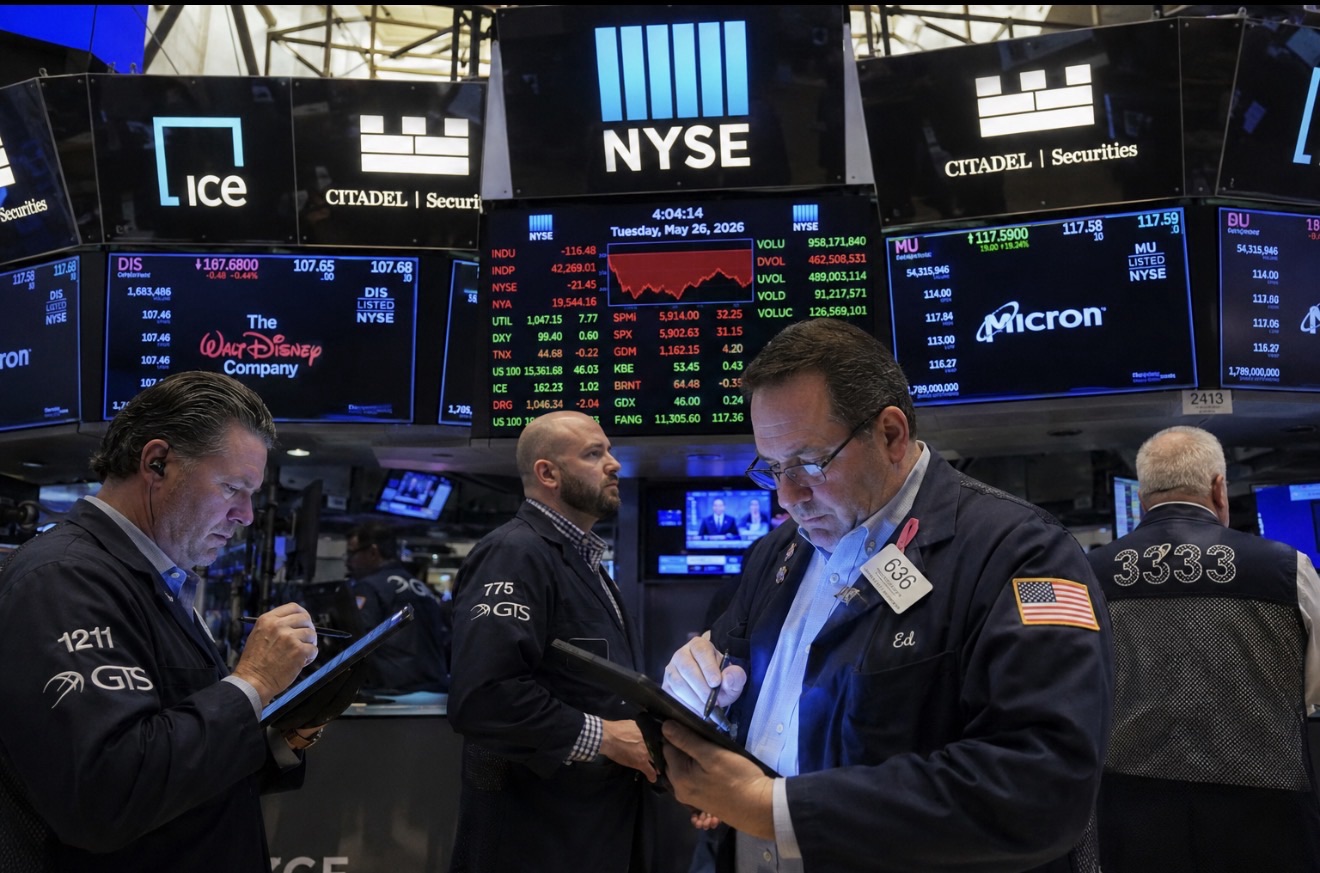
Wall Street opened lower Thursday morning, but the market’s real message was not panic. It was confusion.
Investors on May 28 were forced to process three different forces hitting the market at the same time: inflation that is heating back up, oil prices surging again because of the Iran conflict, and a fresh reminder from Snowflake that the artificial intelligence boom is still producing real corporate growth. The result was a fractured market where indexes fell broadly while select AI-linked technology stocks exploded higher — a sign that traders are becoming far more selective rather than simply abandoning risk altogether.
The Dow Jones Industrial Average fell 0.63% shortly after the opening bell, while the S&P 500 slipped modestly and the Nasdaq Composite edged lower despite Snowflake’s massive rally. Treasury yields moved higher after the Commerce Department reported that the personal consumption expenditures price index — the Federal Reserve’s preferred inflation gauge — rose 0.4% in April and 3.8% from a year earlier.
That annual figure matters more than the headline reaction.
Just two months ago, annual PCE inflation was running at 2.8%. In March it accelerated to 3.5%. Now it sits at 3.8%, marking three straight months of upward movement and reinforcing fears that the inflation slowdown many investors expected earlier this year may have stalled entirely.
The market had spent much of early 2026 betting the Federal Reserve would begin cutting rates aggressively by summer. Thursday’s report further damaged that narrative.
“This is the type of number that keeps the Fed trapped,” one portfolio manager at a major New York asset manager said Thursday morning. “Growth is slowing, consumers are getting squeezed, but inflation is not cooling fast enough to justify cuts.”
That is what traders increasingly fear: not a recession, but something potentially more difficult — a stagflation-style environment where economic growth weakens while prices remain elevated.
Oil is making that fear worse.
Brent crude jumped more than 2.5% Thursday and briefly approached the psychologically critical $100-a-barrel level after Iran claimed responsibility for striking a U.S. air base in retaliation for fresh American military action. Traders immediately began repricing the risk of broader supply disruptions through the Strait of Hormuz, the narrow maritime corridor responsible for transporting roughly 20% of the world’s oil supply.
The move in crude matters beyond gasoline prices.
Higher oil feeds directly into transportation, manufacturing, food distribution, airline costs, chemicals, shipping, and consumer inflation expectations. It is one of the few commodities capable of rapidly spreading price pressure across nearly every part of the economy.
Federal Reserve officials Neel Kashkari and Austan Goolsbee both warned this week that renewed energy inflation could complicate any path toward lower rates. Markets are now beginning to understand that geopolitical risk may effectively be doing part of the Fed’s tightening work for it.
Yet even as the broader market weakened, investors poured aggressively into one area: artificial intelligence.
Snowflake surged roughly 37% after reporting quarterly revenue growth of 33%, one of the strongest large-cap software reports of the earnings season. Product revenue rose 34% to $1.33 billion, while the company raised its full-year forecast and announced an expanded multibillion-dollar relationship with Amazon Web Services.
What mattered most was not just the numbers themselves. It was what the rally revealed about investor psychology.
The AI trade is no longer based purely on speculation. Investors are now rewarding companies showing measurable enterprise spending tied to artificial intelligence infrastructure, cloud computing, and data management. In a market increasingly worried about slowing growth, Snowflake demonstrated that corporations are still willing to spend heavily on AI-related productivity tools even while cutting costs elsewhere.
That distinction is critical.
Wall Street is no longer rewarding “technology” broadly. It is rewarding companies perceived as direct beneficiaries of the AI spending cycle while punishing businesses exposed to consumer weakness, higher rates, or rising commodity costs.
The divergence showed up clearly Thursday morning.
Defensive retailers held relatively stable while economically sensitive sectors weakened. Small-cap stocks, represented by the Russell 2000, traded roughly flat early in the session — a subtle but important signal because smaller companies are typically among the most vulnerable to prolonged high interest rates due to heavier borrowing costs and weaker pricing power.
Investors are also increasingly focused on consumer behavior.
That is why Costco’s earnings report after Thursday’s closing bell carries outsized importance. Analysts are less interested in headline revenue than in what Costco says about discretionary spending patterns. If consumers are increasingly shifting toward essentials while pulling back elsewhere, it would reinforce fears that elevated inflation and energy prices are beginning to erode household resilience.
The market’s deeper problem is that all three dominant narratives now conflict with each other.
If inflation stays high, the Federal Reserve cannot cut aggressively.
If oil keeps rising, inflation may worsen further.
But if rates stay elevated while energy prices climb, economic growth eventually slows.
At the same time, AI-related companies continue producing some of the strongest growth numbers in corporate America, preventing investors from turning outright bearish.
That is why Thursday’s session felt so unstable beneath the surface.
Wall Street is no longer trading a single macro story. It is trading a collision between inflation persistence, geopolitical instability, and a once-in-a-generation technology spending boom. The result is a market becoming increasingly fragmented — one where indexes may struggle even as select winners continue soaring.
New York — JBizNews Desk
© JBizNews.com All Rights Reserved. Reproduction or distribution without written permission is prohibited.