
 Matzav
Edelstein Signals Support for Limited Draft Exemptions: “If Those Not Learning Enlist, the IDF May Say It’s Enough”
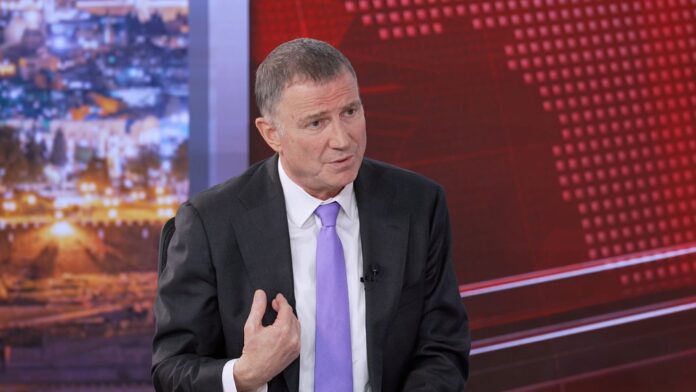
Israeli lawmaker Yuli Edelstein that the IDF may ultimately be satisfied if chareidim who are not seriously engaged in Torah learning enlist for military service, while reaffirming that he never intended to dismantle the Torah world through draft legislation.
Speaking in a lengthy interview with Kikar HaShabbat’s Yishai Cohen amid renewed political turmoil surrounding the draft law crisis and the expected dissolution of the Knesset, Edelstein addressed the security situation, coalition tensions, the possibility of forming a new political party, and the future of efforts to regulate the status of yeshiva students.
Edelstein, who was removed from his position as chairman of the Knesset Foreign Affairs and Defense Committee over disagreements surrounding the draft law, said the debate has become increasingly polarized heading into new elections.
“At this point in the election campaign, things will swing between ‘there is no need for any draft law at all’ and ‘strip voting rights and grant zero exemptions,’” Edelstein said. “But precisely if there is a government without chareidi parties and it becomes possible to pass any law you want, as long as they listen to me I will oppose all this populism. It may be good for election campaigns, but not beyond that.”
Edelstein emphasized that his goal has always been to advance what he described as a realistic and enforceable draft law rather than political slogans.
“What interests me is a real draft law, and that is exactly how I behaved,” he said. “I had no doubt that parts of the opposition only wanted to bring down the government no matter what.”
He also revealed that two opposition lawmakers privately promised to support him if he succeeded in bringing forward what they considered a serious proposal.
“I’ll reveal something that was never published: there were two righteous people in the opposition who wrote to me, ‘Yuli, if you bring a real law — we’ll go with you and support you.’ At least there were good intentions from those two people. As for everyone else, I have no doubt they would have voted to bring everything down.”
Addressing the core issue of exemptions for Torah learners, Edelstein made clear that he supports a framework that would still allow at least some yeshiva students to continue learning full-time without military service.
“Of course,” he said when asked whether he supports exemptions for a number of Torah learners. “I said this every time. I say it unequivocally. Rabbonim spoke with me privately. I never came with the intention of destroying the Torah world. If all those who are not learning enlist, it could be that the IDF itself will say that this already satisfies its needs.”
Elsewhere in the interview, Edelstein described the security situation in northern Israel as “horrific” and suggested Israel may ultimately have no choice but to significantly expand military operations in Lebanon.
“It’s shocking. I was there recently — the situation is terrible,” he said. “Given the current reality, people there do not have many options. There are American interests involved. We are certainly supported by the current administration, but that does not mean everything we want happens. I think there will ultimately be no choice but to expand operations in Lebanon.”
Discussing the growing drone threat facing Israeli soldiers in southern Lebanon, Edelstein said Israel should have prepared more effectively.
“The issue of drone threats came up many times in discussions with us,” he said. “There were ways to prepare somewhat better. It’s not that there is some magic solution now — there isn’t. We should have been more prepared. I proposed things, but the proposals were not accepted because of a combination of unwillingness from the political echelon and a bit of arrogance from relevant systems in the IDF.”
Edelstein also expressed concern about the emerging understandings between Washington and Tehran regarding Iran.
“This is neither a complete victory nor a complete failure,” he said. “On one hand there are incredible achievements and the whole world is looking at it with admiration. But on the other hand, the political leadership has still not succeeded in translating this into any strategic achievement.”
“If things end the way they are currently being discussed — with a ballistic missile threat, continuation of the nuclear program, and support for organizations like Hezbollah and Hamas — then we are facing a major challenge. The war pushed them backward, but we too will have to return to the competition of rebuilding strength.”
Turning to Israeli politics, Edelstein acknowledged deep disappointment with fellow members of the Likud party and hinted at ongoing discussions regarding a possible new political framework.
“I still don’t know what will happen in Likud,” he said. “I won’t tell you I’m not disappointed by the behavior patterns of my colleagues in the faction — friends who, aside from one or two, did not have the courage to speak about the draft law, friends who all ran away from the sovereignty vote.”
“No decision has been made yet. There are discussions. Everyone is talking to everyone. People understand there is a need. There are tens if not hundreds of thousands of votes that are currently politically orphaned. Every pollster says so. There is a real need here, and if it proves viable, it will likely happen.”
At the same time, Edelstein insisted he has no intention of joining camps defined solely by support for or opposition to Prime Minister Binyomin Netanyahu.
“I am not going to join parties of ‘only Bibi’ or ‘only not Bibi.’ That is not what the country needs. The people will decide who receives the mandate.”
Looking ahead to the next coalition negotiations, Edelstein said his goal would be to prevent either political bloc from governing with a narrow majority.
“We will do everything possible to prevent a government of 61 seats for either side,” he declared. “We will make every effort to connect parties from both camps. Life is more interesting than just ‘yes Bibi’ or ‘no Bibi.’”
{Matzav.com}