
 JBizNews
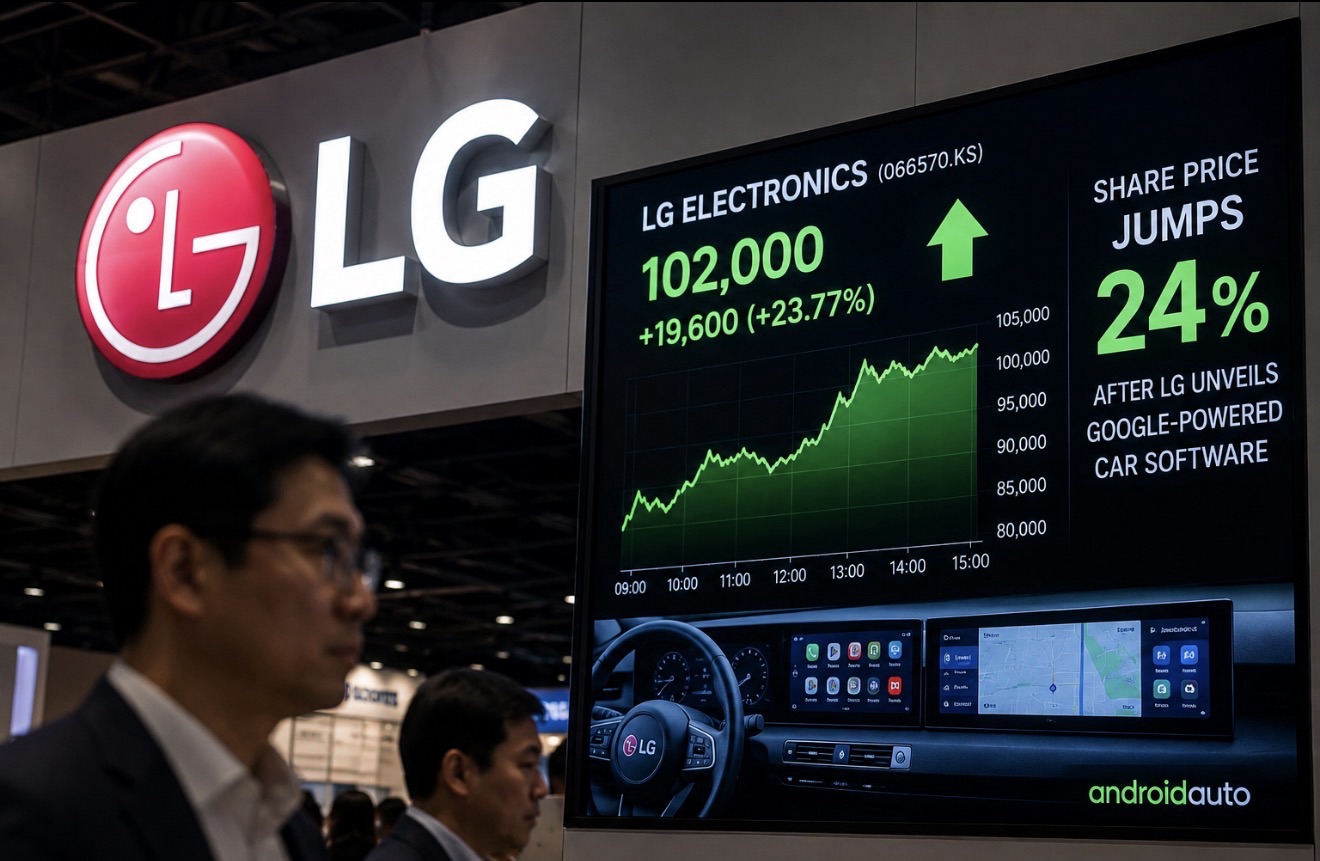
LG Shares Surge 24% After Unveiling Google-Powered Automotive Software Platform
By JBizNews Desk
SEOUL — May 29, 2026 — Shares of LG Electronics surged as much as 24% Friday after the South Korean technology giant unveiled a new generation of in-car software developed with Google, a move investors viewed as a major step in LG’s transformation from a consumer electronics manufacturer into a key supplier for the next generation of connected vehicles.
The rally followed an announcement by LG Electronics on May 28 showcasing a suite of advanced in-vehicle infotainment and software-defined vehicle technologies built on Google’s Android Automotive operating system. The company said the products received recognition from both Google and global automakers, while a Google executive praised the systems for their performance, stability, voice-control capabilities, and flexibility.
The centerpiece of LG’s new platform is technology that allows multiple vehicle displays to operate from a single processor.
Modern vehicles increasingly feature multiple screens, including digital instrument clusters, central infotainment displays, passenger entertainment systems, and head-up displays. Traditionally, each screen requires separate computing hardware, increasing complexity and manufacturing costs.
LG said its new architecture enables multiple displays of varying sizes and configurations to run simultaneously from a single chip, reducing hardware requirements and lowering costs for automakers. The platform is powered by Qualcomm’s next-generation Snapdragon Cockpit Platform, one of the industry’s most advanced automotive processors.
For consumers, Android Automotive provides direct access to familiar applications including navigation, music streaming, voice assistants, and other services without requiring a smartphone connection. The platform has gained traction across the automotive industry as manufacturers seek to create more seamless digital experiences inside vehicles.
The market opportunity is substantial.
Industry estimates from Future Market Insights place the global Android Automotive software market at approximately $895.6 million in 2025, with projections showing expansion to roughly $2.14 billion by 2035 as software becomes an increasingly important component of vehicle design and functionality.
Investors appear to be betting that LG is well positioned to capture a meaningful share of that growth.
The company’s Vehicle Component Solutions division has emerged as one of its fastest-growing businesses in recent years, helping offset slower growth and margin pressure in traditional appliance and television segments. As automakers increasingly prioritize software, connectivity, and digital services, suppliers capable of delivering integrated software-hardware platforms have become strategically important.
A public endorsement from Google provides additional credibility for LG’s automotive ambitions.
The announcement comes at a particularly important time for the company. LG recently reported weaker-than-expected profitability in several of its core consumer electronics divisions, including home appliances and home entertainment products. Against that backdrop, the emergence of a potentially high-growth automotive software business offers investors a new narrative centered on future expansion rather than mature consumer markets.
The partnership also builds on a broader strategy that LG has been pursuing with major U.S. technology firms.
At the Consumer Electronics Show (CES) earlier this year, LG and Qualcomm introduced an AI Cabin Platform designed to bring generative artificial intelligence into vehicle interiors. The newly announced Android Automotive systems extend that initiative and position LG as a supplier of both the hardware and software infrastructure automakers increasingly need but may not want to develop internally.
For the broader automotive industry, the implications could extend beyond infotainment.
Vehicle interiors are rapidly evolving into sophisticated digital environments where software often plays as important a role as mechanical engineering. Automakers are under pressure to add more displays, more computing power, and more connected services while simultaneously controlling manufacturing costs.
LG’s single-chip approach addresses that challenge directly by simplifying system architecture and reducing hardware requirements.
If widely adopted, the technology could help lower production costs for vehicles while bringing premium digital features to a broader range of models.
The stock’s sharp rise reflects investor confidence that LG’s automotive technology strategy is beginning to gain meaningful traction. Whether those gains are sustained will depend on the company’s ability to convert industry recognition into long-term contracts with global automakers and successfully scale its software-defined vehicle business.
For now, however, investors appear convinced that LG’s future may increasingly be found not in living rooms and kitchens, but behind the dashboard.
Asia — JBizNews Desk
© JBizNews.com All Rights Reserved. Reproduction or distribution without written permission is prohibited.