
 JBizNews
Hike, Cut, or Pause: The Impossible Choice Facing Kevin Warsh’s Federal Reserve
By JBizNews Desk
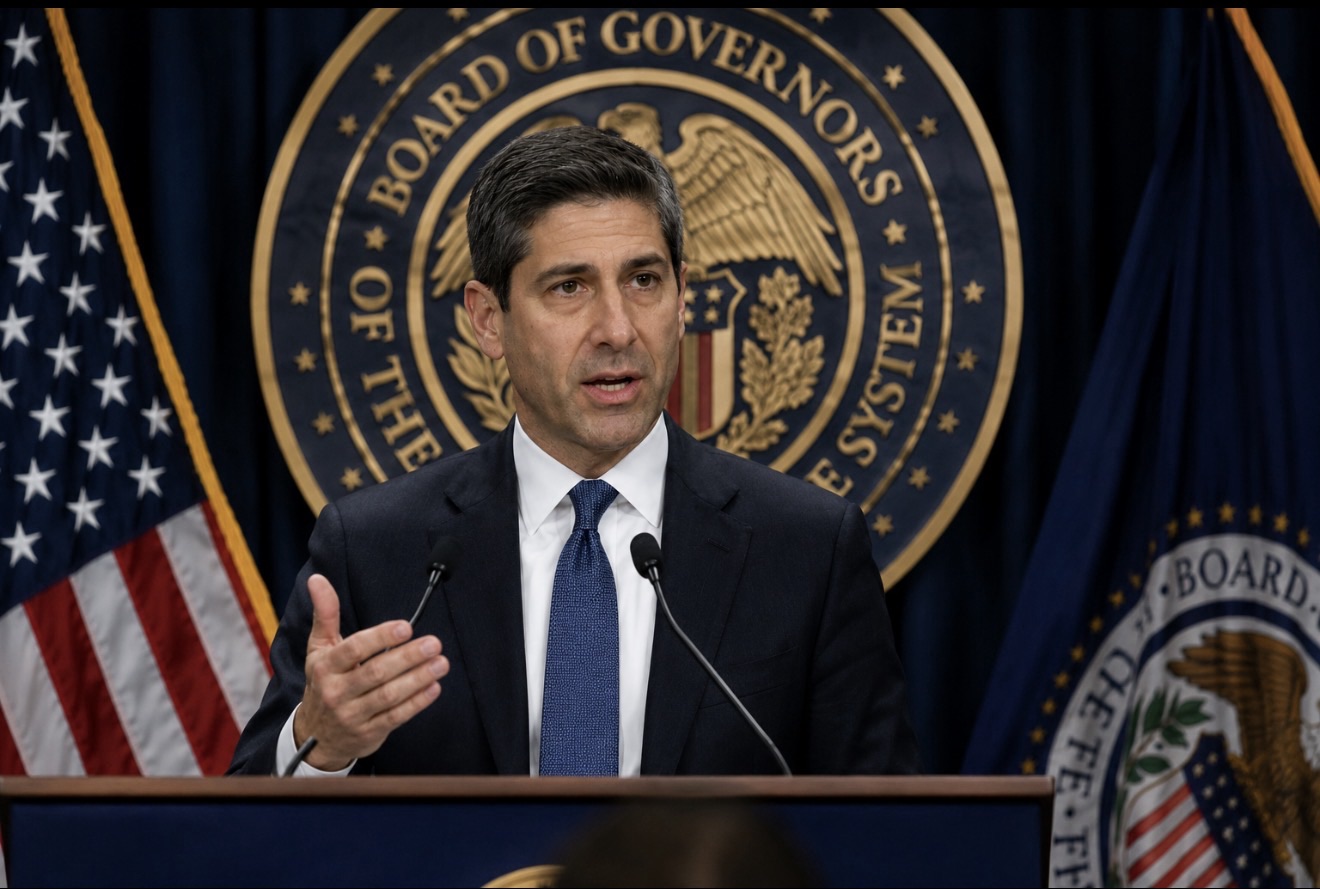
Kevin Warsh got the job he wanted.
Now he has to make the kind of decision new Federal Reserve chairmen almost never face immediately: whether to raise interest rates, cut them, or do nothing — at a moment when every option risks making the economy worse.
Warsh was sworn in May 22 as the 17th chairman of the Federal Reserve, replacing Jerome Powell after a closely watched Senate confirmation vote.
President Donald Trump picked him for a simple reason: Trump wants lower interest rates, and Warsh spent much of the past year arguing they could eventually come down.
As recently as December, Warsh publicly argued that advances in artificial intelligence would improve productivity, cool inflation pressures and open the door for future rate cuts.
Then the Iran war happened.
And suddenly the economy stopped cooperating.
To understand the problem Warsh faces, you only need three numbers.
The first is the federal funds rate itself — currently sitting between 3.50% and 3.75%.
That rate influences mortgages, auto loans, business borrowing and credit-card costs across the economy. The Fed cut rates three times in late 2025 before pausing earlier this year.
The second number is inflation.
Consumer prices in April rose 3.8% from a year earlier — the highest inflation reading in nearly three years and far above the Fed’s official 2% target.
Energy prices drove much of the increase after the Iran conflict sent oil prices sharply higher. Gasoline prices alone rose more than 28% year over year.
The third number is what makes the situation genuinely difficult:
The labor market is weakening.
Job growth has slowed for months. Hiring is softer. Economic momentum is cooling.
So at the exact moment inflation is rising again, the economy itself is no longer clearly overheating.
That creates the trap.
Normally, the Fed’s dual responsibilities point in the same direction. A strong economy with rising inflation usually calls for higher interest rates. A weak economy with slowing inflation usually calls for cuts.
Right now, those signals are pointing opposite ways.
Inflation argues for a rate hike.
The labor market argues for a cut.
And doing nothing risks satisfying nobody.
Cut rates too early, and the Fed could fuel inflation that is already approaching 4%.
Raise rates to fight inflation, and the Fed risks crushing an already fragile labor market while directly frustrating the president who appointed Warsh in the first place.
That leaves the third option: pause and wait.
At the moment, that appears to be Warsh’s instinct.
Traditional central-bank thinking often treats oil shocks differently from broader inflation. Energy spikes can temporarily push inflation numbers higher without necessarily meaning prices across the wider economy are spiraling out of control.
Warsh has long favored looking at “trimmed average” inflation measures that remove the most extreme price swings to identify underlying trends.
Under those measures, inflation appears calmer than the alarming 3.8% headline number suggests.
But even that argument is becoming harder to make.
Core inflation — which strips out food and energy entirely — still climbed to 2.8% in April. Shelter costs continued rising as well.
The oil shock may be the loudest part of the inflation story.
It is no longer the only part.
Warsh also inherits a Federal Reserve that is already deeply divided internally.
At Powell’s final meeting in April, Fed officials split 8-4 — the largest level of dissent inside the central bank since 1992.
And the divide was not simple.
Some officials objected to language hinting future cuts might come later this year, arguing the Fed should keep the possibility of rate hikes on the table instead.
At the same meeting, Governor Stephen Miran, whose seat Warsh now fills, dissented in the opposite direction and argued aggressively for immediate cuts.
That means Warsh is not stepping into a committee unified around caution.
He is stepping into one split between policymakers who think the next move could be a hike and others who think it should already be a cut.
Building consensus out of that may be harder than setting rates themselves.
There is another issue that could matter even more to Wall Street.
Warsh wants to change how the Federal Reserve communicates.
For years, the Fed has publicly telegraphed its thinking through press conferences, forecasts and the famous “dot plot” — a quarterly chart showing where officials expect interest rates to go.
Markets have built entire trading systems around interpreting those signals.
Warsh believes the Fed became too dependent on its own forecasts and trapped itself into policies it should have abandoned earlier during the inflation surge of 2021 and 2022.
He has floated scaling back press conferences and potentially eliminating the dot plot entirely.
“If one has a press conference,” Warsh previously said, “one wants to deliver some important news.”
Critics argue that approach could inject even more uncertainty into already fragile markets.
Former Fed economist Claudia Sahm said she was stunned by how far Warsh appears willing to reduce communication.
The concern is straightforward: markets can tolerate bad news more easily than uncertainty.
And uncertainty is exactly what a less communicative Fed could create.
Investors themselves are already shifting expectations sharply.
Markets now see little chance of rate cuts this year.
According to CME Group’s FedWatch tool, traders increasingly expect the Fed to hold rates steady through the summer, while expectations for a possible rate hike later this year have risen sharply.
Bank of America has projected no rate cuts until the second half of 2027.
That leaves Warsh in an uncomfortable position.
He was selected largely because the White House wanted lower rates.
But the economic data may force him to do the opposite.
As Jim Bianco, president of Bianco Research, summarized it: “He’s got a tough job there now.”
Warsh’s first major test comes June 17, when he chairs his first Federal Open Market Committee meeting.
The most likely outcome, according to nearly every major forecast, is that he does nothing at all.
He pauses.
For a chairman brought in to lower rates, the safest first move may simply be proving he can wait.
New York — JBizNews Desk
© JBizNews.com All Rights Reserved. Reproduction or distribution without written permission is prohibited.