
 JBizNews
Ford Bets Its Old Battery Business on the AI Power Crunch — and Wall Street Lights Up
By JBizNews Desk
Friday, May 29, 2026
Ford Motor Co. is having its best month on Wall Street in nearly two decades, and the reason has little to do with pickup trucks, electric vehicles, or traditional auto sales.
Instead, investors are betting that the 122-year-old automaker may have found an unexpected way to profit from the artificial intelligence boom: supplying batteries to help power the data centers driving it.
According to market data cited by Bloomberg on May 29, Ford shares surged more than 40% during May, putting the stock on track for its strongest monthly performance since April 2009, when the company emerged from the financial crisis while rivals General Motors and Chrysler struggled through government-backed restructurings.
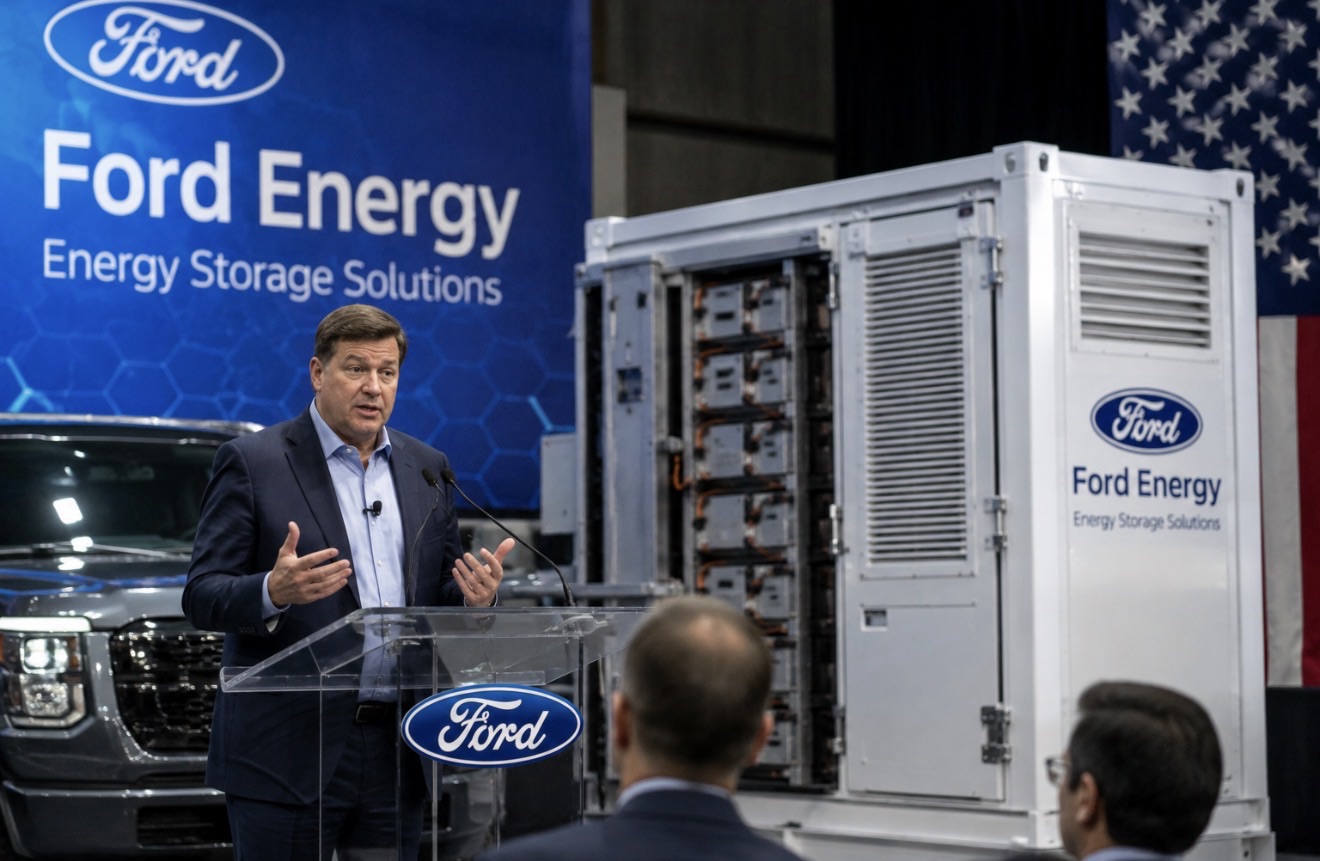
The catalyst behind the rally is Ford Energy, a new business unit launched on May 11 that aims to transform the company’s battery investments into a standalone energy-storage business serving utilities, data centers, and large industrial customers.
For years, Ford’s battery investments were viewed by investors as a financial burden.
The company spent billions building electric vehicle production capacity and battery manufacturing operations only to encounter slower-than-expected EV adoption, persistent losses in its electric vehicle division, and growing investor skepticism about the pace of the industry’s transition away from gasoline-powered vehicles.
Now Ford is attempting to turn that challenge into an opportunity.
The company’s strategy centers on repurposing battery production capacity originally built for electric vehicles and using it to manufacture large-scale energy storage systems. These systems store electricity when supply is abundant and release it when demand spikes, helping utilities and commercial customers stabilize power usage.
That market is expanding rapidly because of artificial intelligence.
The explosive growth of AI has created an unprecedented surge in electricity demand as technology companies race to build data centers capable of training and operating increasingly powerful AI models. Utilities across the United States are struggling to meet projected power requirements, creating strong demand for battery storage systems that can help balance energy loads and improve grid reliability.
Ford believes it is positioned to benefit from that trend.
Investors appear to agree.
The stock climbed as high as $16.50 during Thursday trading, reaching levels not seen since 2022 and extending a rally that carried shares from the low $11 range just weeks earlier.
The enthusiasm intensified after Ford Energy secured its first major commercial agreement.
On May 20, the company announced a five-year framework agreement with EDF Power Solutions North America to provide up to 20 gigawatt-hours of battery storage capacity over the life of the contract.
The deal gave investors something they had been waiting for: proof that customers are willing to buy Ford’s new energy products.
Wall Street analysts quickly took notice.
Andrew Percoco of Morgan Stanley estimated that Ford Energy could ultimately be worth as much as $10 billion as a standalone business. He expects Ford to pursue additional agreements with utilities, industrial operators, and large-scale cloud-computing companies, often referred to as hyperscalers, that are aggressively expanding data center infrastructure.
If those contracts materialize, Ford could find itself participating in one of the fastest-growing sectors of the global economy without abandoning its core automotive business.
The prospect is particularly attractive because it allows the company to monetize investments that investors had largely written off as underperforming EV infrastructure.
Still, significant questions remain.
Ford Energy does not expect meaningful commercial deployment until 2027, meaning much of the current excitement is based on future growth rather than present earnings.
The company’s traditional automotive business also continues to face the challenges that have long defined the industry: intense competition, cyclical demand, thin margins, and slowing growth.
Between 2015 and 2025, Ford’s automotive revenue grew at an average annual rate of approximately 2.2%, reflecting the realities of operating in a mature global market.
Critics argue that investors may be moving too quickly in assigning technology-style valuations to a company that remains primarily an automaker.
Yet Ford’s broader business is showing signs of resilience.
During the company’s first-quarter earnings call, Chief Financial Officer Sherry House reported that paid software subscriptions across Ford Pro, the company’s commercial vehicle platform, rose to approximately 879,000, an increase of 30% year-over-year.
Meanwhile, Ford’s highly profitable F-Series pickup franchise continues to generate substantial cash flow, providing financial flexibility as the company expands into new markets.
Under Chief Executive Officer Jim Farley, Ford has also adopted a diversified strategy that includes gasoline-powered vehicles, hybrids, and electric models, allowing the company to adjust more easily to changing consumer preferences.
Whether Ford Energy becomes a transformational second business or simply a promising side venture remains uncertain.
What is clear is that investors are beginning to view Ford differently.
For much of the past two years, the company’s battery investments were seen as evidence of an expensive and difficult transition to electric vehicles.
Today, those same assets are being viewed as a potential gateway into one of the most important infrastructure markets of the AI era.
The immediate question is whether Ford can convert investor enthusiasm into additional contracts and recurring revenue.
The longer-term question is even larger: whether one of America’s most iconic automakers can successfully reinvent part of itself as an energy company at a time when electricity has become one of the most valuable commodities in the artificial intelligence economy.
Detroit — JBizNews Desk
© JBizNews.com All Rights Reserved. Reproduction or distribution without written permission is prohibited.