
 JBizNews
Wall Street Ends a Holiday-Shortened Week at Record Highs as Dell’s AI Blowout Lifts Tech and the Dow Tops 51,000
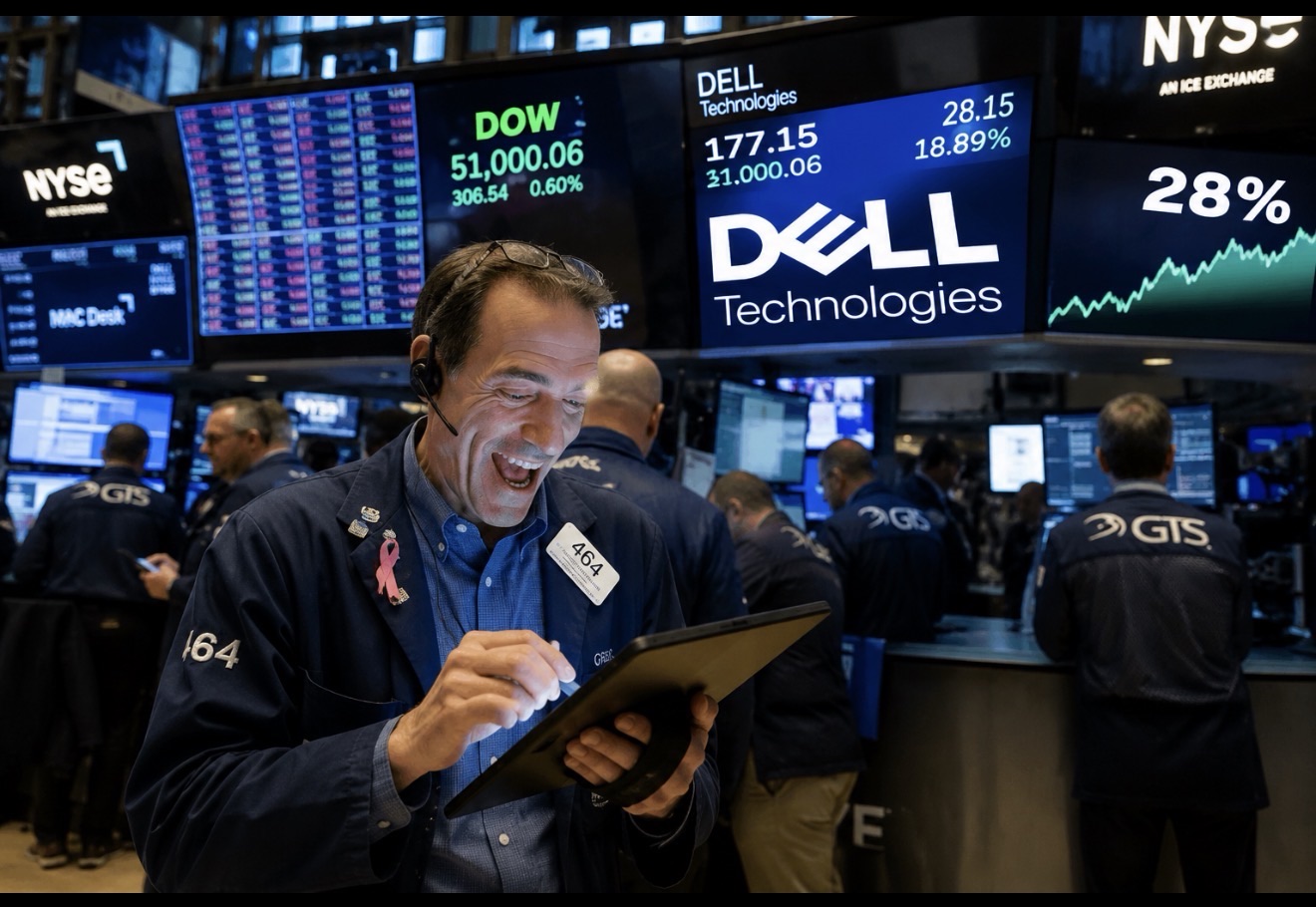
The U.S. stock market closed Friday, May 29, 2026, at fresh record highs across all three major indexes, capping a holiday-shortened week, after Dell Technologies reported quarterly results that stunned Wall Street and reignited enthusiasm for the artificial-intelligence trade. According to market data published at Friday’s close, the Dow Jones Industrial Average rose 363.49 points, or 0.72%, to finish at 51,032.46 — its first close ever above 51,000.
The S&P 500 added 0.22% to end at 7,580.06, while the tech-heavy Nasdaq Composite gained 0.20% to close at 26,972.62. All three benchmarks touched intraday all-time highs earlier in the session, and the S&P 500 logged its ninth consecutive week of gains, extending one of the strongest rallies of the decade.
The day belonged to Dell Technologies. Shares of the Round Rock, Texas-based company surged roughly 33%, marking the strongest single-day gain in its history, after founder and Chief Executive Officer Michael Dell delivered results that far exceeded Wall Street expectations.
For the fiscal first quarter ended May 1, Dell reported $43.84 billion in revenue, up nearly 88% from a year earlier and dramatically above analyst forecasts of approximately $35.43 billion. Adjusted earnings reached $4.86 per share, easily surpassing consensus estimates near $2.94 per share.
The driver behind the blowout performance was artificial intelligence infrastructure. Dell disclosed that revenue from its AI-optimized server business climbed to $16.13 billion, reflecting the extraordinary demand from corporations, cloud providers, and government agencies racing to build the computing capacity required for next-generation AI systems.
The results reinforced Dell’s position as one of the largest beneficiaries of the global AI investment boom. Over the past several months, the company has announced expanded partnerships with Nvidia, Google, and OpenAI, helping transform Dell from a traditional computer manufacturer into a critical supplier of AI infrastructure.
Wall Street analysts responded swiftly.
Citi analyst Asiya Merchant raised her price target on Dell to $475 from $290 while maintaining a Buy rating. JPMorgan lifted its target to $500 from $280 and reiterated its Overweight recommendation. Even UBS analyst David Vogt, who downgraded the stock earlier this month on concerns that AI optimism had already been reflected in the share price, more than doubled his target to $440 from $243.
The enthusiasm quickly spread across the broader technology sector.
Micron Technology climbed approximately 5% Friday and ended May nearly 88% higher than where it began the month. Qualcomm rose roughly 3% during the session and finished May with gains approaching 40%. Investors continued rotating into semiconductor and infrastructure companies viewed as direct beneficiaries of the AI spending cycle.
Beyond corporate earnings, markets also found support from a calmer geopolitical backdrop.
Reports circulated during the week indicating that U.S. and Iranian negotiators had reached a framework agreement to extend a ceasefire for an additional 60 days, easing fears of renewed disruptions to global energy supplies and shipping traffic through the Strait of Hormuz, one of the world’s most important oil transit routes.
That relief was reflected in energy markets.
West Texas Intermediate crude oil fell 1.73% Friday to settle at approximately $87.36 per barrel, while international benchmark Brent crude declined 1.77% to $92.05 per barrel. WTI recorded its largest monthly decline since April 2025, falling nearly 17% during May.
Lower oil prices create both winners and losers. Energy producers typically face pressure when crude declines, but consumers and businesses benefit from lower fuel and transportation costs. Heading into the summer travel season, the decline offers welcome relief after months of elevated energy prices.
The week was not entirely free of concerns.
Investors digested a hotter-than-expected reading from the government’s preferred inflation measure, the Personal Consumption Expenditures (PCE) Price Index, released Thursday. The report showed inflation running at its strongest pace in nearly three years, underscoring that price pressures remain more persistent than policymakers had hoped.
Yet traders largely looked past the data.
Strong corporate earnings, accelerating AI-related investment, and easing geopolitical tensions outweighed inflation concerns. The CBOE Volatility Index (VIX) — commonly referred to as Wall Street’s fear gauge — remained in the mid-teens, signaling relatively low levels of investor anxiety.
For investors, the broader message from this week’s rally is increasingly clear. The companies supplying the physical backbone of artificial intelligence — servers, semiconductors, networking equipment, and data-center infrastructure — are generating real revenue growth rather than merely benefiting from market hype.
At the same time, risks remain.
Dell’s gross margin declined to 17.8% from 21.1% a year earlier, illustrating that rapid revenue growth does not always translate into equally strong profitability. As competition intensifies and companies prioritize market share, investors will increasingly focus on margins and long-term earnings quality.
The holiday-shortened week also produced record closes earlier in the period. The Dow reached new highs Wednesday, while the S&P 500 and Nasdaq closed at records Thursday following strong guidance from cloud-software company Snowflake.
As June begins, Wall Street enters the new month with momentum firmly intact. Markets continue to be supported by strong earnings growth, aggressive AI infrastructure spending, and a calmer Middle East. Whether that combination can overcome persistent inflation pressures may determine whether the rally extends through the summer.
JBizNews Desk — New York
© JBizNews.com All Rights Reserved. Reproduction or distribution without written permission is prohibited.