
 Vos Iz Neias
Religious Zionist Rabbi: How Did We Allow Judiciary To Turn Entire Charedi Community Into Criminals?
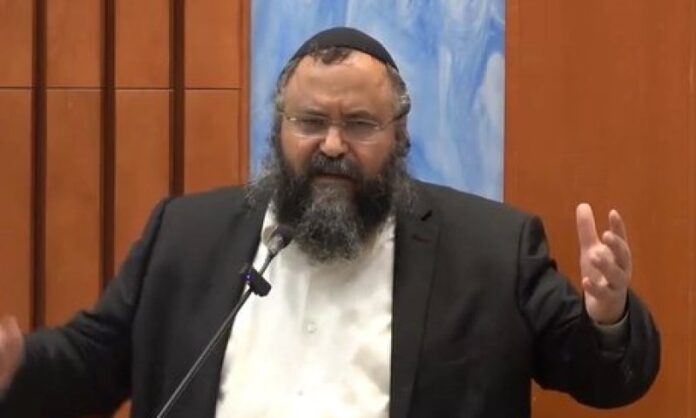
JERUSALEM (VINnews) — Rabbi Meir Hilowitz, rabbi of the community of Bruchin and a senior lecturer at Yeshivat Ma’ale Eliyahu in Tel Aviv, published a letter over the weekend expressing support for the charedi public, which he says is being persecuted by the judicial system. Those close to the rabbi noted that the remarks were originally delivered as a Sabbath sermon and were not intended as a journalistic or political essay.
The rabbi opens the letter with an emotional outcry: “I cannot help but cry out from the depths of my heart: How did we allow a corrupt and rotten system to take an entire community,holy and pure, and officially turn it into a population of criminals and draft evaders, people who must flee from every police officer as though they were the worst criminals and degenerates in our society?”
The rabbi clarified that he has significant disagreements with the charedi community: “It is true that I have a major disagreement with my brothers who are called charedim regarding our understanding of the processes of redemption in which we are living. We disagree about our relationship to the national revival, the state, and its institutions. Included within this disagreement is our dispute regarding the obligation and privilege of serving in our holy army.
The avoidance of military service by most of my charedi brothers is rooted in a worldview that, in my opinion, is fundamentally mistaken. Not only do I disagree with it, I also have serious criticism of it. In my view, this outlook distorts basic concepts of mutual responsibility and sharing the burden. It also creates complications in the development of young people who are not suited to sit on the study benches of the yeshiva and therefore end up needing to ‘work illegally’ and sometimes even ‘live illegally.’ Nevertheless, this disagreement is gradually becoming clarified as part of the broader process of our national redemption.”
The rabbi continued: “The process of rapprochement between the charedi public and the State of Israel is a divine, wondrous, slow, deep, and fundamental process. Yet it is also a steady process that inspires joy and admiration in all who see it. Truly, only the blind, or those who deliberately avert their eyes, fail to see it.
Were it not for the political campaign of vilification being waged against this process, we would already be much further along. One must understand that the charedim are one of the important forces ‘struggling within our camp’ (a reference to the writings of Rabbi Kook), and a great role has been assigned to this public force in the divine and wondrous journey of redemption. My greatest pain is that we have allowed such a pure and holy public,one that raises its children upon the foundations of Torah and fear of G-d to be treated this way.”
He then asks: “How did we allow them, through crude, sophisticated, malicious, and immensely powerful means, to turn the members of this community into a band of criminal deserters stripped of basic rights in our ‘democratic’ state, where the judicial system claims to protect oppressed minorities? Is there any minority in Israeli society whose rights are trampled more than this one? They are now deemed unworthy of daycare assistance, discounted housing, tax benefits under Section 46, and there have even been those who suggested stripping them of the right to vote.”
The rabbi further criticized what he views as persecution by the legal system: “Now these hypocrites in the judicial system have gone even further and brought the members of this community to a terrible situation in which they must walk the streets in fear and hide from every police officer as though they were fleeing criminals.Even the basic social protection that the police are supposed to provide citizens has been denied to them. Roshei Yeshiva must warn their students not to expose themselves to security forces on their way home and not to attract attention. Can such a thing be imagined?”
He compares the current situation to the period before Israel’s 2005 disengagement from Gaza: “I have the same feeling I had before the disengagement, when we in the Religious Zionist community were promised that we would be persecuted relentlessly.
When we asked, ‘Do you really think Israeli society will allow you to commit such an injustice against us and expel an entire holy, pure, and principled public from its homes without cause?’ the architects of the expulsion answered with a terrible response: ‘We have two years to turn you into the scum of Israeli society and the worst of its citizens. We will make you into a community that deserves every disaster that befalls it.’
We experienced two years of slander, humiliation, insult, and persecution. Then came the terrible blow of the expulsion.”
“And now, once again, a well-oiled, malicious system filled with power, authority, and influence over public opinion is taking an entire public and blackening its reputation. But this time it is all anchored in discriminatory laws unlike anything found in any decent human society.
We too, as a community, are persecuted today in the public sphere by many of these same forces and through the same twisted methods. Therefore our destinies are linked, beyond the mutual responsibility and brotherly love between us.”
He then references anti-government protesters: “Perhaps those from Kaplan also represent another of the ‘forces struggling within our camp.’ There is much that could be said about that. But the crushing behavior of their representatives within the judicial system has broken all the rules of the game. Through their blind and malicious persecution of our charedi brothers, they prove that they no longer have a place in building our complete and diverse national stature. These persecutors have no part in our heterogeneous national journey.”
“Perhaps they are fighting like a wounded animal that has lost the ability to show mercy because they feel their totalitarian rule is slipping away from them.Perhaps they cannot bear losing the secular, Zionist state of a more anti-religious character that they established. Perhaps they cannot endure the waves of religious return and spiritual awakening sweeping through our national revival. Yet even after granting them this benefit of the doubt, they must still be condemned, and the oppressed must be rescued from their hands.”
“We, the Religious Zionist community, suffered media persecution before the disengagement and still suffer it today. But the persecution endured by our charedi brothers is far deeper, more painful, more threatening. Against this persecution we should demonstrate, cry out, and warn the public. This monstrous, terrifying, and wicked system must be denounced, fundamentally changed, and uprooted.”
“I call upon you, my brothers in Religious Zionism: do not be deceived. Do not fall into this trap, this political persecution, this profound hatred. Even if some of our charedi brothers themselves fall into the pit dug for them by these enemies, and even if words emerge from their mouths that I cannot bring myself to repeat, we are nevertheless obligated not to be dragged into this unrestrained persecution of them. We must remember and remind others: this persecution has nothing to do with our ideological, religious, and moral disagreements with them.
“Let us return to the sacred covenant shared by all who love Torah and faith. Let us return to the brotherhood of sharing the burden and hoping for complete redemption, even if we disagree about the path by which it will appear. Let us return to pure disagreement, in the spirit of Torah. But the time has come to say: enough of this hatred and terrible persecution.”
“I pray that the Shepherd of Israel will return and gather us together in faithful love, complete the process of our redemption speedily, rescue us from these terrible birth pangs of the Messiah, and cause sorrow and sighing to flee away.”