

By JBizNews Desk
May 31, 2026
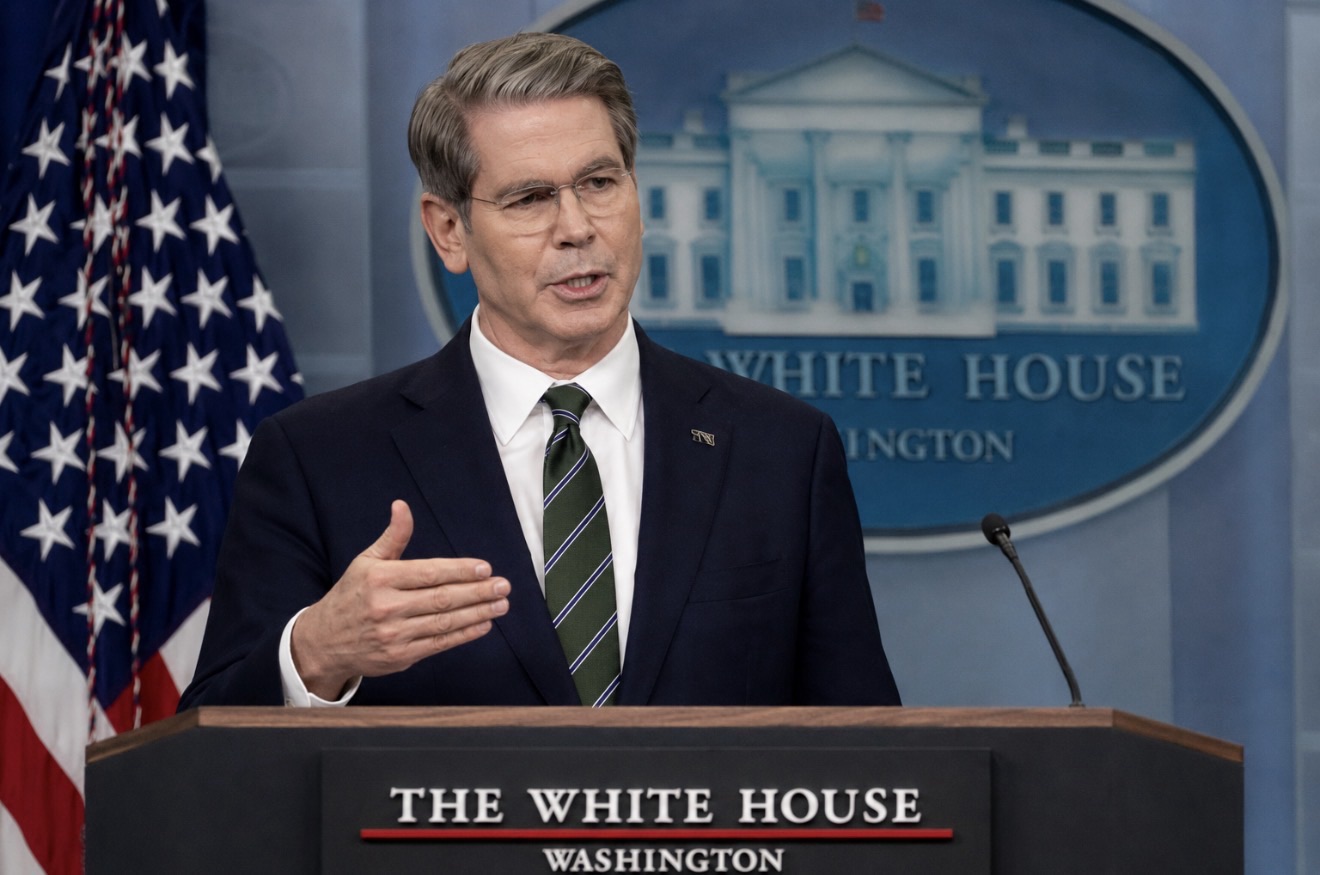
When a reporter asked U.S. Treasury Secretary Scott Bessent whether he had urged newly installed Federal Reserve Chairman Kevin Warsh to cut interest rates during a breakfast meeting Thursday morning, Bessent did not answer directly.
Instead, he offered a carefully crafted response that may have revealed more than a simple yes or no ever could.
Bessent confirmed he had breakfast with Warsh earlier in the day, continuing a long-standing Washington tradition in which Treasury secretaries and Federal Reserve chairs meet privately to discuss economic conditions. Such meetings are common, but details rarely become public.
Asked whether he had pushed Warsh to lower interest rates, Bessent reached back to his relationship with former Federal Reserve Chairman Jerome Powell.
“I had breakfast with Chair Powell 41 times, and I never did that,” Bessent said.
The answer immediately caught Wall Street’s attention.
Rather than directly addressing his conversations with Warsh, Bessent chose to discuss his interactions with Powell. For investors trying to assess whether the White House might pressure the new Fed chairman to lower rates, the distinction mattered.
The context helps explain why.
President Donald Trump frequently criticized Powell during his tenure, arguing that interest rates should be lower and that the Federal Reserve was unnecessarily restraining economic growth. With Powell now gone and Warsh occupying the chairmanship, investors are closely watching for signs that the relationship between the White House and the central bank may change.
At stake is one of the most important questions facing financial markets.
The Federal Reserve’s benchmark interest rate currently sits between 3.5% and 3.75%, following a series of policy adjustments designed to balance economic growth against inflation risks.
Some economists believe Warsh could pursue a more aggressive easing cycle than markets currently expect. Others argue persistent inflation pressures make substantial cuts unlikely in the near term.
The disagreement is reflected in forecasts.
Several economists project that the Federal Reserve could reduce rates significantly before year-end if economic growth slows and inflation eases. Financial markets, however, continue to price in a more cautious path, suggesting investors remain unconvinced that aggressive cuts are imminent.
That gap between expectations and reality matters.
For businesses, lower interest rates reduce borrowing costs and encourage investment. For consumers, they can eventually lead to lower mortgage rates, cheaper car loans, and reduced financing costs across the economy.
At the same time, lower rates can also stimulate demand and potentially add inflationary pressure if price increases remain elevated.
That concern has become increasingly relevant as energy markets remain unsettled.
The ongoing disruption in the Strait of Hormuz has pushed fuel prices higher, raising transportation and logistics costs across multiple sectors. Those increases have begun filtering through the broader economy, complicating the Federal Reserve’s inflation outlook.
A central bank that cuts rates while inflation remains elevated risks fueling further price increases.
That reality may explain why neither Bessent nor Warsh appears eager to signal major policy shifts.
Historically, new Federal Reserve chairs receive a period of adjustment before facing intense political scrutiny. Warsh, still early in his tenure, is likely focused on establishing his credibility with markets, policymakers, and investors before making significant changes to monetary policy.
Bessent’s response may have reflected an effort to preserve that independence.
By emphasizing that he never pressured Powell, the Treasury secretary reinforced the longstanding principle that the Federal Reserve should make decisions based on economic conditions rather than political considerations.
Whether markets accept that interpretation remains another question.
Investors will continue scrutinizing every public statement from both men for clues about the direction of interest rates, particularly as inflation, employment, and economic growth data evolve over the coming months.
For households, however, the practical takeaway is straightforward.
Expectations for sharply lower borrowing costs may be premature.
The Federal Reserve faces an economy still grappling with inflation risks, volatile energy prices, and geopolitical uncertainty. Those factors make aggressive rate cuts difficult to justify in the near term.
For now, mortgage rates, business loans, and credit card costs are unlikely to fall simply because a new Fed chairman has arrived.
The most important message from Bessent’s breakfast meeting may be that Washington is not yet ready to force the issue.
New York — JBizNews Desk
© JBizNews.com All Rights Reserved. Reproduction or distribution without written permission is prohibited.