

JBizNews Desk
The first major economic report of June arrives Monday morning, and it could offer an early indication of whether America’s manufacturing sector is truly regaining momentum or simply benefiting from temporary factors.
The Institute for Supply Management (ISM) will release its closely watched Manufacturing Purchasing Managers’ Index (PMI) at 10:00 a.m. ET on Monday, providing investors, businesses, policymakers, and workers with one of the earliest readings on economic activity for the month.
The report comes at a time when Wall Street sits near record highs and investors are looking for confirmation that economic growth remains durable despite ongoing geopolitical tensions, elevated borrowing costs, and lingering supply-chain concerns.
Recent data has offered reasons for optimism.
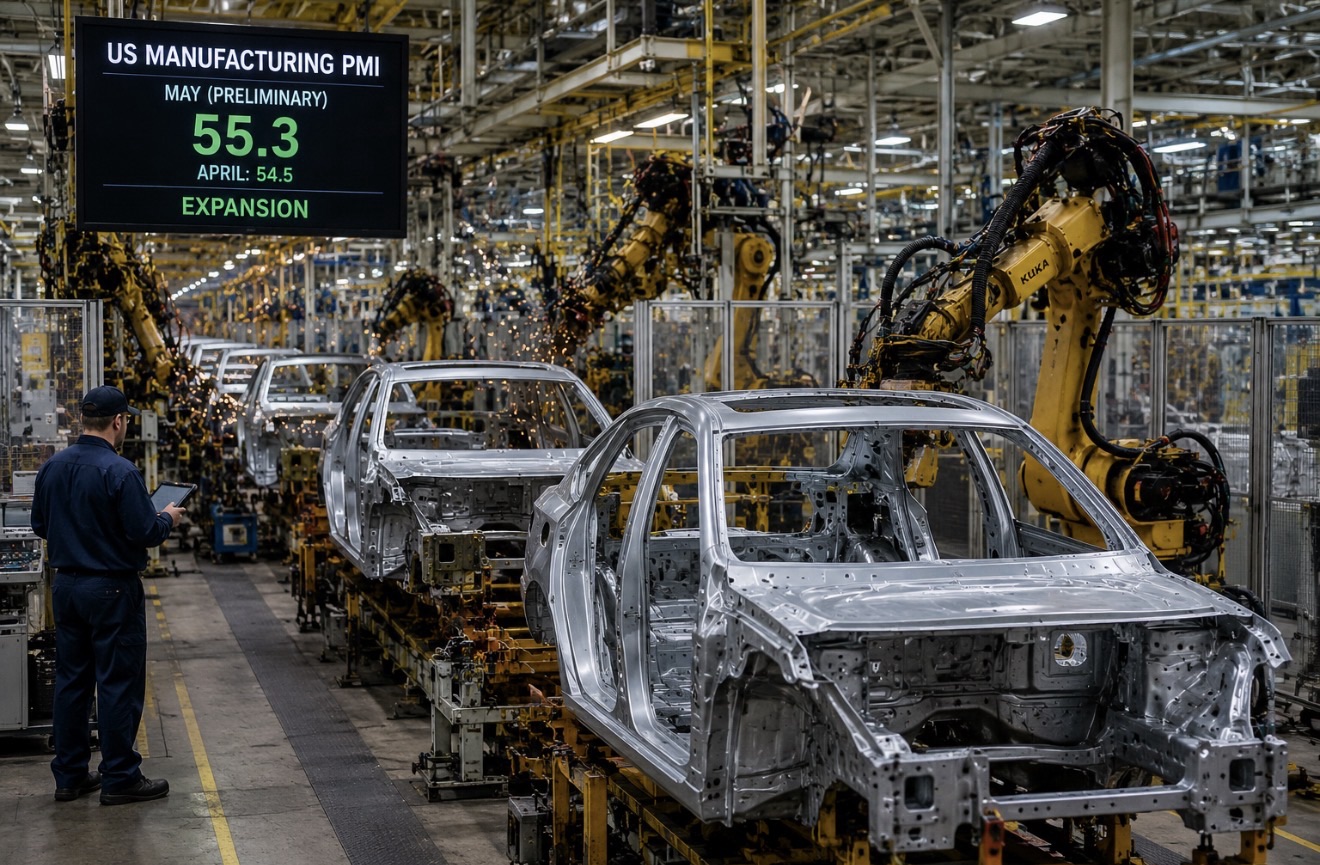
A preliminary May reading from S&P Global showed its U.S. Manufacturing PMI rising to 55.3, up from 54.5 in April and above economist expectations. The figure represented the strongest pace of manufacturing expansion since May 2022 and suggested that factory activity accelerated significantly during the month.
Factory output increased at the fastest rate in more than four years, while manufacturing employment posted its strongest growth since June 2025. New orders remained healthy, signaling continued demand across large parts of the industrial economy.
At first glance, those numbers suggest that manufacturing may finally be emerging from a prolonged period of weakness.
Yet economists caution that the headline figures may not tell the entire story.
According to S&P Global, part of the increase in manufacturing activity may have been driven by businesses building inventory as a precaution against disruptions linked to ongoing instability in the Middle East. Companies increased purchases of raw materials and components while supplier delivery times lengthened, reflecting concerns about potential supply interruptions.
In other words, some of the activity may have been defensive rather than demand-driven.
For investors and economists, Monday’s ISM report will help determine whether manufacturers are expanding because customers are placing more orders or because companies are temporarily stockpiling goods in anticipation of future uncertainty.
The distinction matters.
If the report shows strong new orders alongside higher production levels, it would suggest that demand remains healthy and that the manufacturing recovery has a stronger foundation. If new orders weaken while inventories continue to rise, concerns could emerge that recent gains may prove temporary.
The implications extend far beyond factory floors.
Manufacturing activity affects employment throughout the economy, including transportation, logistics, warehousing, raw materials, construction, and energy. Strong factory demand often translates into additional hiring, increased business investment, and greater economic activity across multiple sectors.
Manufacturing also plays a direct role in consumer prices.
When factories operate efficiently and supply chains remain stable, goods tend to move more smoothly through the economy, helping keep prices under control. Supply disruptions, production bottlenecks, and transportation delays can have the opposite effect, contributing to inflationary pressures on everything from automobiles and appliances to building materials and consumer products.
The timing of Monday’s report is particularly notable because it arrives amid growing attention on global energy markets. Manufacturers have spent months coping with higher fuel, transportation, and logistics costs stemming from geopolitical uncertainty and disruptions to global trade routes.
A reduction in those pressures could provide meaningful relief to industrial producers during the second half of the year.
Longer term, manufacturing leaders remain cautiously optimistic. The ISM has projected manufacturing employment growth in 2026 while forecasting revenue expansion across much of the sector. Whether those expectations are being realized will become clearer once Monday’s report is released.
For investors, business owners, and workers alike, one component may matter more than any other: new orders.
Production can be influenced by inventory building, supply concerns, and short-term events. New orders, however, provide one of the clearest signals about future demand.
If customers continue buying, factories keep producing.
That makes Monday’s report one of the most important economic indicators to watch as June begins.
JBizNews Desk
© JBizNews.com All Rights Reserved. Reproduction or distribution without written permission is prohibited.