

By JBizNews Desk
June 2, 2026
NEW YORK — Savers willing to lock up their cash can still earn yields that would have seemed attractive only a few years ago. The catch is that many Americans are leaving money on the table because the highest rates are often found far from the bank branch they use every day.
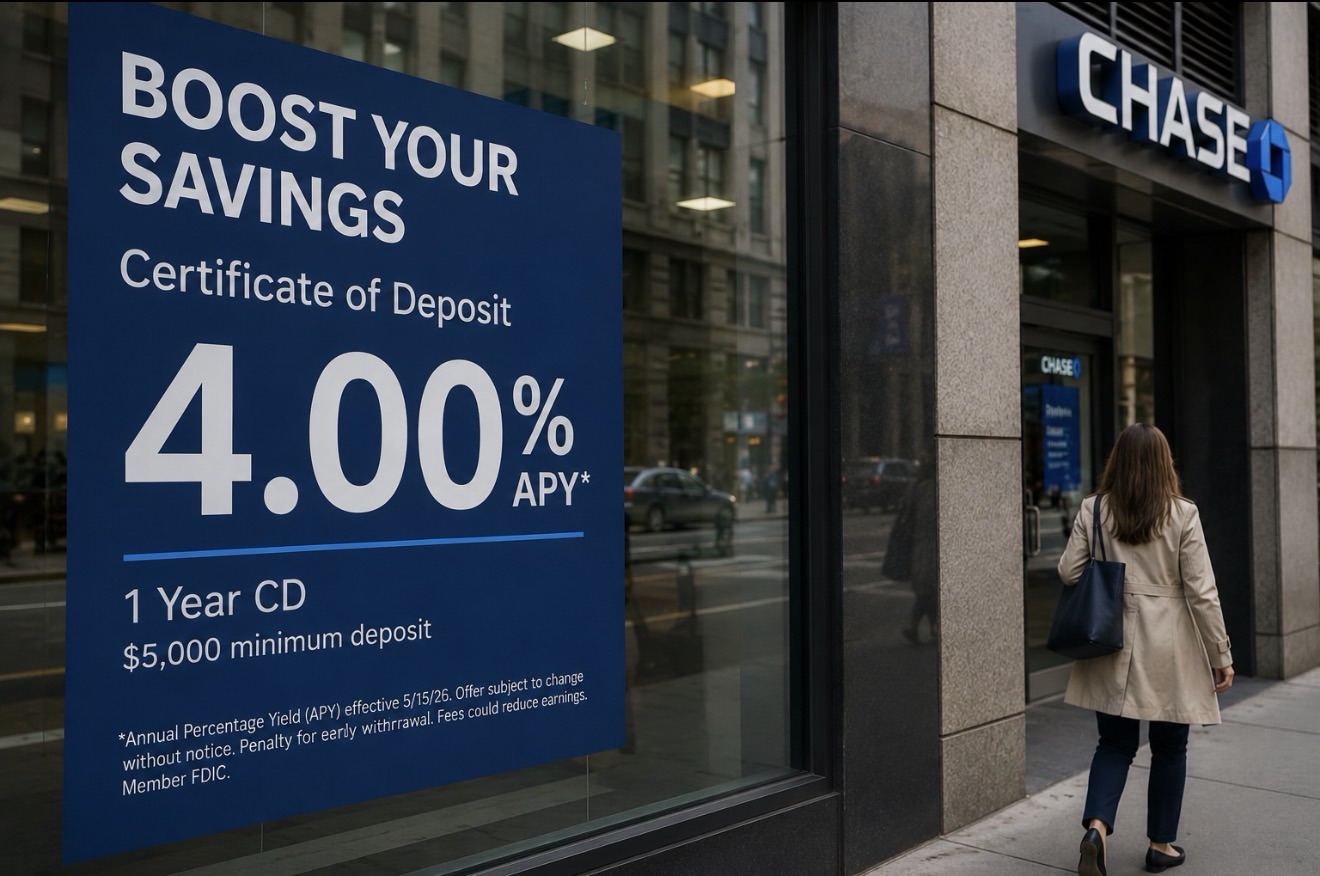
As of June 1, several of the nation’s largest banks were advertising certificate-of-deposit yields approaching 4%, while the national average for a one-year CD remained below 2%, according to industry data. The gap highlights a growing divide between headline rates available to shoppers willing to compare offers and the much lower returns many depositors continue to receive.
For consumers looking to protect savings without taking stock-market risk, the difference can be meaningful.
A saver placing $100,000 into a one-year CD earning 4% would collect roughly $4,000 in interest over twelve months. The same deposit earning the national average near 2% would generate only about $2,000. Over time, that gap compounds into a significant difference in returns.
The disparity has emerged as the Federal Reserve’s interest-rate outlook continues to evolve.
After cutting benchmark rates multiple times during 2025, policymakers have adopted a more cautious stance in 2026 as inflation remains stubbornly above target. That uncertainty has created an environment where banks are competing aggressively for deposits in some areas while allowing rates to drift lower in others.
The result is a marketplace where informed shoppers can often earn double what less-active savers receive.
Among major banks, promotional CD rates have remained relatively attractive, particularly for shorter-term deposits ranging from four months to fourteen months. Several institutions continue offering yields around 4%, reflecting their desire to attract stable funding without significantly increasing borrowing costs elsewhere.
Online banks remain among the industry’s most aggressive competitors.
Without the expense of maintaining extensive branch networks, many digital-first institutions have been able to offer yields exceeding those available at traditional banks. Some one-year CDs continue to pay above 4.2%, while select longer-term products remain competitive despite expectations that rates may gradually decline in the coming years.
The trend is prompting many financial advisers to encourage clients to review cash-management strategies.
For much of the past decade, low interest rates made the decision relatively simple. Savings accounts, money-market funds, and CDs often paid similarly modest returns, leaving little incentive to move money.
That environment has changed.
Today’s rate differences can significantly affect household income, particularly for retirees and conservative investors who rely on interest earnings.
The renewed popularity of CDs also reflects uncertainty about the direction of future rates.
A certificate of deposit guarantees a fixed return for a specified period. If rates decline after the CD is opened, the saver continues receiving the higher locked-in yield until maturity.
That feature has become increasingly attractive as markets debate whether the Federal Reserve will eventually resume cutting rates.
Many consumers appear to be acting accordingly.
Banks report growing interest in CDs as households seek ways to preserve purchasing power while avoiding the volatility that can accompany stocks and other investments.
Still, financial professionals caution that CDs are not appropriate for every dollar a family saves.
Unlike traditional savings accounts, certificates of deposit generally impose penalties for early withdrawals. Money committed to a CD may be difficult or costly to access before maturity.
As a result, many advisers recommend maintaining emergency funds in more liquid accounts while using CDs for cash that is unlikely to be needed immediately.
Safety remains another key selling point.
Deposits held at FDIC-insured banks are protected up to $250,000 per depositor, per ownership category, per institution. Credit-union deposits receive similar protection through the National Credit Union Administration (NCUA).
That federal backing makes CDs one of the lowest-risk financial products available to consumers.
Historical perspective also helps explain why current rates are drawing attention.
During the early 1980s, CD yields climbed into double digits as the Federal Reserve battled runaway inflation. By contrast, rates spent much of the 2010s hovering near historic lows, with many savers earning less than 1%.
The inflation surge of the early 2020s pushed yields sharply higher before recent rate cuts caused them to moderate.
Today’s rates near 4% sit somewhere between those extremes.
They are below the peaks reached during the inflation-fighting period but remain substantially higher than what savers became accustomed to during much of the previous decade.
For banks, the competition reflects a broader battle for deposits.
Higher funding costs can pressure profitability, but attracting deposits remains essential for supporting lending activity and maintaining liquidity. Institutions must balance the desire to gather deposits with the cost of paying higher rates.
Consumers ultimately benefit from that competition.
The challenge is knowing where to look.
Many depositors continue keeping large cash balances in low-yield accounts simply because of convenience or familiarity. Others actively compare rates and move money to institutions offering stronger returns.
The difference between those approaches can be substantial.
With some CDs paying around 4% while average rates remain below 2%, the simple act of comparing offers may be one of the easiest financial decisions available to savers in 2026.
For households focused on preserving capital while earning a predictable return, certificates of deposit remain one of the few places where patience is still being rewarded.
JBizNews Desk — New York
© JBizNews.com All Rights Reserved. Reproduction or distribution without written permission is prohibited.