
 Vos Iz Neias
Iraqi Jewish Survivors Mark 85 Years Since Farhud at President’s Residence
Speaking at the President’s Residence in Jerusalem, Herzog called for the Farhud—and the broader history of Jews from Arab lands—to receive greater recognition in Israeli memory, education and public discourse.
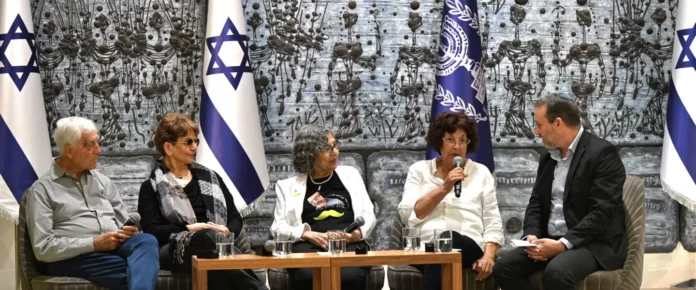
The commemoration, hosted by the president and his wife, Michal, brought together members of Israel’s Iraqi-Jewish community alongside Farhud survivors, descendants and scholars.
A pogrom during Shavuot
The Farhud—an Arabic term meaning “violent dispossession”—erupted in Baghdad on June 1–2, 1941, during the Jewish festival of Shavuot. Jewish homes and businesses were looted, synagogues were desecrated, women were raped, and Jews were beaten, wounded and murdered.
Herzog placed the pogrom within the longer story of Iraqi Jewry, tracing its roots to the Babylonian exile and describing it as one of the oldest and most significant Jewish communities in the Diaspora.
“On that terrible night, between June 1 and 2, 1941, the writing and the slogans turned into terrible violence,” Herzog said.
Rioters stormed Jewish homes throughout Baghdad, beating, wounding and killing Jews solely because they were Jewish.
“In those terrible hours, 179 Jews were slaughtered—women, children, adults, men—and for one reason alone: their Judaism,” he said.
Most of the roughly 180,000 Jews who had lived for generations in Iraq eventually left, many finding refuge in the young State of Israel. Herzog said Iraqi immigrants became a pioneering force in Israeli society and played a decisive role in helping build the state.
Remembering the Farhud, he said, is not only an act of historical justice but also part of Israel’s responsibility to confront antisemitism and pass the story of Babylonian Jewry to future generations through education, culture and public discourse. “We must teach not only about the Farhud,” Herzog said, “but also about the heritage of Babylonian Jewry.”
Referring to the battle against antisemitism, he said, “Eighty-five years have passed since those harrowing events, yet the waves of antisemitic hatred continue to rise, and even to intensify, threatening the safety of Jews across the world. We are witnessing mounting antisemitic attacks, including in democratic countries, and even among longtime friends of the State of Israel.”
He added, “When we give voice to what our sisters and brothers in Iraq endured 85 years ago … we remind the world, again and again, of the dangers contained in antisemitic incitement, and of where that racist hatred led us in the past.”
‘Faces of the Farhud’
Organized by documentary filmmaker David Kahtan, the commemoration included a memorial candle-lighting, an excerpt from his documentary series, The Long Journey Home: The Untold Story of Iraq’s Jews, a panel discussion moderated by Rabbi Elhanan Miller and a portrait exhibition, “Faces of the Farhud,” featuring photographs by Rona Olshevsky.
Herzog singled out Kahtan, who has spent more than two decades documenting the stories of Iraqi Jews.
“There is one person for whom this event is his life’s work,” Herzog said. “That is David Kahtan.”
“You are doing a great mitzvah,” he added.
Kahtan said preserving testimony has become increasingly urgent as the last generation of eyewitnesses fades.
“As the sun sets on my father’s generation, the last witnesses of the Farhud, I have begun recording the testimonies of the remaining survivors before their voices are lost to time,” he told the audience.
“Memory is an act of resistance,” he said.
A melody that needed no translation
The program also included a musical tribute by Israeli pianist, composer and conductor Gil Shohat, who performed the third movement of Beethoven’s Piano Sonata No. 17, known as the “Tempest.” In the middle of the restless finale, Shohat wove in “Enta Omri,” the classic Arabic song made famous by Umm Kulthum; within a few notes, many in the audience were clapping in rhythm.
Shohat later told JNS that while the melody was not Iraqi, it belonged to the classical Arabic music through which his late father, Yehuda Shohat, preserved and passed on his Iraqi Jewish identity. He recalled his father listening every day between 5 and 6 p.m., often holding a white jasmine flower from their balcony. “My father was not an emotional man,” Shohat said, “but in this hour he was emotional.”
From integration to rupture
Prof. Emerita Esther Meir-Glitzenstein of Ben-Gurion University of the Negev traced the Farhud to the political and ideological changes that transformed Iraq in the decade before the pogrom.
In the early 1920s, she said, Iraq was established as a constitutional monarchy in which Muslims, Christians and Jews were citizens. Jews held public office and played prominent roles in government, commerce, culture and the arts. Among them was finance minister Sassoon Eskell, widely regarded as one of the architects of the modern Iraqi state.
King Faisal, she noted, spoke of Iraq’s citizens as “children of Abraham.”
“That was the foundation meant to gather the Iraqi people together,” Meir-Glitzenstein said. “It was a liberal monarchy.”
That vision began to unravel following Iraq’s independence in 1932 and Faisal’s death the following year. Iraqi nationalism increasingly adopted a more exclusionary character, while Nazi influence spread through the country.
According to Meir-Glitzenstein, Nazi propaganda entered Iraq through the German legation in Baghdad and expanded steadily throughout the 1930s. Palestinian Arab activists who arrived after the Arab Revolt established youth movements modeled on the Hitler Youth, while Haj Amin al-Husseini, the Mufti of Jerusalem, arrived in Iraq in 1938 and later played a central role in the 1941 revolt of Rashid Ali al-Gaylani.
“All of this happened within 10 years,” she said.
The significance of the Farhud, she argued, extended well beyond Baghdad. Similar outbreaks of anti-Jewish violence would follow elsewhere in the Arab world, including Libya, Aden, Egypt and Syria.
“What these events said was that there is no place for Jews in the national movements of the Arab countries, and no place for them in the nations being created,” she said.
The question many Jews began asking, she added, was not only what future they had, but “what future is there for our children?”
A child survivor remembers the Farhud
Edi “Edmond” Mor was 5 years old when the Farhud erupted.
Speaking on the panel and later with JNS, Mor recalled how organized the violence appeared even before it began.
“It was organized,” he said. “They went through with brushes and marked every Jewish house. When they passed a house that was not Jewish, they wrote that too, so it would not be attacked.”
Mor had been visiting relatives in Baghdad with his older brother when the violence broke out. On the way home, their minibus passed through a Shi’ite neighborhood where riots were already underway.
The vehicle ahead of them was stopped by a mob and the Jewish passengers were dragged out and murdered.
Their driver managed to reach a police station, where the family sheltered overnight.
Back home, Mor’s father looked out onto the streets and saw bodies being carried through Baghdad. Fearing relatives were among the dead, he began mourning before knowing their fate.
The following day, when the family attempted to return home, a crowd armed with knives, iron bars and other weapons waited outside. A Muslim neighbor tried to intervene and was attacked.
Mor’s father produced a pistol and fired into the air.
“I don’t know where he got it,” Mor said.
The family escaped through the neighbor’s house and across the rooftops.
“When we returned home in the evening, there was no home,” Mor said. “The flowerpots were smashed. The doors and windows had been broken. Anything that had not been looted had been destroyed. It was a pogrom.”
The family’s fabric store, which he said his father “rebuilt from nothing,” was looted as well. Mor said the Farhud ultimately convinced many Iraqi Jews that their future no longer lay in Iraq.
“From this moment,” he said, “I think the entire community understood this was not its place.”
From Baghdad to Kissufim
For another panelist, the Farhud was not simply history. Hadassah Lazar drew a direct line between the violence in Baghdad and the Oct. 7, 2023, Hamas massacre through the life of her brother, Shlomo Mantzur.
Born in Iraq, Mantzur survived the Farhud as a child before immigrating to Israel. More than eight decades later, he was abducted from Kibbutz Kissufim during the Hamas attack. At 86, he was the oldest hostage taken that day. He was murdered in captivity and his body was held in Gaza for 509 days before being returned for burial.
Herzog, who eulogized Mantzur at his funeral, described his life as a journey “from the rivers of Babylon to Zion.”
“The writing was on the wall in Iraq,” Lazar said. “And the writing was on the wall here, in our country, in our sovereign state. We thought ‘never again.’”
Her brother repeatedly warned that danger was building near the Gaza border, she said.
“He told me: until there is a disaster here, no one will wake up.”
Lazar also drew a comparison between the Farhud and the delayed military response on Oct. 7.
“The British army sat at the fence and did not enter to help them during those two days,” she said. “Our army, which is supposed to protect us, sat at the fence for seven or eight hours. No one came in to help them.”
The lesson, she said, remains unchanged.
“We need to believe our enemy that he intends to do something,” she said, “and not say that he is deterred.”
‘They did not want to listen’
Nadia Cohen, a young child in Baghdad during the 1941 pogrom and the widow of Israeli spy Eli Cohen, who was executed in Damascus on May 18, 1965, asked to add one final thought before the panel ended.
“Every person from Iraqi Jewry carries the wound of the silence here in Israel about what happened in Iraq—and also in Libya,” she said. “For years, they did not want to listen. They did not want to know. They did not dare to tell.”
She expressed hope that growing efforts to document the experiences of Jews from Arab lands would finally bring broader recognition to a largely overlooked chapter of Jewish history.
“That was a Holocaust too,” she said.
Then she returned to the theme that had defined the evening.
“I hope this evening will become a yearly reminder,” she said. “We Jews forget. But an Arab from 200 or 300 years ago remembers his house, his key, and what was done to him. Here too, there must be memory, of what happened to us, of what happened to Iraqi Jewry.”
Cohen added, “Our fate depends on learning and remembering—not on forgetting.”