
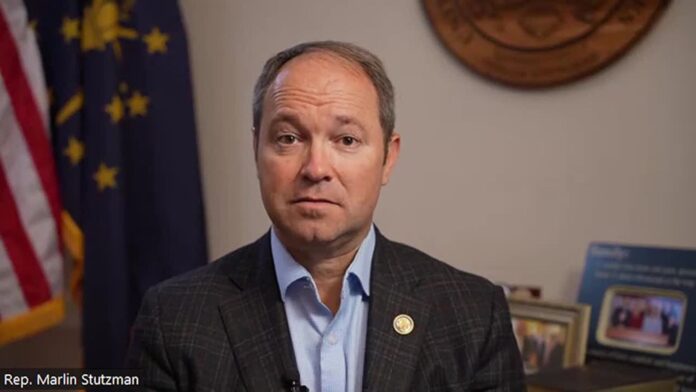

A Republican congressman known for his strong support of Israel has introduced a resolution urging the United States to end its annual military aid package to Israel and replace it with a new arrangement under which Israel would purchase American defense equipment using its own resources. The proposal has received the backing of Prime Minister Binyamin Netanyahu.
Rep. Marlin Stutzman of Indiana unveiled the measure on Wednesday, calling for negotiations on a new memorandum of understanding that would gradually move the U.S.-Israel defense relationship away from direct aid and toward a framework based on arms purchases funded by Israel.
The proposal seeks to replace the current 10-year agreement that provides Israel with $38 billion in military assistance through 2028. Rep. Abe Hamadeh of Arizona has joined Stutzman in supporting the initiative.
According to Stutzman, he personally presented a draft of the resolution to Netanyahu during a 45-minute meeting at the prime minister’s office in Yerushalayim on May 27. Hamadeh also attended the meeting.
“I like it,” Netanyahu replied after reading, according to Stutzman.
“This is the direction I’ve been wanting to go for a long time,” Netanyahu said.
Netanyahu later reinforced that position in a letter sent Monday expressing support for the effort. In the letter, he wrote that Israel remains grateful for American military assistance but believes the relationship has reached a new stage.
Israel, he wrote, “appreciates the financial component of the military aid” but that “the time has now arrived for us to move from aid recipient to partner.”
Supporters of the proposal stress that it does not call for an abrupt termination of military cooperation. Instead, it envisions replacing direct aid with a trade-based defense partnership while maintaining extensive strategic collaboration between the two countries.
Additional forms of cooperation could continue under joint defense programs, including discussions surrounding provisions in the next National Defense Authorization Act that would expand cooperation in weapons development and military technology.
During the Jerusalem meeting, Netanyahu emphasized Israel’s desire for greater self-sufficiency while preserving its close alliance with the United States.
“We want to stand on our own feet,” Netanyahu told the lawmakers in Jerusalem, language the prime minister has used publicly for months.
Stutzman argued that changing the structure of the relationship would address shifting attitudes in the United States and help strengthen public support for the alliance.
“A lot of taxpayers don’t even like foreign aid altogether, but there’s a lot of questions around why are we giving Israel $3.8 billion a year under the MOU,” he said.
The congressman said the proposal would demonstrate that Israel is a capable strategic partner rather than a nation dependent on American assistance.
The goal, he added, is to signal “to the rest of the world that Israel is not just leaning on America,” and that “even though we will have a strong partnership with them going forward, it’ll look different.”
Stutzman said he has already discussed the idea with the White House, House Speaker Mike Johnson’s office, senators, and AIPAC, and reported a generally favorable reception.
He described the response as “very much an openness to the dialogue.”
Recent developments suggest that the proposal is gaining traction among some policymakers. Earlier this week, U.S. Ambassador to Israel Mike Huckabee publicly referenced a future arrangement based on trade rather than aid.
In a post on X, Huckabee wrote that the “New MOU w/ Israel ends aid & will be based on trade,” marking the first public confirmation by an American official that such a framework is being discussed.
The debate comes as public opinion toward Israel has become more divided in the United States. A Pew Research Center survey conducted in spring 2026 found that 60 percent of American adults view Israel unfavorably, compared to 53 percent a year earlier. Among Republicans under age 50, 57 percent expressed negative views.
Hamadeh praised the proposal, saying it reflects the evolution of the U.S.-Israel alliance into a more equal partnership.
The relationship, he said, is “moving towards true collaboration as strategic partners.”
The resolution itself would not immediately change existing policy. As a nonbinding measure, it serves primarily as a statement of congressional intent and would not alter the current military aid agreement, which remains in effect through 2028.