
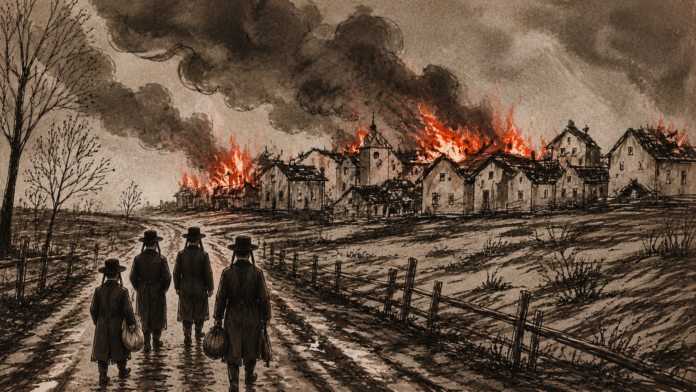

New York (VINNEWS/Rabbi Yair Hoffman)It was twelfth-century France, and there was an accusation. The accusation followed the now-familiar pattern of medieval anti-Jewish slander. In Blois, a Christian servant accused a Jewish man of murdering a Christian boy—whom historians believe was either killed by the accuser or never existed, since a body was never found.
Despite the absence of any victim, the consequences were horrific. On the twentieth of Sivan in the year 4931 (1171), the town’s Jewish community was burned at the stake after refusing to renounce Judaism.
What distinguished Blois from earlier accusations was the role of the authorities.
Although this was not the first blood libel, it was the first in which the government openly participated, and the first time that Jews were killed due to the libel. The event was thus understood as a grim turning point, a harbinger of tragedies to come.
The response of the generation’s leadership was swift and unified. The Jews of England, France, and the Rhineland, together with Rabbeinu Yaakov ben Meir—known as Rabbeinu Tam, grandson of Rashi and the Jewish leader of the time—declared the twentieth of Sivan to be a day of fasting and atonement. Rabbeinu Tam declared the day a fast “greater than Tzom Gedalya, more akin to Yom Kippur,” and instituted special selichos to be recited. Rabbeinu Tam himself died on the fourth of Tammuz, just three weeks later.
The Crusades and a Period of Mourning
The fast did not remain attached to Blois alone. The timing of the tragedy, falling as it did within the broader era of Crusader violence, lent the day a wider significance. Since the tragedy took place during the general period of the Crusades, the twentieth of Sivan was often viewed as the mourning day for the murders and excesses of that era, as each of the early Crusades resulted in the destruction of hundreds of communities in central and western Europe and the killing of thousands of Yidden.
The month of Sivan had, in fact, already been associated with sorrow for these communities even before the events at Blois unfolded. Yet with the passage of time and the expansion of Crusader devastation, the observance gradually faded from practice.
The Gezeiros Tach V’Tat
Nearly five centuries later, the date would be reborn through a catastrophe of staggering proportions. Approximately five hundred years after Blois, most of the Jewish communities of Eastern Europe suffered the massacres known as the Gezeiros Tach veTat, referring to the years 5408 and 5409—corresponding to 1648 and 1649.
The first great blow fell upon the community of Nemirov. Bogdan Chmielnicki’s Cossacks approached the city on the twentieth of Sivan, 5408 (1648), displaying Polish flags and thereby tricking the Jews into opening the city gates; once inside, a bloodbath ensued in which six thousand Jews were murdered and drowned. The destruction extended to the holiest objects of the community. The shul was destroyed and all the Sifrei Torah were torn to pieces and trampled, their parchment used for shoes and clothing.
The rav of Nemirov, Rav Yechiel Michel, did not abandon his flock in their final moments. He passionately implored the people to keep their faith and die Al Kiddush Hashem, and he himself perished among them.
Nemirov was only the beginning. The two years of similar havoc wiped out around one hundred thousand Jews in Eastern Europe—roughly one third of Europe’s Jewish population at the time—and destroyed many centers of Jewish learning and communal life.
The Shach and the Restoration of the Fast
The Gadol who is most closely bound to the renewed observance was Rav Shabsai HaKohen, the great commentator on the Shulchan Aruch known as the Shach, who recorded the events of Nemirov firsthand. The Shach was the first rav to institute a fast day on the twentieth of Sivan in commemoration of the Gezeiros Tach V’Tat. Significantly, his original intention appears to have been modest in scope. From his own words it seems that he had prescribed the fast day only for his family and descendants.
The communal adoption followed shortly thereafter. In 1652, the Vaad Arba Aratzos – the Council of the Four Lands also declared a fast on the twentieth of Sivan, establishing one for the public at large. Other great authorities who had themselves suffered loss joined in expanding the observance. The Taz, who also lost family members to the pogroms, as well as the Tosfos Yom Tov, expanded on the Shach’s personal fast, which was ultimately adopted by the Four Lands—covering Poland, Ukraine, and other areas.
The poskim duly recorded the fast for posterity. The Taz (Orach Chaim 566:3) and the Magen Avraham (Orach Chaim 568:10 and 580:9) report that the rabbis of Poland and the surrounding areas declared a fast day on the twentieth of Sivan to commemorate the events of Nemirov and the Gezeiros Tach v’Tat. A moving kinah composed by the Tosfos Yom Tov, Rav Yom Tov Lipman Heller, gave voice to the loss. Published in Cracow in 1650, it lists by name twelve of the nearly three hundred communities that were totally decimated during the massacres.
The rabbonim of that generation understood the catastrophe as a summons to do teshuvah. The tragedy was so immense that the rabbonim felt strongly that only specific aveiros of the Jewish people could have brought about such mass destruction. Among the failings cited by Rav Berachia Berach, a leading rav of the era, were Shabbos desecration, davening without proper kavanah, the sale of rabbinical positions, and false interpretations of Torah by darshanim—accompanied by a call for an immediate tikkun.
The Slow Fading of the Day
The fast endured for generations. The Mishnah Berurah, in Hilchos Taanis, makes reference to the fast of chof Sivan, and the date, together with the special selichos composed for it, was observed until recent times.
Its disappearance from our contemporary practice is itself a kind of tragedy. The communities that carried the memory of Nemirov and Blois were themselves consumed, and with them, in large measure, the day they had set aside to remember.
The twentieth of Sivan could perhaps be a way to do Teshuvah in areas in which we lack, and could be a solution to the tzaros that we are currently experiencing.
The author can be reached at [email protected]