
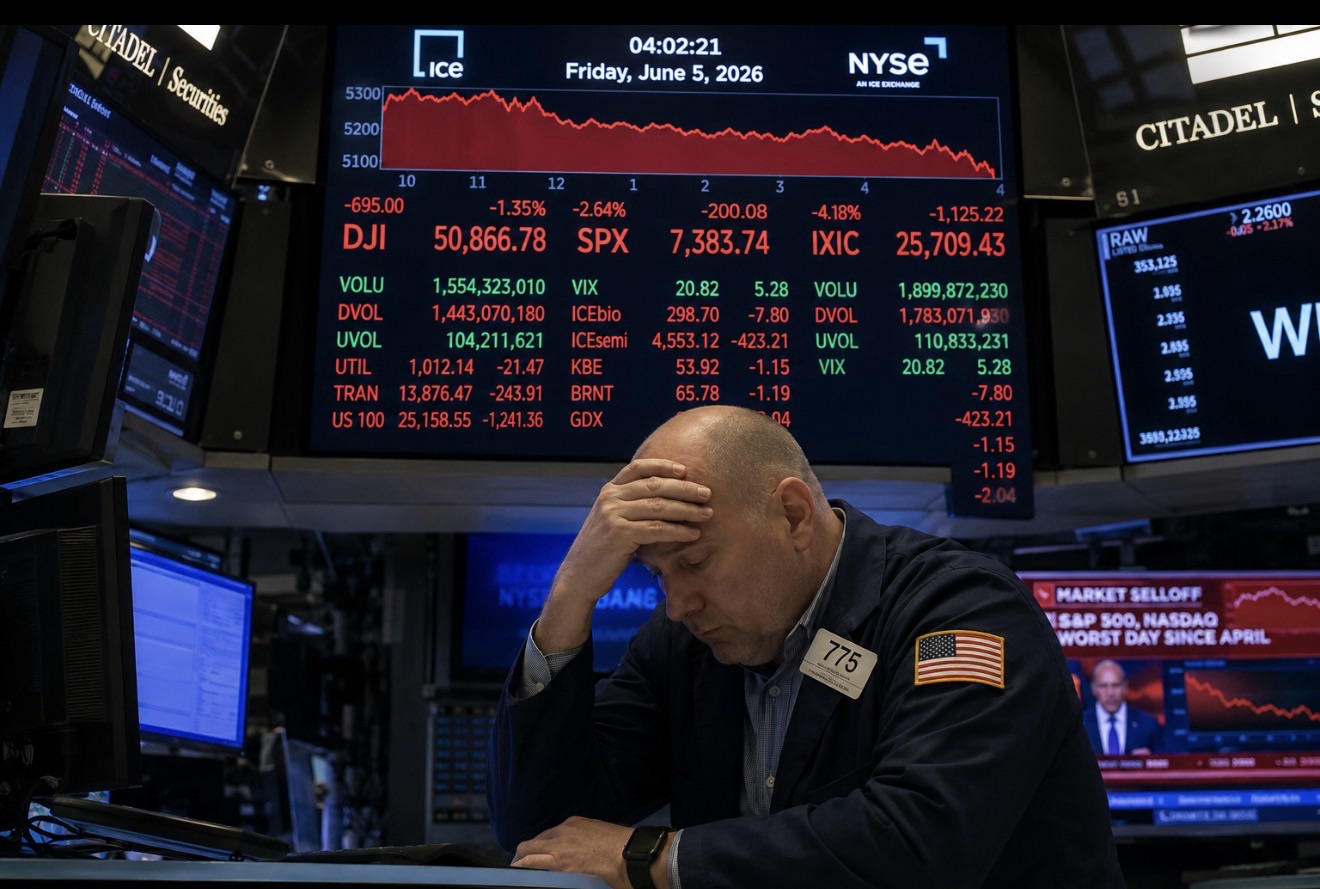

NEW YORK — A violent selloff in semiconductor stocks erased roughly $1.7 trillion from the U.S. stock market on Friday, June 5, with the world’s largest chipmakers alone shedding more than $1 trillion in market value, as investors suddenly reassessed whether the artificial-intelligence boom can justify the extraordinary valuations that have fueled Wall Street’s rally over the past two years.
The selloff struck at the heart of the market’s strongest sector. The Nasdaq Composite fell 4.18% to 25,709.43, its worst one-day decline since the tariff-driven market shock of April 2025. The S&P 500 dropped 2.64% to 7,383.74, ending a nine-week winning streak, while the Dow Jones Industrial Average lost 695 points, or 1.35%, to close at 50,866.78. The Cboe Volatility Index, commonly known as Wall Street’s fear gauge, surged more than 34%, finishing above the key 20 level.
At the center of the rout was the Philadelphia Semiconductor Index, which plunged approximately 8.5%, marking its steepest single-session loss since April 2025.
Nvidia, the dominant supplier of AI chips and the world’s most valuable semiconductor company, fell roughly 6%, wiping out more than $300 billion in market capitalization in a single day. Micron Technology tumbled about 11%, while Advanced Micro Devices dropped more than 10%. Marvell Technology lost approximately 12%, and Broadcom extended a two-day slide that approached 20%.
The immediate trigger was Broadcom’s earnings report, released earlier in the week. Although the company reported strong results by most measures, investors focused on signs that demand growth for certain custom AI chips was not accelerating as rapidly as Wall Street had expected. After two years in which semiconductor companies repeatedly exceeded forecasts and raised guidance, even modest signs of slowing momentum proved enough to spark a sharp revaluation.
The selling pressure intensified Friday after the release of a surprisingly strong U.S. jobs report.
The Bureau of Labor Statistics reported that employers added 172,000 jobs in May, significantly above economists’ expectations of roughly 80,000 jobs. The stronger-than-expected labor market reinforced concerns that the Federal Reserve may have little reason to lower interest rates and could potentially be forced to consider another increase if inflation remains stubborn.
Bond yields rose sharply following the report, creating additional pressure on high-growth technology stocks. Higher interest rates reduce the present value of future earnings, making richly valued growth companies less attractive to investors.
By Friday’s close, futures markets were assigning a significantly higher probability that the Fed could raise rates before year-end, a dramatic shift from expectations only weeks ago when investors were largely debating the timing of future rate cuts.
Market strategists largely characterized the move as a correction rather than evidence of fundamental deterioration in the AI industry itself.
The semiconductor sector remains one of the strongest-performing areas of the market despite Friday’s losses. Even after the decline, the Philadelphia Semiconductor Index is still up approximately 75% in 2026, reflecting the extraordinary gains generated by the AI boom.
The underlying businesses also remain healthy. Demand for AI infrastructure continues to grow, major cloud-computing companies are still spending heavily on AI development, and semiconductor manufacturers continue reporting substantial revenue growth. What changed Friday was not demand for AI technology but the price investors were willing to pay for future growth.
The episode also highlighted a growing concern among market analysts: concentration risk.
A relatively small group of AI-related companies has accounted for a disproportionate share of the stock market’s gains over the past year. As a result, broader indexes have become increasingly dependent on the performance of a handful of technology giants. When sentiment shifts against those companies, the impact quickly spreads throughout the market.
That concentration affects far more than professional traders. Because companies such as Nvidia, Broadcom, Microsoft, and other technology leaders carry enormous weightings in major indexes, their movements directly influence the performance of countless retirement accounts, pension funds, and index funds owned by ordinary Americans.
Investors now turn their attention to the next major economic test: the government’s inflation report scheduled for Wednesday, June 10. A hotter-than-expected reading could reinforce expectations for higher interest rates and extend pressure on technology shares. A softer report, meanwhile, could help restore confidence that Friday’s selloff was merely a pause in the AI-driven bull market rather than the beginning of something larger.
JBizNews Desk — New York
© JBizNews.com All Rights Reserved. Reproduction or distribution without written permission is prohibited.