
 Matzav
Trump Could Also Tear Down the Statue of Liberty, DOJ Argues In Defense of White House Ballroom
A federal appeals court appeared unconvinced Friday by the Trump administration’s argument that courts lack the authority to halt construction of the new White House ballroom, even if the project were ultimately found to violate federal law.
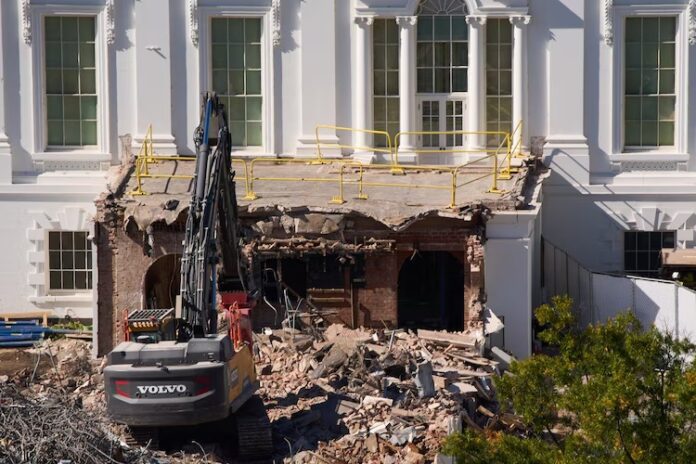
During a hearing before the U.S. Court of Appeals for the District of Columbia Circuit, two judges repeatedly questioned administration attorneys over their claim that the project has advanced too far to be stopped, particularly after the demolition of the East Wing and the commencement of large-scale construction.
Judge Patricia Millett pressed government lawyer Yaakov Roth on whether there were any limits to the administration’s position.
“When did it become a fait accompli?” Judge Patricia Millett asked. “If this were complete lawlessness by the government … it couldn’t be stopped?”
Roth responded bluntly.
“On these theories, I think that’s right,” replied Yaakov Roth, a Justice Department attorney.
Millett continued to challenge the administration’s reasoning, questioning whether the government could effectively shield any project from judicial review simply by acting quickly enough.
“If the government decides, very quickly, to bulldoze the Statue of Liberty — the people whose ancestors that was the first thing they saw coming to this country, but the government moved too fast — nothing can be done?” the judge asked.
“I think that’s right, yes,” Roth responded.
The dispute stems from President Trump’s ambitious White House renovation plan, which includes construction of a large ballroom that has become one of the administration’s highest-profile building projects. While a federal district judge temporarily blocked the work in March, the D.C. Circuit later suspended that ruling, allowing construction to proceed while the legal battle continues.
Friday’s arguments highlighted the administration’s aggressive defense of the project, which Trump has repeatedly championed as part of a broader effort to reshape and modernize portions of Washington’s most iconic buildings.
Millett was not alone in expressing concern. Judge Bradley Garcia also appeared skeptical of the administration’s sweeping legal arguments.
Judge Neomi Rao, meanwhile, focused much of her questioning on whether the lawsuit should be allowed to proceed at all. Rao suggested the National Trust for Historic Preservation may lack standing, particularly given the administration’s contention that the ballroom serves important security functions in addition to hosting events.
Roth argued that preservation concerns raised by opponents pale in comparison to the security considerations involved in the project.
“The balance of harms and public interest are so lopsided in favor of this project,” Roth said. “It’s an architectural preference on one hand and the safety and security of the president of the United States on the other hand.”
The administration also maintained that courts should not intervene even if the project were eventually determined to be unlawful. According to Roth, any corrective action would need to come from Congress rather than the judiciary.
“Congress can figure out how to deal with that, given the fact that we have these national security imperatives,” Roth said. “It’s well along. They’ve installed like 3 million pounds of steel rebar. … Congress would be the appropriate entity to decide: How do we balance these considerations at this juncture?”
Attorneys for the National Trust for Historic Preservation argue that the White House grounds are part of a federally protected national park and therefore cannot be substantially altered without congressional approval. They contend that the administration lacks authority to make such sweeping changes on its own.
“They just don’t want to go to Congress,” the trust’s attorney, Tad Heuer said, stressing that, under the Constitution, “Congress controls federal property.”
Heuer acknowledged that smaller additions to the White House over the years—including recreational facilities such as tennis courts and swimming pools—may also have been installed without explicit congressional authorization. However, he argued that the ballroom project is fundamentally different because it required the complete removal of the East Wing.
President Trump has repeatedly mocked the lawsuit and questioned the legitimacy of those challenging the project.
In a social media post, Trump claimed the lawsuit was “brought by a woman walking her dog, who has absolutely No Standing to bring such a suit.”
The National Trust, however, says its legal standing is based on historian and retired professor Alison Hoagland, who has served on preservation boards and frequently visits the White House area.
Notably, Hoagland’s sworn court declaration makes no mention of a dog.
The case now presents a significant test of executive authority, judicial oversight, and congressional control over federal property, as construction of Trump’s signature White House ballroom continues while the courts weigh whether it was authorized in the first place.
{Matzav.com}