
 Matzav
Court Extends Detention of 52 Suspects in Solberg Riot Case, Citing “Severity and Dangerousness”
A Yerushalayim court on Sunday extended the detention of 52 suspects arrested in connection with last week’s violent disturbance outside the home of Deputy Supreme Court President Justice Noam Solberg, ruling that the alleged actions reflected a significant level of seriousness and danger. At the same time, police arrested an additional suspect in the case, prompting protests that led to major traffic disruptions in the Yerushalayim area.
The Yerushalayim Magistrate’s Court ordered that the 52 suspects remain in custody for four more days, until June 10, as investigators continue examining the events surrounding the riot and the damage caused at Justice Solberg’s residence.
Two additional suspects were released to full house arrest through June 11 under restrictive conditions that include a prohibition on contacting other individuals involved in the case, as well as financial guarantees.
During the hearing, which was conducted by video conference, several of the detainees appeared relaxed and smiling, with some applauding. An Israeli flag was visible on the wall behind them, while several suspects covered the Star of David on the flag with their hats.
A police representative told the court that two detainees attempted to escape while being transported by bus near Hebron on their way to a police station. He also noted that many of the suspects initially refused to identify themselves during questioning. According to the officer, “Only on Friday did a significant number of detainees who had refused to identify themselves finally agree to do so,” and he urged the court to consider that conduct when deciding whether to extend their detention.
Police further argued that the large number of suspects had significantly complicated the investigation, explaining that every investigative action had to be repeated for each individual involved. As a result, authorities maintained that the time already spent in custody had not been sufficient to complete the necessary investigative work or gather additional evidence.
Attorney Roi Politi, who represents some of the suspects, requested that his clients be released to house arrest. He argued that the bus in which the detainees were held after their arrest effectively functioned as a “detention center on wheels.” He also contended that only a minority of the suspects had actually entered the property and that the remaining investigative steps could be carried out without continued detention.
In its decision, the court stated that the suspects were part of “a large group that gathered together with the purpose of reaching the home of the deputy president.” The judge also referenced the reported escape attempts and noted that investigators had thus far been unable to carry out many of the required investigative actions due to the succession of court hearings and the suspects’ observance of Shabbos. The ruling added that “the prior organization, the joint arrival at the scene, and the actions taken there demonstrate the severity and dangerousness” of the alleged conduct.
Meanwhile, police continued their investigation and made another arrest in the case. Detectives from the Judea and Samaria District’s major crimes unit detained a man in his twenties from Beit Shemesh after attempting to question him while he was driving near Beitar Illit.
According to police, the suspect refused to comply with detectives’ instructions and barricaded himself inside his vehicle. Officers eventually forced their way into the car, arrested him, and brought him in for questioning.
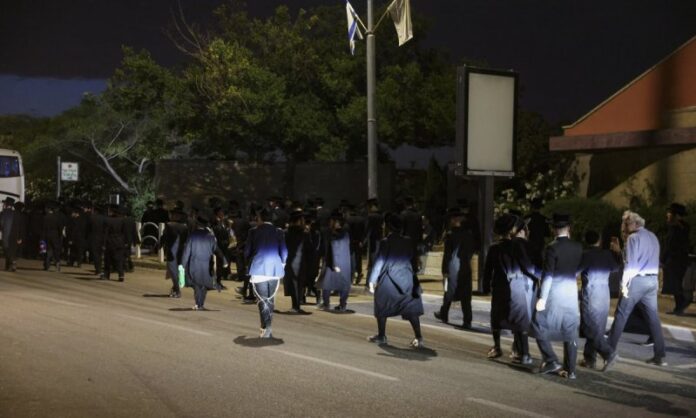
The arrest sparked protests that shut down the Tunnels Highway for more than an hour. Demonstrators reportedly blocked the route connecting Jerusalem and Gush Etzion, causing significant traffic disruptions.
Police later reported that the disturbances included road blockages, the obstruction of buses, the placement of rocks and barriers on roadways, and the setting of fires in traffic lanes. Police and Border Police forces were deployed to the area and worked to disperse the demonstrators and restore the flow of traffic.
{Matzav.com}