
 Vos Iz Neias
Only 3 Militaries Have Air-Launched Ballistic Missiles, Iran Claims Israel Used Them In Attack
JERUSALEM (VINnews) — Iran claimed that the Israeli strike early Monday morning was carried out using air-launched ballistic missiles, a capability that, according to reports, is possessed by only a small number of militaries.
Israel has never officially acknowledged using such missiles, but according to previous foreign reports, it possesses more than one type of air-launched ballistic missile:
- Rafael Advanced Defense Systems’s “Ankor” (Sparrow), originally developed as a target missile to simulate surface-to-surface missiles and used by Israel in several tests of the Arrow system.
- “Rampage,” produced by Elbit Systems and Israel Aerospace Industries.
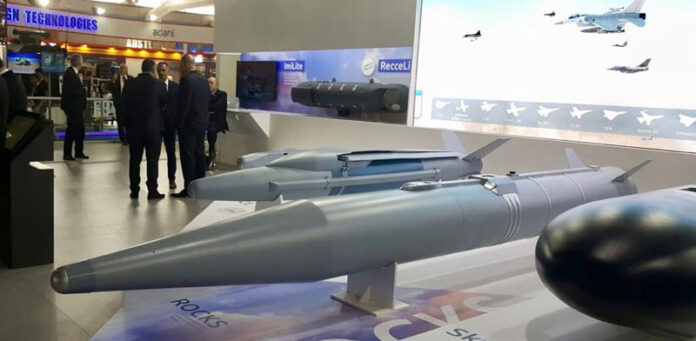
- “Rocks” produced by Rafael and reportedly based on the Ankor missile.
Ballistic missiles, unlike cruise missiles, are considered more difficult targets for dense air-defense systems. Cruise missiles are slower, although they can alter their flight path. Ballistic missiles are usually launched from known launch sites and generally follow a fixed trajectory that cannot easily be changed. Precise, high-speed ballistic missiles launched from aircraft rather than from the ground can overcome some of these limitations, or at least eliminate the disadvantage of a known launch point.
It was previously reported that the Rampage missile can be launched from a fighter jet at a distance of 150 kilometers (93 miles), making detection and interception more difficult for enemy defense systems.
“The greatest advantage of missiles launched from aircraft compared to cruise missiles is the speed with which they penetrate defenses,” said Jeffrey Lewis, director of a research institute in California. “The disadvantage used to be accuracy, and that appears to have been solved.”
As part of Operation “Summit of Fire” about a year ago, it was claimed that Israel used these special missiles when it struck a facility hosting meetings of Hamas leadership in Qatar while they were discussing a hostage deal. At the time, The Wall Street Journal reported that the strike was carried out by 12 Israeli Air Force aircraft—eight **F-15 Eagle**s and four **F-35 Lightning II**s—which launched ballistic missiles into space above Saudi Arabia, and those missiles struck the villa in Doha.
Ground-launched ballistic missiles, or surface-to-surface missiles, are used by many militaries around the world, as well as by organizations such as the Houthis in Yemen. Cruise missiles are also widespread. However, ballistic missiles launched from aircraft are unusual and, according to previous reports, are possessed by only a handful of countries, including Russia, China, and Israel.
Air-launched ballistic missiles are carried by aircraft, allowing them to be fired from different locations. “They can come from any direction and make defense against them more difficult,” said Uzi Rubin, a two-time recipient of the Israel Defense Prize and the first head of the “Homa Administration,” under which the Arrow missile was developed.
The United States previously tested a hypersonic ballistic missile known as the AGM-183 ARRW, but the project did not receive funding last year and was effectively canceled. Because the U.S. already possesses a large arsenal of cruise missiles and other long-range weapons, Washington has shown little interest in developing air-launched ballistic missiles. A U.S. Air Force official previously told Reuters that such missiles are not used in Air Force operations.
A senior defense-industry official previously told Reuters that because air-launched ballistic missiles combine guidance systems, warheads, and rocket motors, many countries that already possess precision-guided weapons have the ability to develop them:
“It’s a smart way to combine components and technologies and turn them into a new weapon that provides much greater capabilities, and therefore more options, at a reasonable cost.”
About two years ago, before the rounds of war with Iran, leaked Pentagon documents mentioned that Israel had been working on air-launched ballistic missiles. The documents referred to “Golden Horizon”, a system whose existence had never previously been publicly mentioned either in Israel or abroad, and to Rafael’s Rocks missile.
The Rocks missile was unveiled by Rafael in 2019 and, according to reports, is based on the Ankor missile. Described by Rafael as an air-to-surface missile, it is launched “from significant stand-off ranges well outside the coverage zones of enemy air-defense systems and follows a supersonic trajectory toward the target.”
According to Rafael’s website: “This reduces the exposure of the launching aircraft to enemy threats and improves the chances of successfully striking targets. It can be used against high-value targets, stationary or relocatable, and even in environments where the enemy employs countermeasures and electronic interference.”
According to the company, the Rocks missile has “proven itself on the battlefield,” which may suggest that it has already been used operationally. Rafael states that the missile is capable of destroying targets both above ground and underground.