
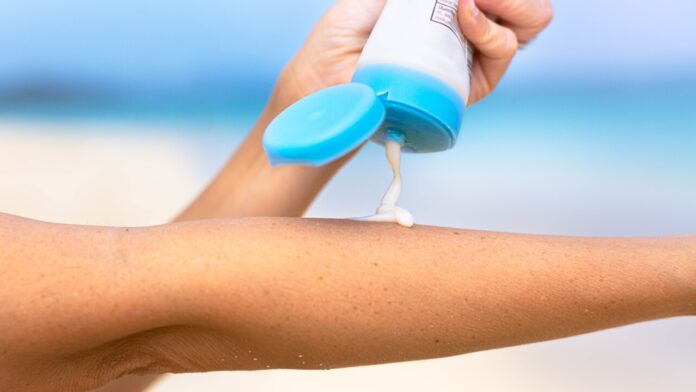

Americans will soon have access to a new sunscreen ingredient for the first time in more than a quarter-century after federal regulators approved a widely used ultraviolet filter that has been available in Europe and other international markets for years.
The Food and Drug Administration announced Tuesday that bemotrizinol has satisfied the agency’s safety and effectiveness requirements, providing protection against harmful ultraviolet radiation while showing minimal skin absorption and irritation.
According to the FDA, the ingredient has been approved for use by adults as well as children six months of age and older.
The new ingredient will make its U.S. debut through Dutch-based DSM Nutritional Products, which plans to market it under the Parsol Shield brand later this year.
Following an 18-month period of market exclusivity, other sunscreen manufacturers will be permitted to incorporate the ingredient into their products.
For decades, efforts to bring newer sunscreen technologies to the American market have been slowed by the FDA’s lengthy and complex process for updating approved over-the-counter drug ingredients.
Bemotrizinol is the first sunscreen ingredient to receive approval through a faster review pathway established by Congress in 2020.
Industry observers say the ingredient offers a significant advantage because it protects against both UVA and UVB radiation while avoiding the white residue commonly left behind by mineral-based sunscreens.
“For decades, Americans have used outdated sunscreen tech while the rest of the world moved forward,” said David Andrews of the Environmental Working Group. “The approval of bemotrizinol will help change that.”
Andrews and his organization have spent years urging regulators both to strengthen sunscreen regulations and to allow modern ingredients already used abroad to enter the U.S. marketplace.
Current FDA regulations require sunscreens to shield users from UVB rays, which are primarily responsible for sunburns, and UVA rays, which are closely linked to skin cancer and premature aging.
Most chemical sunscreen ingredients presently sold in the United States protect against either UVA or UVB radiation, forcing manufacturers to combine multiple ingredients in order to achieve what is marketed as broad-spectrum protection.
Mineral sunscreens, such as those containing zinc oxide, provide protection against both forms of ultraviolet radiation but are often criticized for leaving a noticeable white film on the skin.
European regulators first approved bemotrizinol in 1999, and an application seeking FDA approval was submitted in 2005.
“The FDA is committed to ensuring the American consumer has access to the most effective and safe therapies, including over-the-counter products like sunscreens,” said Dr. Mike Davis, acting director of FDA’s drug center.
The FDA has gradually revised sunscreen regulations over the years. In 2011, the agency prohibited marketing terms such as “waterproof,” concluding that they were misleading, and required all sunscreen products to offer protection against both UVA and UVB rays. Prior to that change, some products only shielded users from UVB exposure.
A decade later, in 2021, regulators proposed additional reforms, including limits on SPF claims and tougher UVA-protection requirements. Those proposed changes, however, have yet to be finalized.
{Matzav.com}