

New York (VINNEWS/Rabbi Yair Hoffman) “Mah rabu maasecha Hashem, kulam b’chochmah asisa” — How great are Your works, Hashem; You made them all with wisdom (Tehillim 104:24).
David HaMelech said these words long ago. But a new discovery about a simple tree shows just how true they are. Scientists have found something so clever, so perfectly designed, that it is hard to believe it happened by accident.
The Problem the Oak Tree Faces
Every spring, forests come back to life. Trees grow new leaves, and at the same time, insects hatch. One of these insects is the caterpillar.
Caterpillars are an enormous problem for trees. They hatch in the spring at exactly the precise moment — just when the new leaves are young, soft, and full of food. The baby caterpillars come out hungry, and a feast of fresh leaves is waiting for them. They eat and eat, and they can do serious damage to the tree.
The tree clearly has an enemy. But what can it do about it?
The Oak Tree’s Amazing Trick
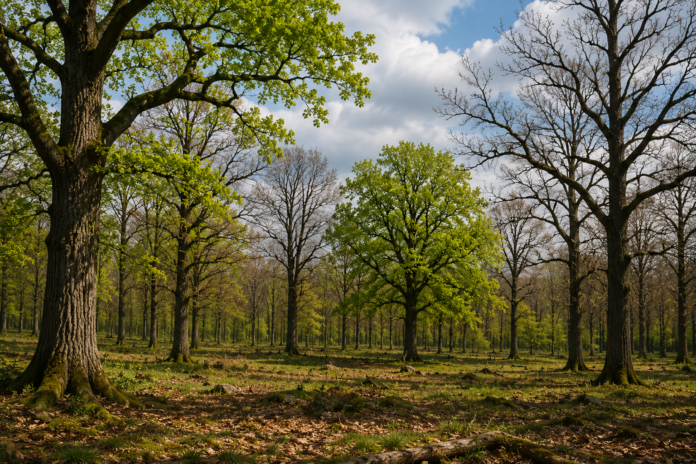
Scientists that have been studying oak trees have discovered something incredible. When an oak tree gets attacked by a lot of caterpillars one year, it remembers. The next spring, the tree does something different. Instead of growing its leaves on time, it waits. It holds back its leaves for three extra days.
Three days does not sound significant. But for the baby caterpillars, it is a disastrous.
How so? They hatch expecting to find soft leaves to eat. Instead, the leaves are still sealed inside their buds, leaving them with nothing to eat. With no food, many of the caterpillars die.
The repercussions of the three-day delay? The damage to the tree drops by about 55 percent. By waiting just three days, the oak tree cuts the harm almost in half.
The lead scientist, Dr. Soumen Mallick of the University of Würzburg in Germany, pointed out that this waiting trick actually works better for the tree than fighting the caterpillars with poison. Many trees defend themselves by filling their leaves with bitter chemicals called tannins. But making more tannins costs the tree a huge amount of energy. Simply changing the timing of its leaves is cheaper and smarter. The tree wins the battle without firing a shot.
How Scientists Discovered This
To find this out, an international team of researchers watched a huge area of forest in northern Bavaria, Germany — about 1000 square kilometers — using special radar satellites in space. These radar satellites can see changes in the forest even through thick clouds. The scientists studied 137,500 observations over five years, from 2017 to 2021, and published their findings in a respected science journal called Nature Ecology & Evolution.
In the year 2019, there was a big outbreak of caterpillars from a moth called Lymantria (the spongy moth). The satellites recorded exactly which trees were stripped bare — and exactly how those same trees reacted the following year.
Why This Could Not Have Happened by Accident
Some might explain a discovery like this through evolution. But this oak tree behavior is very hard to explain that way. There are a number of reasons for this.
First, the tree remembers. The oak tree somehow keeps a record of how badly it was attacked one year. It holds onto that information for almost a whole year. Then, the next spring, it acts on it. A chemical that stores information and acts on it at the right time is exactly like a machine following instructions. A thermostat in your house also has a “mechanism” that stores a setting and acts on it. Nobody believes a thermostat built itself. The question is not how the tree stores the message. The question is: who wrote the instructions that tell the tree what the message means and what to do about it?
Second, the timing is just right. Why three days? Not two, not ten — three. If the tree waited too few days, the caterpillars would still find food. If it waited too many days, the tree would lose precious sunlight and hurt itself. Three days it seems is the perfect balance.
Third — the tree only uses this trick when it needs to. The oak waits longer only after it has actually been attacked. In a quiet year, it grows its leaves on time. The scientists found that the delay was strongest exactly where it would help the most, which points to a real, built-in defense.
If the tree waited late every single year, the caterpillars would simply learn to hatch later too, and the trick would stop working. But because the tree waits late only sometimes, the caterpillars can never adjust. The tree keeps the enemy guessing. That is not just a fixed habit — it is a flexible strategy, switched on and off depending upon the situation. This is the behavior and thinking of a clever general, not a plant with no brain.
The wisdom we see in the oak tree did not come from the tree itself. It came from the One who made the tree. This tree with neither brain, nor eyes, nor the ability to think has a battle plan so sophisticated and smart that it can outsmart its enemy and keep it guessing.
Where does that cleverness come from?
The answer lies in the Chovos Halevavos. Almost a thousand years ago, Rabbeinu Bachya ibn Paquda wrote a famous sefer called Chovos HaLevavos, “Duties of the Heart.” One whole section of it is called Shaar HaBechina — the Gate of Reflection.
In that section, Rabbeinu Bachya teaches that one of our duties is to stop and look carefully at the world Hashem made. He explains that examining the wisdom built into creation is one of the clearest ways to recognize that there is a Creator. Every created thing, from the largest mountain to the smallest insect, is packed with countless clever details that point back to Hashem who designed it.
Rabbeinu Bachya told us nine hundred years ago to do exactly what these scientists just did — look closely at nature and notice the wisdom inside it. The closer we look, the more wisdom we find.
This is exactly what David HaMelech meant: “Mah rabu maasecha Hashem, kulam b’chochmah asisa.” How great are Your works, Hashem — You made them all with wisdom. The wisdom is not an accident. The wisdom belongs to Hashem.
So the next time we walk through a forest in the spring and notice one oak tree turning green a few days behind the others, let us be me’ayen in what we are really seeing. We are looking at the Etzbah Elokim – the fingerprint of the Creator of the world, written right there in the leaves and the buds, telling everyone who is willing to listen: there is wisdom here, and it did not come from nothing.
The author can be reached at [email protected]