
 Matzav
Rav Tzemach Mazuz Warns Political Hopefuls: “Everyone Wants to Be Prime Minister—In the End, They’ll Cut Off Your Ears”
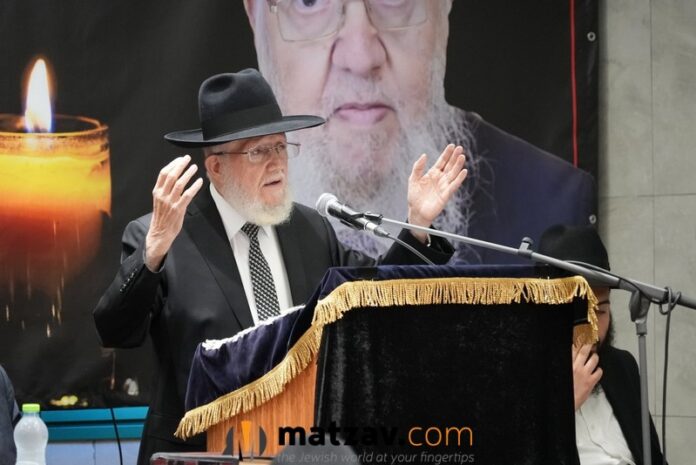
As Israel’s political system gears up for another election season and candidates position themselves as the country’s would-be saviors, Rav Tzemach Mazuz used his weekly shiur to deliver a pointed message about ambition, honor, and the limits of human effort.
Drawing on the lessons of this week’s parshah (in Eretz Yisroel), Parshas Korach, the Rosh Yeshiva connected the political maneuvering of the present day with timeless Torah teachings, offering a sharp critique of the relentless pursuit of power and what appeared to be a veiled jab at those determined to unseat Prime Minister Binyamin Netanyahu at all costs.
“There is nothing better than peace,” Rav Mazuz began. “Soon the election season will be here, and everyone wants to ‘save’ the country. Everyone wants to be prime minister. But Shlomo Hamelech already taught us in Koheles: ‘Hevel havalim, amar Koheles, hevel havalim, hakol havel.’”
The Rosh Yeshiva then cited the words of Chazal in Maseches Yoma, “Bimkomcha yoshivucha, u’mishelcha yitnu lach,” along with the verse in Mishlei, “Al tiga l’ha’ashir.” The message, he explained, is that a person is obligated to make only a reasonable effort and then place his trust in Hashem.
“There is no need to exhaust oneself and struggle excessively,” Rav Mazuz said. “A person must make some hishtadlus, but beyond a limited amount of hishtadlus, nothing more is required. This is the tradition we have received from our rabbeim.”
To illustrate the dangers of chasing status and honor beyond what Heaven has allotted, Rav Mazuz cited a famous parable from the Gemara in Sanhedrin.
“This is what people say: ‘The camel went to ask for horns, and in the end they cut off the ears that it already had.’”
The Rosh Yeshiva elaborated on the Gemara’s imagery with a smile.
“Anyone who has seen a camel knows that it is a tall and impressive animal, but it has one deficiency—its ears are small. The camel said to itself, ‘I am much taller than the ox. If the ox has horns, then I deserve even larger and more beautiful horns.’ In the end, not only did it fail to receive the horns it wanted, but even the ears it already possessed were taken away.”
He then applied the lesson directly to human behavior.
“What is the lesson? A person thinks that what he has is not enough. He fights and struggles for more and more. What does he gain in the end? Not only does he fail to receive what he sought, but even what he already had can be taken from him.”
Rav Mazuz pointed to Korach as the classic example of someone whose ambition led to ruin. Although Korach was already enormously wealthy and held a position of great distinction as one of those entrusted with carrying the Aron, he was not satisfied.
“That tremendous greatness was not enough for him,” Rav Mazuz said. “He set his sights on the Kehunah Gedolah and sought to overthrow Moshe and Aharon. But what happened in the end? Not only did he fail to become Kohen Gadol, not only did he cease being among those who carried the Aron, he did not even remain alive. The earth opened its mouth and swallowed him, his family, and all his possessions. Nothing remained. In the end, Korach lost everything.”
Concluding his remarks, Rav Mazuz delivered what many listeners viewed as a timely message for politicians and public figures caught up in the current political climate.
“From here we learn that a person must be happy with his portion and with what he has,” he said. “A person should remember: If something truly belongs to you, Hakadosh Baruch Hu will bring it to you on a golden platter. One may—and indeed should—make hishtadlus. But one must not wage war for it.”