
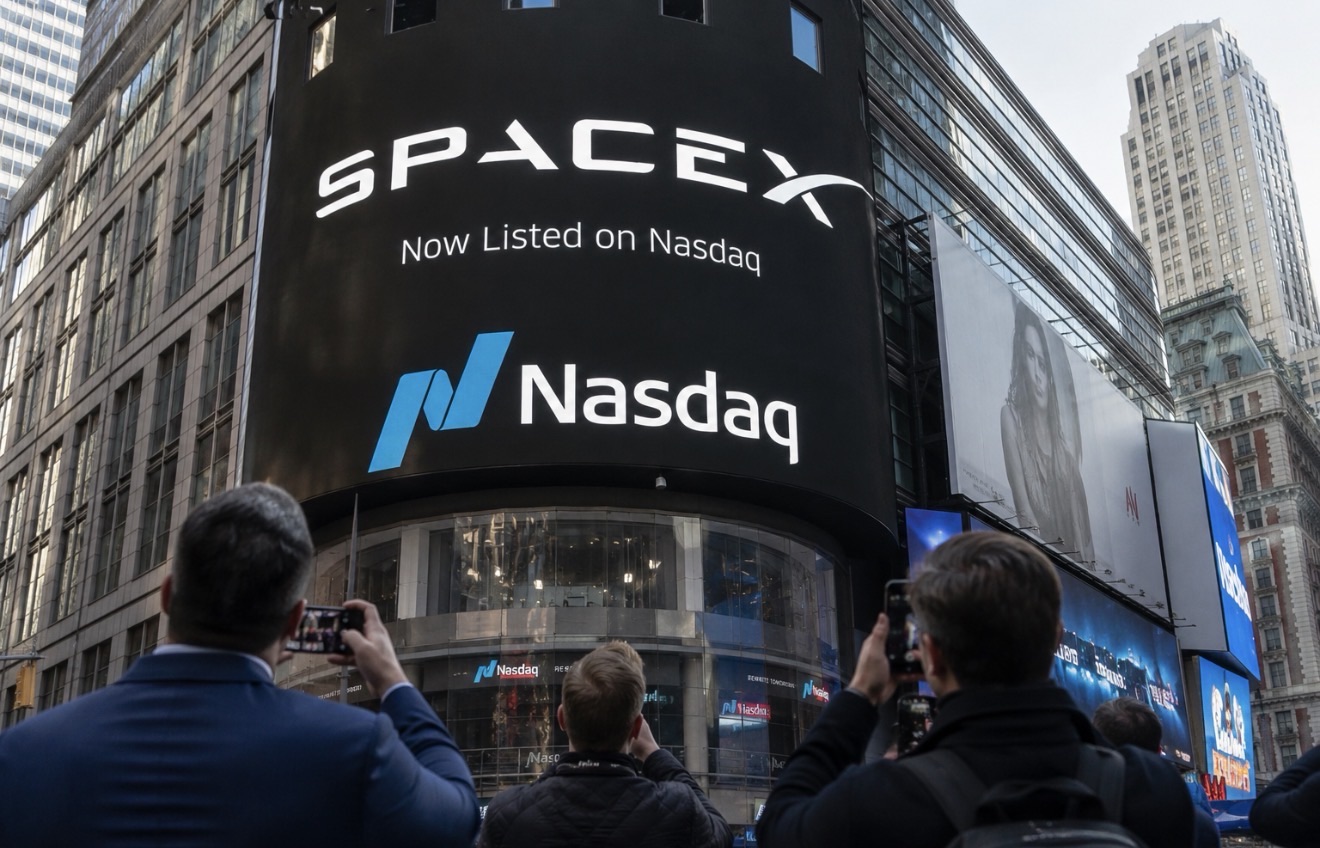

NEW YORK — SpaceX confirmed Friday that it had completed the largest stock-market debut in history, selling 555.6 million shares at $135 apiece to raise about $75 billion and listing on the Nasdaq under the ticker SPCX. The company’s filing with the Securities and Exchange Commission valued it near $1.77 trillion, instantly making it the sixth-largest public company in the United States.
But the sheer size of the deal did something Wall Street is still working through: it forced investors to sell other holdings to pay for it, tightening the supply of money available for every other stock.
The math is blunt. A $75 billion sale has to be paid for with $75 billion in real cash, and most of that cash was already parked inside other companies’ shares. To buy SpaceX, large funds and everyday investors had to sell something else first. That selling spread across the market in the days around the listing, and it arrived on top of an even larger pull on the world’s money — the race to build artificial intelligence.
That race has become the single biggest draw on cash anywhere.
Morgan Stanley estimates technology companies will spend about $740 billion building AI this year alone, a 69% jump from 2025, and expects the global total to climb toward $3 trillion over the next several years. Roughly half of that will have to be borrowed or raised rather than paid for out of profits. The bank expects AI-linked borrowing to approach $570 billion in 2026.
That is where the strain on banks starts to show.
For years, companies such as Microsoft, Amazon, Alphabet, and Meta funded their data centers and computing infrastructure largely through operating cash flow. Now costs are rising faster than earnings, pushing companies toward loans and bond offerings. The Bank for International Settlements warned in January that the AI boom is increasingly being financed through debt, with private lenders taking a growing share of the market.
The SpaceX offering put that pressure on display.
Five banks — Goldman Sachs, Morgan Stanley, Bank of America, Citigroup, and JPMorgan Chase — led the deal and collected roughly 85% of underwriting fees, with Goldman and Morgan Stanley each earning about $100 million. A syndicate of 21 banks backed the transaction.
The same institutions are expected to lead the next wave of mega-listings.
And that wave is enormous.
SpaceX, which acquired Elon Musk’s AI company xAI earlier this year, is only the first of three major offerings. Anthropic, maker of the Claude chatbot, confidentially filed for an IPO on June 1, while OpenAI, creator of ChatGPT, followed on June 8.
Together, the three companies carry an estimated combined valuation of $3.6 trillion — larger than the total value of all companies that went public during 2021, the busiest IPO year on record.
Each offering will require fresh capital from the same pool of investors.
There are already signs of how interconnected the AI ecosystem has become. SpaceX disclosed that much of its newly raised capital will be directed toward AI computing infrastructure and that it has agreed to lease computing capacity to Anthropic for approximately $1.25 billion per month through 2029.
In other words, money raised in one AI offering is already flowing directly into the operating costs of another.
Retail investors showed little hesitation.
SpaceX became the most-purchased stock among individual investors on Friday, with demand reportedly exceeding available shares by more than ten-to-one.
But that enthusiasm comes with risk.
Ethan Feller, a strategist at Zacks Investment Research, warned that the biggest threat is not any single valuation, but what happens if investor appetite for AI suddenly fades.
If capital stops flowing into the sector, prices could decline sharply across multiple companies at once.
The connection is also closer to home than many investors realize. While most Americans cannot buy Anthropic or OpenAI shares at IPO prices, millions already own indirect stakes through retirement accounts that hold Amazon, Alphabet, and Microsoft, all of which are major investors in leading AI firms.
For now, SpaceX’s record-setting debut has opened the door for the offerings behind it.
The question for the remainder of 2026 is whether investors still have the cash — and the appetite — to absorb OpenAI and Anthropic when their turn arrives.
Wall Street — JBizNews Desk
© JBizNews.com. All Rights Reserved. Reproduction or distribution without written permission is prohibited.