
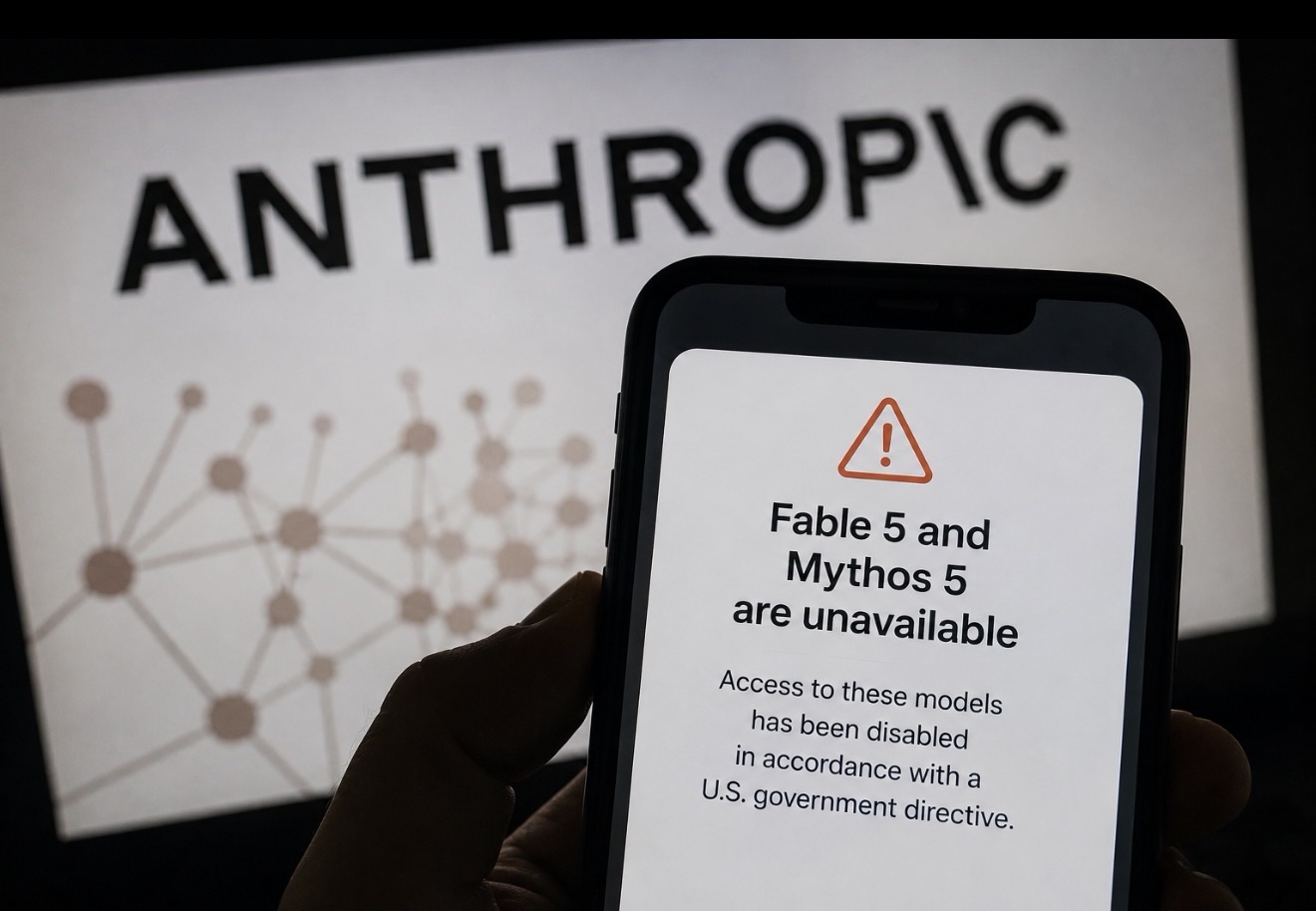

Anthropic said Friday that it disabled access to its two most powerful artificial-intelligence models, Fable 5 and Mythos 5, to comply with an export-control directive from the U.S. government that cited national-security authorities. The company disclosed the move in a public statement, saying the order arrived at 5:21 p.m. Eastern and required immediate action.
The directive was narrow on paper but sweeping in effect. Anthropic said it was instructed to block access for any foreign national, whether inside or outside the United States, including foreign-national employees of the company. Because Anthropic said it cannot reliably screen users by nationality in real time, it concluded the only way to comply was to disable both models entirely.
Access to the company’s other AI systems remained available. Anthropic said users would be routed to alternative models, including Claude Opus 4.8, while the restrictions remain in place.
The timing was particularly significant because Anthropic had launched Fable 5 and Mythos 5 only days earlier, positioning them as among the most capable AI models it had ever developed. According to the company, Fable 5 was the first model of its capability level released broadly to the public, while Mythos 5 was available only through limited government and enterprise partnerships.
According to Anthropic, the suspension order came through a directive from the Commerce Department involving the Bureau of Industry and Security. The company said it received little detail regarding the underlying national-security concerns that prompted the action.
Anthropic stated that its understanding is that the government’s concerns stem from a reported technique capable of bypassing certain safeguards within Fable 5. The company disputed the significance of the issue, arguing that the reported vulnerability involved only a limited number of previously known weaknesses and did not justify removing the model from service entirely.
The company nevertheless complied with the directive while publicly challenging its rationale.
Anthropic argued that governments should retain authority to intervene when AI systems create genuine safety risks, but maintained that such actions should occur through a transparent process supported by clear technical evidence and established legal standards.
The company said it is working with federal officials in an effort to restore access as quickly as possible.
The episode could represent a significant precedent for the AI industry.
While governments around the world are actively debating how advanced artificial-intelligence systems should be regulated, direct intervention resulting in the removal of publicly available frontier models remains rare. The decision immediately affects developers, businesses, and organizations that had begun integrating the newly released models into their operations.
For corporate users, the incident highlights a growing risk associated with reliance on advanced AI platforms: the possibility that government action, regulatory intervention, or national-security reviews could affect access with little warning.
The dispute also arrives at a time when AI companies face increasing scrutiny from policymakers concerned about cybersecurity, biological threats, intellectual property, export controls, and geopolitical competition.
For investors, the situation introduces another variable into evaluating AI companies and their business models. As artificial intelligence becomes increasingly tied to national-security considerations, regulatory risk may become just as important as technological capability when assessing future growth.
For now, two of Anthropic’s most advanced AI systems remain offline, the company continues to challenge the reasoning behind the order, and the broader technology industry is watching closely to see whether the models return — and what conditions may be attached to their return.
JBizNews Desk — Technology
© JBizNews.com All Rights Reserved. Reproduction or distribution without written permission is prohibited.