
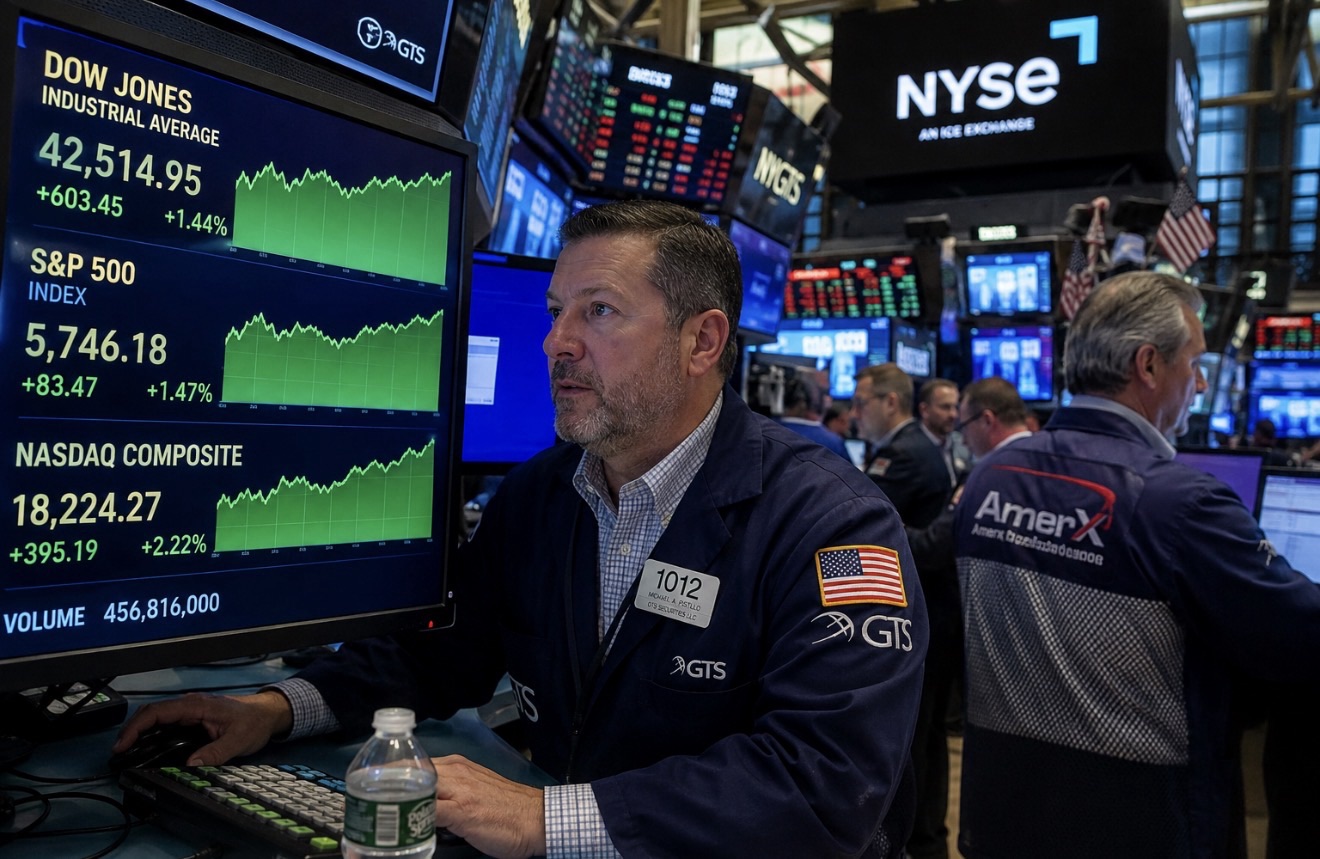

Stocks climbed and oil prices fell sharply Monday morning as Wall Street welcomed the weekend agreement to end the war between the United States and Iran and reopen the Strait of Hormuz. Speaking on CNBC, Vice President JD Vance said the administration expects the vital waterway to reopen “in a toll-free way for the long term,” with technical details still to be finalized. The agreement, which President Donald Trump declared “complete” in a Sunday evening social media post, sparked a broad market rally as investors moved quickly to remove the war premium that had pushed energy prices higher for months.
Shortly after the opening bell, the Dow Jones Industrial Average rose about 600 points, or 1.2%. The S&P 500 gained 1.5% to around 7,546, while the tech-heavy Nasdaq Composite led major indexes with a jump of roughly 2.3%. Smaller companies also participated in the rally, with the Russell 2000 moving higher. Treasury bonds gained, sending yields lower, while the U.S. dollar weakened against most major currencies.
The market reaction reflects expectations that lower oil prices could ease inflation pressures and reduce economic uncertainty. Energy costs became one of the most visible consequences of the conflict, contributing to a rise in consumer prices and increasing pressure on businesses and households alike.
The agreement also launches what promises to be a busy week for investors. The Federal Reserve begins its first policy meeting under new Chair Kevin Warsh on Tuesday, with a decision expected Wednesday. Most economists anticipate the central bank will leave interest rates unchanged in the 3.50% to 3.75% range, but markets will focus on any signals regarding inflation and future rate cuts.
Several key economic reports are also due this week, including housing and retail sales data. U.S. markets will be closed Friday in observance of the Juneteenth holiday. Meanwhile, Pakistan Prime Minister Shehbaz Sharif said an official signing ceremony for the Iran agreement is expected to take place Friday in Switzerland.
SpaceX Remains Center Stage
Among individual stocks, SpaceX remained one of the market’s biggest stories. Shares climbed roughly 6% Monday after surging 19% during Friday’s debut. The company’s public offering valued the aerospace giant at more than $2 trillion, making it one of the most valuable companies in the world.
Over the weekend, CEO Elon Musk posted on X that SpaceX could generate more than $1 trillion in annual revenue by 2030, adding to investor enthusiasm.
Wall Street remains divided on the stock’s valuation. Wolfe Research initiated coverage with a $175 price target, while CFRA issued a Sell rating with a $115 target. Morningstar estimated the company’s value at approximately $780 billion, arguing the stock is significantly overvalued and expressing concerns about Musk’s merger of SpaceX with artificial intelligence startup xAI.
The broader space sector also benefited from the excitement. Rocket Lab rose about 4% after KeyBanc Capital Markets upgraded the company to Overweight with a $135 price target. KeyBanc also upgraded Firefly Aerospace to Overweight and assigned a $50 target.
Energy Stocks Fall as Oil Retreats
Energy companies were among the market’s weakest performers as crude prices dropped.
APA Corp. and Devon Energy each fell more than 3.5%, while Marathon Petroleum and EOG Resources lost roughly 3%. Oil giants Chevron and Exxon Mobil declined more than 2.5%.
The decline reflected the sharp drop in crude prices after the reopening of the Strait of Hormuz reduced fears of supply disruptions.
At the same time, lower fuel prices boosted sectors that depend heavily on transportation costs. Airline and cruise company shares moved higher as investors anticipated relief from elevated jet fuel and marine fuel expenses.
Other Market Movers
Traws Pharma dropped approximately 17% after British regulators delayed a mid-stage clinical trial, disappointing investors who had hoped for faster progress.
Meanwhile, Madison Square Garden Sports gained ground following the New York Knicks’ first NBA championship since 1973, as enthusiasm surrounding the franchise boosted investor sentiment.
In commodities trading, West Texas Intermediate crude oil fell about 5% to near $80 per barrel, while international benchmark Brent crude dropped nearly 5%. Both remain well below the levels above $100 per barrel reached during the height of the conflict.
Bitcoin climbed above $66,000, reflecting renewed investor appetite for risk assets.
Despite the optimism, traders note that the agreement has not yet been formally signed. Weekend exchanges of fire between Israel and Hezbollah highlighted how fragile the ceasefire remains, and President Trump has warned all parties against actions that could derail the process.
For now, however, financial markets are sending a clear message. With oil flowing again and fears of a broader regional conflict easing, investors are betting that the worst of the crisis is over — and that Friday’s planned signing ceremony in Switzerland will confirm it.
Wall Street – JBizNews Desk
© JBizNews.com All Rights Reserved. Reproduction or distribution without written permission is prohibited.