
 Matzav
Captured Hamas Documents Reveal Another Motive Behind October 7 Massacre
Newly uncovered Hamas documents seized in Gaza suggest that, beyond the group’s murderous assault on Israeli civilians, a central objective of the October 7 attack was to derail the rapidly advancing normalization process between Israel and Saudi Arabia.
The documents, analyzed by the Amit Intelligence and Terrorism Information Center and revealed Sunday by Kan 11, shed light on internal Hamas discussions in the months and years leading up to the massacre carried out on Simchas Torah 5784. According to the findings, Hamas leadership viewed Saudi-Israeli normalization as a major strategic threat and sought ways to prevent it.
The records indicate that in February 2022—approximately 20 months before the October 7 attack—Hamas leaders in Gaza convened a meeting and approved the creation of a dedicated office tasked with managing what they described as the struggle against normalization.
According to minutes from the meeting, the office would be responsible for shaping strategy, ideology, policy, and operational plans related to opposing normalization efforts, while coordinating implementation across various branches of the organization.
One recommendation contained in the documents stated that Hamas should work to intensify unrest in Gaza, Yehudah and Shomron, and Yerushalayim in order to disrupt the normalization process between Saudi Arabia and Israel.
Another document emphasized the importance of violence on the ground as a tool for undermining diplomatic progress. It argued that the Second Intifada had played a decisive role in derailing earlier normalization initiatives connected to the Arab Peace Initiative and suggested similar tactics could once again prove effective.
The documents further reveal that as 2023 progressed, Hamas leaders increasingly concluded that their efforts to halt normalization were failing to achieve the desired results.
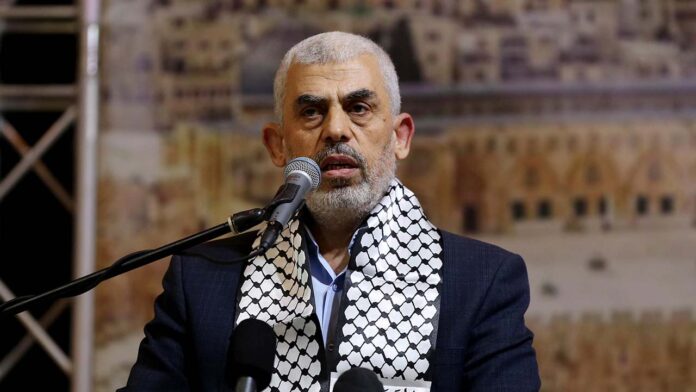
According to the report, just two weeks before the October 7 attack, Hamas leaders held a crucial meeting devoted to the issue. During that session, then-Hamas leader Yahya Sinwar presented a position paper titled “Confronting the Saudi-Israeli Normalization Process.”
Minutes from the meeting quote Sinwar as declaring: “Normalization is an entirely evil disease, and there is no difference between one country and another in normalization. However, Saudi Arabia has a special status on the Arab and Islamic level and great influence, and this is a regrettable, troubling, reprehensible and bewildering step.”
Sinwar also launched a sharp attack on Saudi Crown Prince Mohammed bin Salman, stating: “Bin Salman seeks to establish his image as the leader of the region at the expense of all countries, including Egypt. Leadership of the region must pass through the Israeli gate in understanding with the Americans. His growing ambitions and political madness have implications for our issue and for the region, and herein lies the danger of this step.”
According to the documents, Sinwar argued that Hamas had a responsibility to strike Israel and send a message to nations pursuing normalization. He reportedly stated: “We will have a role in striking the Zionist enemy and sending a message to the normalization partners—that the Israeli occupation is not an oasis of security and stability. We may not succeed in stopping the move, but we will disrupt it and strip it of legitimacy.”
The documents also reveal that Hamas leadership held another pivotal meeting on October 2, 2023—five days before the massacre. It was reportedly the final leadership session before the attack.
During that meeting, Sinwar described Saudi-Israeli normalization efforts as a development that would lead to what he called “regional deterioration.”
His conclusion, according to the records, was that the advancing diplomatic process left Hamas with no alternative but to undertake what he termed an “extraordinary action.”
Sinwar reportedly declared: “There is no escaping an extraordinary action by the movement and the forces of the resistance axis to create a major shift or strategic turning point in the trajectories and balances of the region, regarding the Palestinian issue and confronting normalization and the collapse of the region.”
Five days later, Hamas launched its unprecedented assault on Israel.
Since the outbreak of the war, efforts to normalize relations between Saudi Arabia and Israel have effectively been frozen, a reality that continues to this day.
{Matzav.com}