
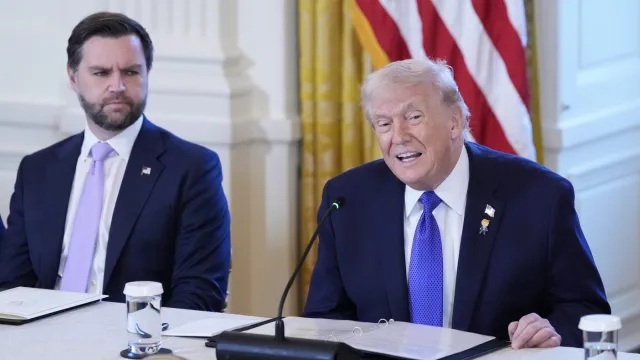

The United States and Iran have taken the first formal step toward a broader agreement, with President Trump and Vice President Vance electronically signing a memorandum of understanding on Sunday alongside Iranian Parliament Speaker Mohammad Bagher Qalibaf, according to senior U.S. officials.
Officials said the contents of the memorandum are expected to be made public within the next 24 to 48 hours.
While describing the agreement as significant, administration officials stressed that it serves only as an opening framework. One official said the next phase will involve “real technical discussions,” which are scheduled to begin later this week under Vance’s leadership.
Speaking Monday on ABC’s “Good Morning America,” Vance emphasized that any economic benefits for Iran would depend entirely on Tehran fulfilling its commitments.
“We’ll be releasing the text this week, and what everybody will see is that Iran doesn’t get a dime of money unless they perform their obligations, and the money that we’re talking about is fundamentally sanctions relief,” Vance said in an interview with ABC’s “Good Morning America” on Monday.
President Trump delivered a similar message while attending the G7 summit in France alongside French President Emmanuel Macron. Trump indicated that the complete agreement would likely become public “sometime after Friday.”
A formal signing ceremony for the document is scheduled to take place Friday in Geneva, Switzerland. Vance and Jared Kushner, Trump’s son-in-law, are expected to attend, while Trump suggested he does not plan to be present.
During a briefing with reporters, administration officials said the United States will keep its military presence in the region unchanged throughout the 60-day negotiating window.
One official noted that commercial activity through the Strait of Hormuz has already begun increasing and is expected to continue expanding gradually. According to the official, traffic through the strategic waterway will “ramp up slowly over time.”
Officials also confirmed that Iran has not yet received any frozen assets currently held by the United States or other nations.
“We are prepared to release frozen funds, and we are prepared to release sanctions,” one official said. “And we’ll do some small gestures of that in the beginning, if they make some small gestures to us that show that they’re willing to meet their commitments as well.”
Another administration official dismissed speculation that separate arrangements could be made with Gulf countries to provide Iran with access to funds outside the framework of the agreement.
“They’re very supportive of this,” the official said, calling the idea “not just unlikely, but preposterous.”
Officials further clarified that the agreement does not require Israel to withdraw its forces from Lebanon.
“The deal is a ceasefire, and it will not be a one-way ceasefire, meaning that if Iran is not able to control Hezbollah, and if they attack, you know, Israeli positions or Israeli towns, Israel will have the right to defend themselves and respond,” the official said.
Despite the challenges ahead, administration officials expressed confidence that the negotiations could reshape regional dynamics and lead to broader stability.
But optimism was also expressed that “we can find a way to create a new framework for the region based on modern times, modern aspirations.”
{Matzav.com}