
 Yeshiva World News
“UNTHINKABLE”: Conservative Mark Levin Eviscerates Iran Agreement Point By Point In Scathing Takedown
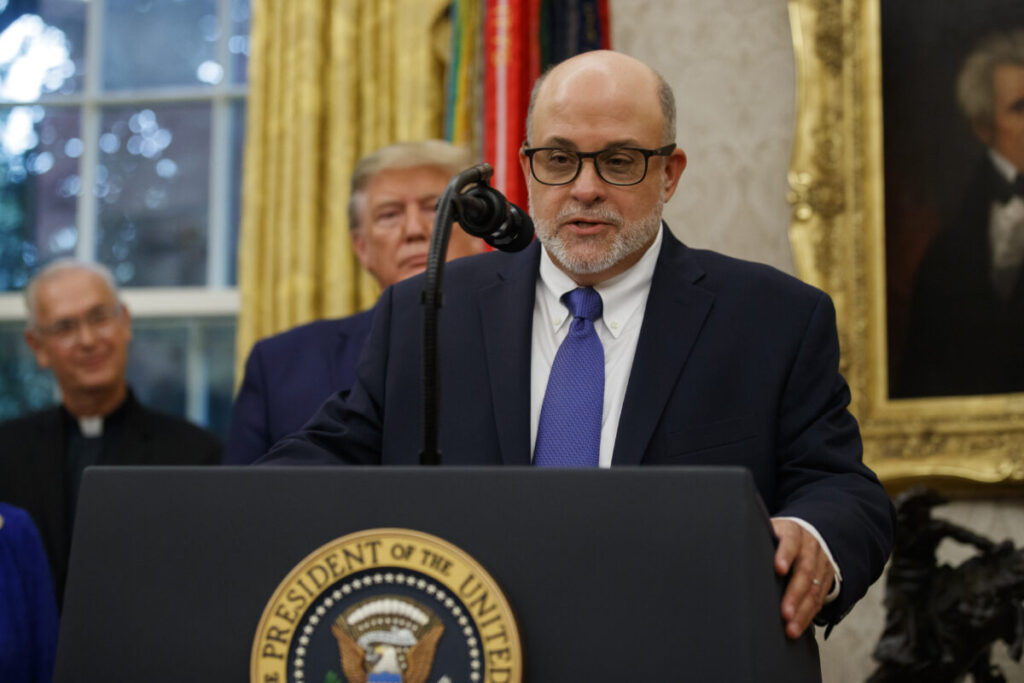
Fox News host Mark Levin delivered a blistering, point-by-point indictment of the emerging U.S.-Iran agreement Wednesday, warning that the memorandum of understanding abandons America’s strongest leverage, funnels billions of dollars back to Tehran and offers only vague promises on the nuclear threat that prompted the war in the first place.
In a lengthy social media post following the formal release of the memorandum, Levin praised President Donald Trump for launching the military campaign against Iran, but argued that Washington now risks negotiating away the victories secured on the battlefield.
Levin noted that the opening phase of the war inflicted severe damage on Iran’s military and demonstrated a level of resolve no previous president had shown. But that momentum was interrupted by a ceasefire that remained in place for more than two months despite repeated alleged violations by Iran and Hezbollah.
The United States briefly resumed military operations for two days when Tehran resisted signing the memorandum, Levin said, only to halt them again after the regime promised to accept the framework.
Now, he warned, Iran is poised to receive immediate economic and strategic benefits before a final agreement is reached — and before its nuclear program is permanently dismantled.
“The Iranian regime is back in business — immediately,” Levin wrote.
Levin’s first major objection concerned the memorandum’s declaration of an immediate and permanent end to military operations, including in Lebanon.
The contradiction, he argued, is glaring: The parties have given themselves at least 60 days to negotiate a final agreement, yet Washington is already promising to end the war and refrain even from threatening force. That strips the United States of its most powerful bargaining tool before Iran has fulfilled the memorandum’s requirements or agreed to the final nuclear terms.
“Why would we agree to immediately drop the most important leverage we have over the regime?” Levin asked.
He was especially outraged by the inclusion of Lebanon, arguing that the provision effectively protects Hezbollah from further military pressure. Hezbollah has killed hundreds of Americans and remains Iran’s most formidable regional proxy, Levin noted. Yet the United States, under the memorandum’s terms, appears prepared to support an end to operations against the group while it remains armed and capable of attacking Israel and American interests.
Levin argued that Israel cannot reasonably be expected to accept such a restriction while its citizens remain exposed to Hezbollah’s missiles and drones.
The memorandum also requires the United States to remove its naval blockade within 30 days of signing — not after a final agreement is completed. Levin characterized that as another unilateral surrender of leverage.
Washington would also agree to withdraw forces from Iran’s vicinity within 30 days after the final deal. Although those forces could theoretically be redeployed, Levin questioned whether any future administration would have the political will to send them back.
That concern runs through his entire critique: Once sanctions are lifted, forces are withdrawn and money begins flowing, restoring pressure would be far more difficult than removing it.
Levin warned that Trump may be uniquely willing to use military force against Iran, but a successor may not act with the same resolve if Tehran violates the agreement.
Among the most astonishing provisions, Levin said, is the American commitment to help develop a reconstruction and economic plan worth at least $300 billion for Iran.
Administration officials have stressed that the money would not come directly from U.S. taxpayers and would depend on Iran meeting certain conditions. Levin dismissed that defense as a distraction. The central issue, he argued, is not whether the money comes from the U.S. Treasury. It is why the United States would coordinate or facilitate hundreds of billions of dollars for the same regime it had just gone to war to stop from obtaining a nuclear weapon.
The memorandum’s language, he said, does not guarantee that Iran will be permanently denied the money if it temporarily complies and later violates the final agreement.
Nor does Levin believe the funds would materially improve the lives of ordinary Iranians. The Islamic Republic continues to brutally suppress its population, he said, and there is little reason to believe a massive reconstruction fund would be directed toward those suffering under the regime rather than toward preserving the regime itself.
Levin called the provision a disguised substitute for Iran’s demand for reparations — a demand he said should have been rejected outright.
“Here we are committing to helping reconstruct the terror regime we presumably just destroyed,” he wrote.
The agreement calls not only for ending U.S. sanctions, but for Washington to help remove international restrictions imposed through the United Nations, the International Atomic Energy Agency and other institutions. That would transform the United States from the architect of economic pressure into an advocate for Tehran’s global rehabilitation, Levin argued.
Even more consequentially, several forms of relief would begin immediately. Upon signing the memorandum, the United States would issue waivers allowing Iran to export crude oil, petroleum products and related services, including banking, insurance and transportation. That means Tehran could begin earning billions of dollars before a final deal is negotiated.
The agreement would also release Iran’s frozen or restricted funds and make those assets fully available. Again, the benefits are immediate. The nuclear concessions are not.
The memorandum states that Iran reiterates it will never produce nuclear weapons. For Levin, that assurance is nearly meaningless. The Iranian regime has spent decades deceiving international inspectors, concealing nuclear activities and using negotiations to delay pressure while advancing its strategic objectives, he argued.
Yet the memorandum fails to spell out, in concrete terms, how Iran’s nuclear infrastructure will be dismantled, how its enriched uranium will be destroyed or how violations will trigger automatic consequences. Instead, the fate of the enriched material and other nuclear issues will be determined through future negotiations.
Levin said the nuclear question should have been the agreement’s first and most detailed provision. Instead, it appears deep in the document and relies heavily on broad language and unresolved mechanisms.
“This was supposed to be the core of everything,” he wrote.
The United States went to war, Levin stressed, because Iran was believed to be dangerously close to obtaining a nuclear weapon. But the agreement gives Tehran sanctions relief, oil revenue, frozen assets and a path toward massive reconstruction funding before securing the permanent elimination of that threat.
While the final agreement is negotiated, Washington promises not to impose new sanctions or strengthen its military forces in the region. Levin argued that this gives away still more leverage at the moment it is most needed. Iran, meanwhile, is asked to maintain the status quo of its nuclear program.
The result, he warned, is an arrangement in which the United States repeatedly binds its own hands while relying on assurances from a regime with a long history of violating agreements.
Levin rejected the idea that a negotiated document could fundamentally change Iran’s conduct. The regime’s revolutionary ideology, he argued, views conflict with the West not as a temporary policy dispute but as a defining mission. Negotiations are therefore a tactic, not evidence of moderation.
Levin also highlighted what the memorandum does not address. There is no provision dealing with Iran’s ballistic-missile arsenal, despite the destructive power of those weapons and Tehran’s willingness to use them. There is no meaningful demand that Iran stop financing and directing terrorist groups. There is no clear commitment to support the Iranian people, whom the United States had pledged to help at the beginning of the conflict. And there is no requirement that Iran compensate the United States, Israel or Arab countries for the destruction caused by its missiles and proxies.
Those omissions, Levin argued, expose the fundamental weakness of the framework.
The memorandum offers Iran relief from military, economic and diplomatic pressure while leaving its missiles, terror networks and internal repression largely untouched.
Levin acknowledged Trump’s courage in launching the military operation and inflicting damage on Iran’s capabilities. But his praise made his warning more pointed: The United States now risks converting a battlefield victory into a diplomatic rescue package for the enemy it had weakened.
Levin maintained that there was never a plan for American ground troops or an endless occupation. The alternative to this memorandum, he argued, was not necessarily a “forever war,” but the continued destruction of Iran’s military and regime capabilities.
Unless the document is fundamentally rewritten during the coming negotiation period, he warned, the lasting war will be the one Iran has already been waging against the West through terrorism, missiles, proxies and nuclear blackmail.
“During the next 60 days, this MOU requires serious changes, if not outright abandonment,” Levin concluded.
(YWN World Headquarters – NYC)