
 JBizNews
Goldman Flags Student Shift Toward AI Majors as Labor Market Reprices Degrees
Julia Parker – JBizNews Desk
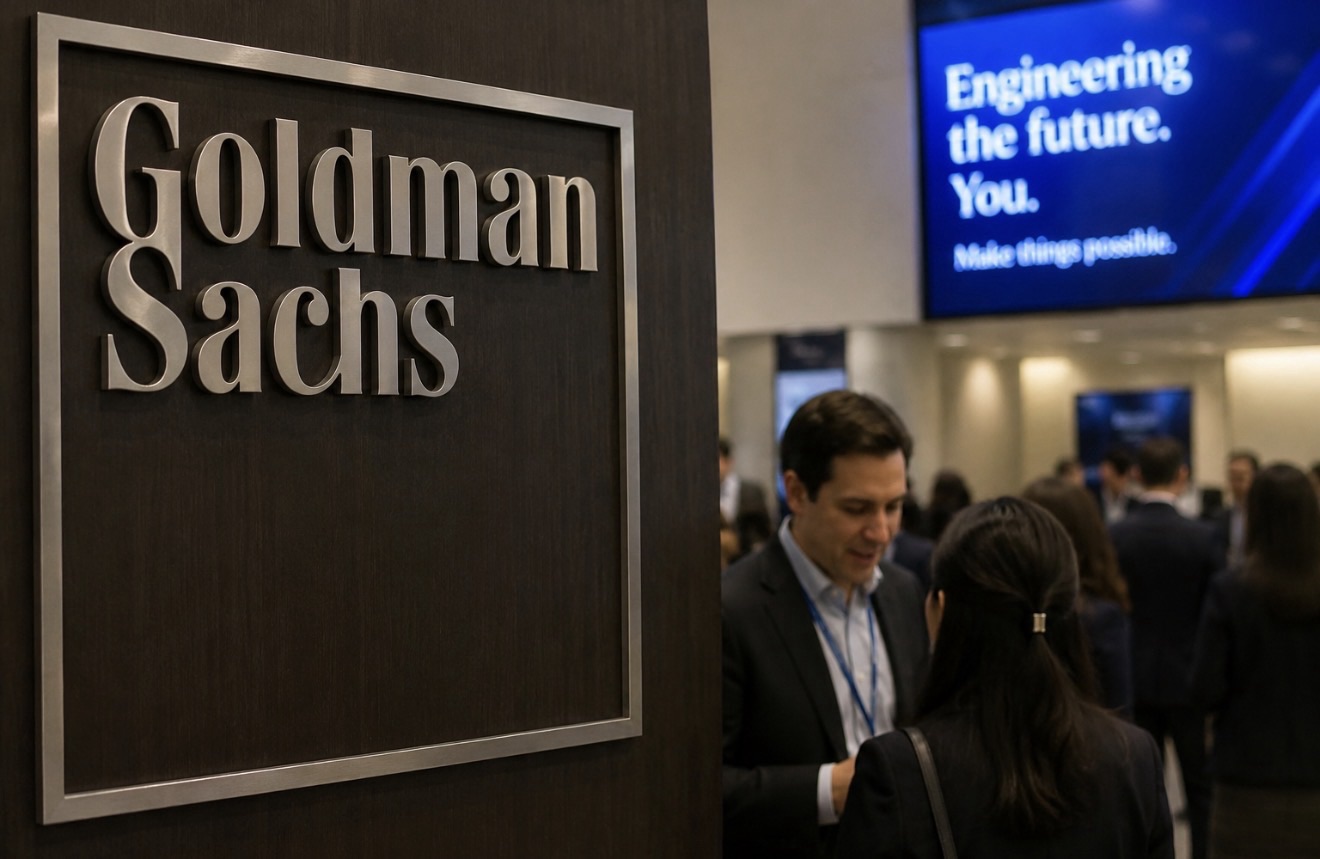
The college major, long treated as a personal credential and a cultural marker, now looks more like an early career trade tied to artificial intelligence exposure, according to Goldman Sachs, which described student choices as a signal that young workers already price the technology into lifetime earnings decisions.
The scale of the shift shows up in enrollment data: National Center for Education Statistics figures show U.S. bachelor’s degrees in computer and information sciences more than doubled from roughly 48,000 in 2012 to more than 108,000 in 2022, while Goldman Sachs has linked that migration to a broader repricing of skills around generative AI.
That comparison matters because students increasingly treat majors as an investment decision rather than a fixed identity, according to Goldman Sachs, whose economists have said generative AI could lift global gross domestic product by 7% and expose the equivalent of 300 million full-time jobs to automation.
The original undergraduate bargain looked simpler: choose a field, obtain a credential and enter a labor market that rewarded degree completion broadly, according to National Center for Education Statistics, which tracks degree production across disciplines and shows how technology programs gained share during the past decade.
That realization changed the economics of campus choice, according to Bureau of Labor Statistics, which projects software-developer employment growth of 17% from 2023 to 2033 and data-scientist employment growth of 36%, far above the agency’s projection for total employment growth.
The inflection point arrived when artificial intelligence moved from research labs into consumer and corporate tools, according to Stanford University, whose AI Index has said industry now dominates advanced AI model development and private capital continues to cluster around machine learning infrastructure and applications.
Large technology companies reinforced that message, according to Microsoft, which has described AI copilots as a core layer across enterprise software, and OpenAI, whose public releases accelerated student awareness that coding, statistics and domain knowledge could combine into a new premium skill set.
Employers then supplied the market confirmation, according to Bureau of Labor Statistics, whose occupational data show computer and mathematical roles carrying median pay well above national averages, giving students a clearer numerical basis for shifting from lower-return majors into AI-adjacent programs.
Universities have responded by expanding data-science, analytics and computational social-science offerings, according to National Center for Education Statistics, whose degree classifications show a broad increase in computer-related awards rather than a narrow boom limited to traditional computer science.
The demand surge also reflects corporate capital spending, according to Goldman Sachs, which has said AI investment could approach a scale large enough to influence productivity, cloud demand and semiconductor supply chains, making undergraduate talent pipelines relevant to investors tracking long-cycle technology adoption.
That investor connection runs through Nvidia, which has said demand for accelerated computing and AI infrastructure has driven record data-center revenue, turning what students see in classrooms into the human-capital side of one of the equity market’s dominant growth themes.
Still, the path upward contains risk, according to Goldman Sachs, which has cautioned that AI can automate tasks inside high-skill occupations even as it creates new demand for workers capable of deploying, supervising and integrating the technology.
That tension has fed skepticism among students and parents, according to Bureau of Labor Statistics, whose projections imply strong demand for technical roles but do not eliminate cyclical hiring risk in technology, where graduate timing can collide with layoffs, start-up funding pullbacks and changing corporate budgets.
The middle of the market looks especially vulnerable, according to Goldman Sachs, whose research has emphasized that generative AI affects cognitive work rather than only routine physical labor, challenging the old assumption that any white-collar degree provides durable insulation from automation.
For that reason, the emerging campus trade favors hybrid majors, according to Stanford University, whose AI Index highlights demand for AI literacy across industries, suggesting that economics, biology, engineering, finance and law programs may gain value when paired with statistics and computation.
Financial firms see the same pattern inside their own workforces, according to Goldman Sachs, which has described AI as a productivity tool for knowledge workers, implying that future analysts, bankers and portfolio managers may need technical fluency even when their formal degree sits outside computer science.
The practical question for students now concerns option value, according to Bureau of Labor Statistics, whose wage and growth data suggest majors tied to software, data architecture, cybersecurity and applied analytics offer wider career paths than programs with weaker links to expanding digital capital budgets.
But a narrow coding-only strategy carries its own limitation, according to Goldman Sachs, which has said productivity gains depend on organizational adoption, meaning students who combine technical training with business judgment, regulation, health care or industrial expertise may command a more durable premium.
The current market position of AI education resembles an early-cycle infrastructure buildout, according to Stanford University, whose AI Index frames the technology as a general-purpose platform with investment, talent and model development feeding one another across corporate and academic systems.
That creates a feedback loop for universities, according to National Center for Education Statistics, whose degree data imply that student demand can pressure schools to redirect faculty hiring, course capacity and capital budgets toward computing-heavy programs.
For investors, the enrollment shift offers a human-capital indicator, according to Goldman Sachs, which has connected AI adoption to productivity and growth potential, making student major selection a modest but telling signal for labor supply in technology-intensive sectors.
The broader lesson reaches beyond campus, according to Goldman Sachs: AI has turned education into a forward-looking allocation of risk, time and earning power, and students now move accordingly before labor markets fully settle the final price of the new technology cycle.
JBizNews Desk