
 Matzav
Somaliland President: “I Wrote to 193 Countries Seeking Recognition — Only Israel Responded”
Somaliland President Abdirahman Mohamed Abdullahi revealed that after reaching out to every member state of the United Nations seeking recognition for his country’s independence, only one nation responded: Israel. He now says ties between the two countries are rapidly expanding and has left open the possibility of future Israeli military cooperation on Somaliland territory.
In an interview with The Jerusalem Post, Abdullahi said that on May 17, 2025, he sent letters to the leaders of all 193 UN member states requesting formal recognition of Somaliland as an independent nation.
“Only one of them answered,” Abdullahi said. “It was Israeli Prime Minister Benjamin Netanyahu. After that, we reached the conclusion that Israel would recognize Somaliland.”
Somaliland, a self-governing territory of approximately six million people located in the Horn of Africa, declared independence from Somalia in 1991 following the collapse of Somalia’s central government. Despite functioning independently for decades, it has remained largely unrecognized by the international community.
That changed on December 26, 2025, when Prime Minister Netanyahu announced that Israel would formally recognize Somaliland, making Israel the first UN member state to do so.
This week, Abdullahi arrived in Israel for an official visit, the first by a Somaliland president since recognition was granted. He disclosed, however, that he had previously traveled to Israel in secret.
“I came discreetly in October 2025. At that time, we were exploring ways and means to secure recognition for Somaliland,” he said.
During his visit, Abdullahi held meetings with Netanyahu and Foreign Minister Gideon Sa’ar, both of whom played central roles in advancing contacts between the two governments.
The Somaliland leader said he hopes to broaden cooperation with Israel across a wide range of fields, including economic development, natural resources, agriculture, water management, healthcare, education, energy, and security.
Since Israel’s recognition of Somaliland, foreign media outlets have repeatedly speculated that Israel could eventually establish a military presence there due to the territory’s strategic location along the Gulf of Aden, directly across from Yemen and near the Bab el-Mandeb Strait, a crucial maritime route for vessels traveling to Eilat.
“We have not discussed that,” Abdullahi told The Jerusalem Post. Nevertheless, he did not dismiss the possibility.
“I cannot rule out the possibility that it could happen in the future. If our cooperation continues to deepen, our relationship may evolve far beyond where it stands today.”
Israeli officials say practical cooperation is already underway, particularly in the field of water management.
“We identified many areas where they need support, but we identified water management as the most important because it is a field where significant change can be achieved relatively quickly,” Einat Shlein, a senior official at Israel’s international development agency within the Foreign Ministry, told The Jerusalem Post.
Even before the war with Iran, 25 water engineers from Somaliland traveled to Israel for advanced training in water-resource management. Shlein noted that Somaliland has also requested Israeli assistance in healthcare.
“We funded the arrival of children suffering from heart disease through the Save a Child’s Heart organization. There will be cooperation in many sectors — whether agriculture, energy or education — to reflect the importance of the connection between our two countries.”
As part of his visit, Abdullahi also met with a large group of Israeli business leaders and investors, describing overwhelming interest in Somaliland’s economic potential.
“There was so much interest that many businesspeople who wanted to attend could not be accommodated, and we had to limit participation to only 200 companies,” he said.
The president highlighted Somaliland’s natural resources and investment opportunities.
“We have many opportunities to offer — mineral resources, natural gas, oil, fishing and livestock. There is much that we can bring to the table.”
While acknowledging criticism from some countries, particularly in the Arab world, following Israel’s recognition of Somaliland, Abdullahi expressed confidence that additional nations would eventually follow suit.
“We hope that our relationship with Israel will continue to strengthen, and I believe that more Arab countries will eventually recognize us.”
He said the visit generated tremendous international attention.
“The entire world followed my visit to Israel; millions of people watched,” Abdullahi said. “The very exposure Somaliland received is a major achievement. Israel and Somaliland are close partners, and the relationship between us will continue and grow even stronger.”
Asked whether Netanyahu would one day visit Somaliland, Abdullahi expressed confidence that such a trip would occur.
“Netanyahu will come to Somaliland at the right time. In the meantime, the relationship between us will continue to flourish.”
One of the most notable examples of humanitarian cooperation between Israel and Somaliland dates back to 2004, when Somaliland’s representative in Ethiopia approached the Israeli Embassy seeking help for his son, who suffered from a serious heart condition. The request led the Israeli Foreign Ministry to connect the family with the Save a Child’s Heart organization, which provided life-saving treatment in Israel.
Since then, the Foreign Ministry has continued supporting the initiative, helping bring 58 children from Somaliland to Israel for critical cardiac treatment.
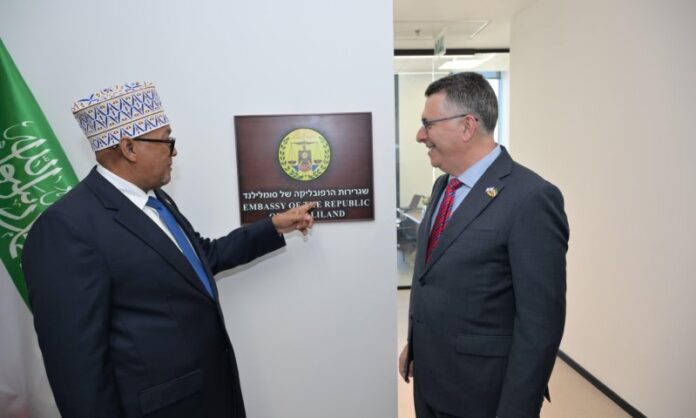
The humanitarian partnership began more than two decades before formal diplomatic ties were established. The political breakthrough that eventually led to recognition was accelerated by Foreign Minister Gideon Sa’ar’s historic visit to Somaliland in January 2026, which paved the way for the opening of Somaliland’s embassy in Jerusalem earlier this week.
The latest group of children, ranging in age from three months to 18 years old, arrived in Israel following a medical mission to Somaliland organized and funded by Israel’s national aid agency in cooperation with Save a Child’s Heart.
During his visit, Abdullahi met with the children, their families, and the medical teams caring for them, hearing firsthand about the organization’s work and the ongoing partnership between Israel and Somaliland in pediatric cardiac care.