
 JBizNews
General Motors Teams Up With Lockheed Martin to Crank Out More Missiles and Munitions as Iran and Ukraine Drain U.S. Stockpiles
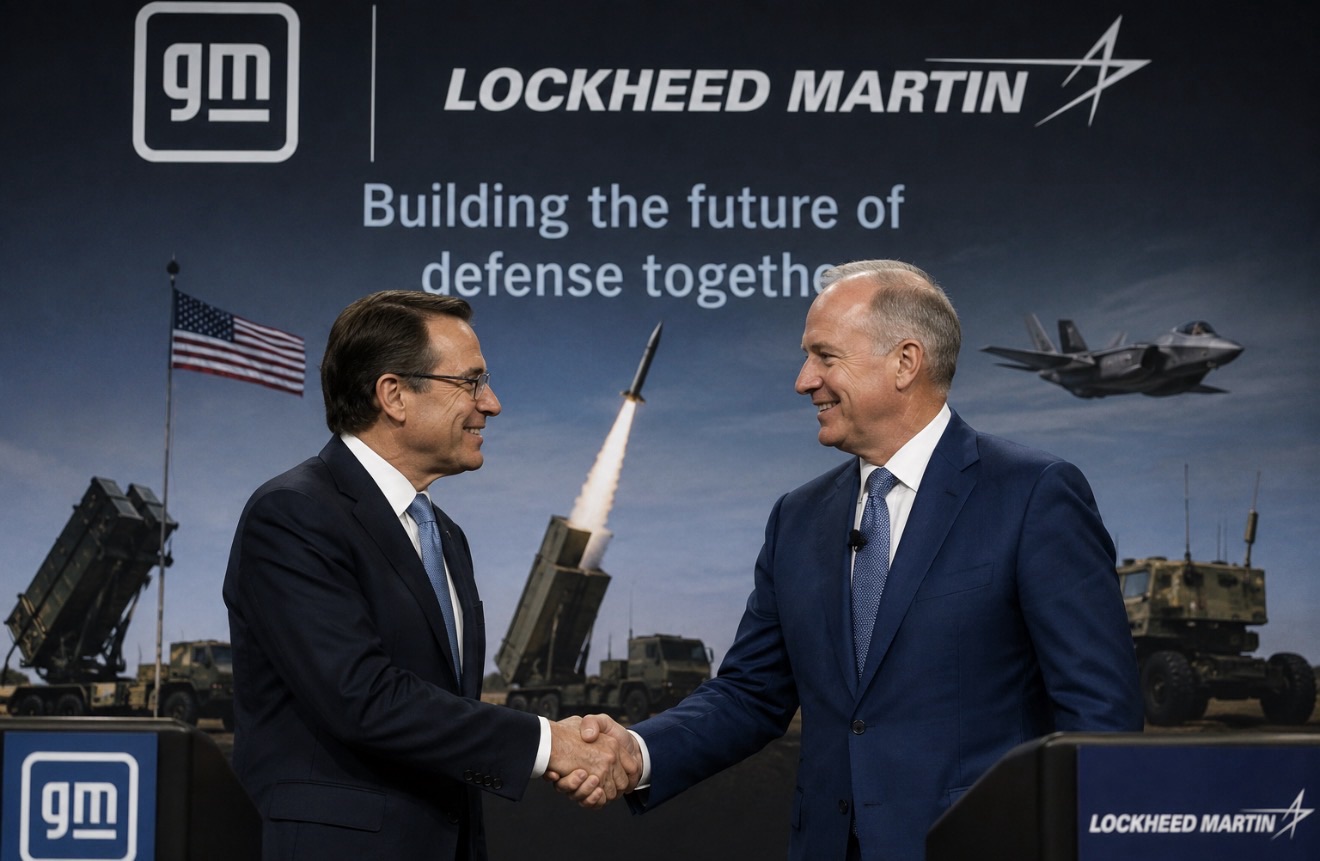
General Motors and Lockheed Martin announced Tuesday that they have signed a partnership aimed at using the automaker’s manufacturing expertise to help increase production of missiles, munitions, and other defense systems as growing global conflicts place pressure on U.S. weapons stockpiles.
The companies unveiled the agreement at the Reindustrialize Summit in Detroit, describing it as a step toward accelerating weapons production while strengthening America’s industrial base.
Lockheed executives argued that the manufacturing principles behind building advanced military hardware are not all that different from those used to build automobiles.
“What does a THAAD air defense interceptor have in common with a Corvette?” asked Frank St. John, Lockheed Martin’s chief operating officer. The answer, he said, is precision engineering, complex supply chains, advanced manufacturing processes, and the ability to produce at scale.
The goal is not to merge the products themselves but to apply the manufacturing strengths of one industry to another.
The timing reflects growing Pentagon concerns about production capacity.
America’s weapons inventories have been strained by military operations involving Iran and by years of weapons shipments supporting Ukraine. Defense officials have repeatedly urged contractors to increase production rates to replenish stockpiles and prepare for future conflicts.
According to company executives, the memorandum of understanding was developed following discussions with the Pentagon, which has been encouraging industry partners to find ways to expand output more rapidly.
That is where GM enters the picture.
Through GM Defense, established in 2017, the automaker already supplies military vehicles and specialized transportation systems to government agencies. The division currently holds contracts with the U.S. Army, the Department of State, and other federal entities.
But Lockheed is interested in something beyond GM Defense’s existing products.
General Motors possesses one of the world’s most sophisticated manufacturing networks, capable of producing complex systems at high volume while managing thousands of suppliers and logistics partners. Defense leaders increasingly view those capabilities as essential to rebuilding America’s defense-industrial capacity.
Bruce Brown, vice president of strategy at GM Defense, said technological innovation alone is not enough. The ability to manufacture, scale, and deliver consistently is equally important.
The partnership also represents a return to history.
During World War II, General Motors produced tanks, aircraft engines, military trucks, and other equipment for the U.S. war effort. In the decades that followed, the company focused primarily on civilian vehicles. The new partnership signals a renewed push into defense manufacturing at a time when government demand is rising.
For General Motors, defense work offers access to a market supported by long-term government contracts and potentially higher margins than traditional automotive manufacturing.
For Lockheed Martin, the agreement supports a broader expansion already underway.
The defense giant has committed more than $9 billion through 2030 to modernize and expand production facilities. That investment includes a new munitions manufacturing center in Troy, Alabama, where construction began last month and is expected to create a significant number of jobs.
Lockheed produces some of America’s most important military systems, including the F-35 fighter jet, THAAD missile-defense system, PAC-3 interceptors, and the Black Hawk helicopter. The company has faced increasing pressure from the Pentagon to expand output of missile-defense systems and precision-guided weapons.
Executives emphasized that the partnership remains in its early stages.
No specific factories, products, or contracts have been announced. St. John said it is too early to determine which Lockheed programs will benefit most from the collaboration.
Steve duMont, president of GM Defense, said both companies will spend the coming weeks identifying projects where GM’s manufacturing capabilities can provide the greatest value.
Beyond the immediate defense implications, the announcement reflects a broader trend reshaping American industry.
The push toward reindustrialization has gained momentum as policymakers seek to strengthen domestic manufacturing, reduce dependence on foreign supply chains, and expand production of strategically important goods. Increasingly, the line between commercial manufacturing and defense production is becoming less distinct.
If successful, the partnership could channel additional defense work into factories, supplier networks, and manufacturing communities across the United States, supporting skilled jobs and industrial investment.
Questions remain.
Defense manufacturing involves strict security requirements, specialized certifications, and procurement rules that differ significantly from automotive production. Transforming commercial manufacturing capacity into military output is not as simple as repurposing an assembly line.
Ultimately, both companies will be judged not by the announcement itself but by whether the partnership results in more weapons reaching U.S. stockpiles.
The first major test will come when Lockheed Martin and General Motors identify the specific defense programs they intend to pursue together.
For now, the message from Detroit is clear: the companies that helped build America’s automotive industry are being asked to help rebuild its arsenal.
Detroit – JBizNews Desk
© JBizNews.com All Rights Reserved. Reproduction or distribution without written permission is prohibited.