

Iran is celebrating its newly finalized agreement with the United States as a major strategic triumph, with senior officials claiming the deal preserves key elements of Tehran’s military and nuclear posture while forcing Washington to make significant concessions.
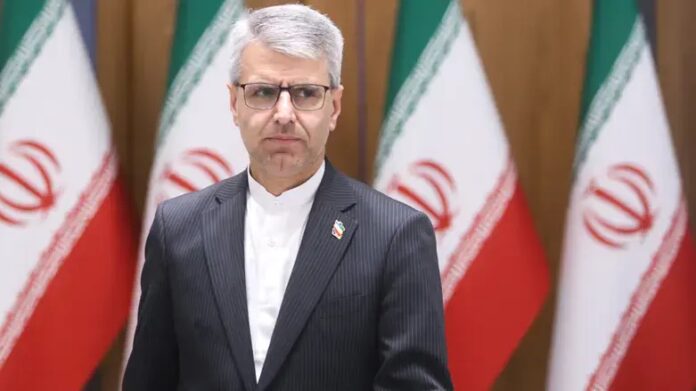
Speaking Thursday after the memorandum of understanding was signed, Iranian Foreign Ministry spokesman Esmaeil Baghaei portrayed the agreement as a decisive victory for the Islamic Republic and argued that the outcome demonstrated Iran’s growing power on the world stage.
One of the most significant points highlighted by Iranian officials is the survival of Tehran’s ballistic missile program. The issue has long been a source of tension between Washington and Tehran. The Trump administration had previously criticized the Obama-era nuclear agreement for failing to address Iran’s missile capabilities, and President Trump repeatedly identified the missile program as a major security concern for both the United States and Israel.
In remarks carried by Iranian state television, Baghaei confirmed that the agreement had been formally completed and said both countries had approved identical versions of the document.
“As I speak with you now, the text of the memorandum of understanding has been signed by the presidents of Iran and the U.S.,” Baghaei said.
“The text of the Iran-U.S. memorandum of understanding is now officially finalized as both parties have signed it,” he added.
Baghaei cautioned that the real challenge would come during implementation and signaled that Iran intends to closely monitor every step taken by Washington.
“Iran will monitor the U.S.’ compliance without any leniency,” he said, adding that Iran would not fulfill its end of the agreement if Washington “evades its obligations.”
According to Baghaei, Tehran expects immediate economic benefits from the agreement, including relief from restrictions on oil exports and renewed access to shipping services, insurance markets, and oil-related revenue streams.
He also insisted that the United States refrain from expanding its military footprint in the region or imposing additional sanctions while negotiations toward a final agreement continue.
“Within the 60-day window, the other side must not take action to reinforce its military presence in the region or impose new sanctions,” Baghaei said. “Such actions would be considered a violation of the agreement.”
One of the most contentious issues remains Iran’s stockpile of enriched uranium. While the memorandum reportedly does not explicitly authorize Iran to retain the material, Baghaei made clear that Tehran rejects any requirement that it be removed from the country.
“Transferring enriched nuclear material out of the country is unacceptable to us,” he said. “Diluting enriched material is not a new option. It has now been introduced as one option, so as not to close the door on other options.”
Baghaei also insisted that Iran’s missile arsenal remains completely off-limits in any future discussions, despite ongoing international concerns about the country’s growing military capabilities.
“Iran’s missiles are meant to be fired, not negotiated over. Our missiles don’t even like being talked about,” he said. “Iran’s defensive capabilities will not be discussed in any process, with any party.”
The spokesman further outlined Tehran’s vision for the future management of the Strait of Hormuz, one of the world’s most important energy chokepoints.
According to Baghaei, Iran and Oman have already reached broad understandings regarding oversight of the waterway, and Iran intends to collect fees connected to services provided there.
“Iran will charge fees for services in the Strait of Hormuz,” Baghaei said. “The mechanisms for managing the Strait of Hormuz have largely been agreed upon with Oman.”
He added that maritime traffic would continue uninterrupted while maintaining “the sovereignty and dominion of the Islamic Republic of Iran over the Strait of Hormuz.”
Presenting the agreement as the culmination of months of conflict and pressure, Baghaei argued that Iran had emerged stronger despite the hardships of war.
“Our enemies have inflicted harm on us,” he said. “But a wounded lion remains a lion. The war they imposed not only did not bring us to our knees, but made us stronger.”
He then escalated his rhetoric even further, claiming that Iran had prevailed against some of the world’s most powerful nations.
“Iran defeated two nuclear powers that were also backed by some other countries. We are not making slogans: We truly are a superpower.”
The agreement has been met with fierce opposition in Israel and among some American political figures, who contend that the arrangement gives Tehran substantial economic and strategic gains while leaving critical military capabilities intact.
Israeli officials have warned that the deal could strengthen Iran’s position throughout the region and diminish deterrence against future aggression.
Among the sharpest critics is Times of Israel founding editor David Horovitz, who has argued that Trump’s agreement amounts to a “catastrophic capitulation to” Iran and its regional ambitions.
Horovitz has further contended that the memorandum heavily favors Tehran by providing access to as much as $100 billion in immediate assistance while failing to secure concrete commitments regarding Iran’s nuclear weapons ambitions or long-term intentions.
{Matzav.com}