
 Vos Iz Neias
A Hidden Mercy? Why the MOU That Looks Disastrous May Yet Protect Our Brethren in Israel
New York (VINNEWS/Rabbi Yair Hoffman) At first glance, the Memorandum of Understanding that President Trump signed this week to end the war with Iran appears to be an unmitigated disaster—for Israel and, in a different way, for the United States as well.
Israel, by most accounts, was not even shown the document before it was finalized. The agreement extends the ceasefire, lifts the American blockade of Iranian ports, and commits Tehran only to the reopening of the Strait of Hormuz, while leaving the ballistic-missile question and Iranian support for its proxies to a future round of negotiations that may never bear fruit.
The President himself, even as he defended the document, has spent the week publicly deriding Prime Minister Netanyahu and criticizing Israeli operations against Hezbollah in southern Lebanon as overly aggressive. To an observer who is concerned for the safety of the residents of Israel, it is difficult to read the news of recent days without a sinking heart.
And yet there is a way of looking at these events that yields a more hopeful conclusion. The argument that follows does not deny the immediate pain. It suggests, rather, that in the longer arc of history, this seemingly disastrous agreement may prove to be in Israel’s genuine interest. The reasoning rests on three observations.
The Shifting Ground in America
The first observation concerns the changing temperature of American politics. The United States has, over the past several years, taken a pronounced turn toward the left on the question of Israel, and both antisemitism and anti-Israel sentiment now stand at heights not seen in many decades.
This is not a partisan claim so much as a sociological one; it can be measured in campus encampments, in polling, and in the rhetoric that has migrated from the fringes toward the center of public discourse. A relationship that was once treated as a fixed point of American foreign policy is, for the first time in living memory, genuinely contested terrain.
When a friendship is unconditional, a single bad agreement is a wound; when a friendship has grown conditional and brittle, the dynamics that produce agreements—and the personalities who negotiate them—take on outsized importance. Which brings us to the second observation.
The Cost
The war with Iran was not free, and Americans have felt its price most directly at the gasoline pump. With roughly a fifth of the world’s oil normally passing through the Strait of Hormuz, the disruption sent prices soaring well above four dollars a gallon—more than a dollar higher than before the war, and in some states considerably more than that. Independent estimates of the added burden on the average American household have ranged from several hundred dollars to projections approaching a thousand dollars over the course of the year if elevated prices persist.
Whatever the precise figure, the political reality is unambiguous: the war imposed a real and resented cost on ordinary voters, and that resentment has consequences.
A public that associates a Middle Eastern war with pain at the pump is a public whose patience for further such ventures is thin. This is the uncomfortable backdrop against which the succession to President Trump will play out—and it is in that succession that the third, and most consequential, observation lies.
Vance, Rubio, and the Republican Succession
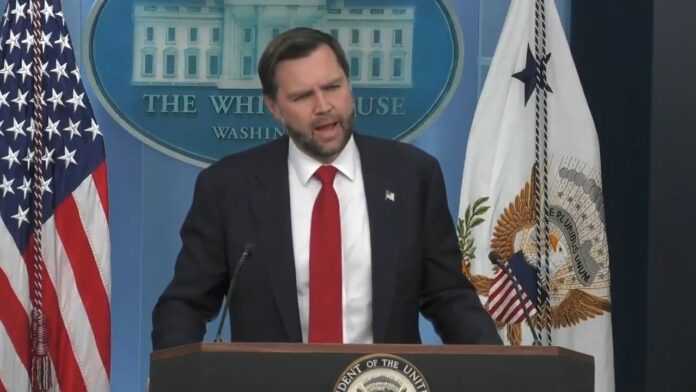
Vice President Vance is widely regarded as the heir apparent to the President as the Republican standard-bearer. On the question of Israel, however, his reputation is, to put it gently, not the warmest. He has long been associated with a more restrained, less interventionist posture, and it was Vance who took the lead in negotiating the very Memorandum of Understanding now under discussion. Whatever one thinks of the deal, its paternity is his.
Secretary of State Marco Rubio, by contrast, has been one of the most consistent and full-throated supporters of Israel in American public life for the better part of two decades. And the political ground has been shifting with remarkable speed. He is also Hispanic and a very likable fellow – to the extent that even Democrats would vote for him rather than a hyper-liberal.
Polling that not long ago showed Vance running away with the 2028 Republican field now shows a genuine two-horse race, with several surveys placing Rubio ahead—in one national poll by a margin approaching sixteen points, a swing of dramatic proportions in a matter of months. The contest that once looked settled is settled no longer.
If the MOU comes to be seen by Republican primary voters as a flawed bargain—negotiated by Vance, leaving Iran’s missiles and proxies intact, and sidelining a close ally—it may sharpen precisely the challenge that Rubio would mount.
A primary in which the Vice President must defend an unpopular agreement against a rival with impeccable pro-Israel credentials is, in the long run, a primary whose outcome could serve Israel’s interests far better than the present moment would suggest. The document that wounds Israel today may help elevate, tomorrow, the candidate most committed to its security.
And the truth is that the Trump 2.0 administration was the best one in recent history for the safety of those living in Israel. But what would have happened if Biden did not win? It could very well have turned out that President Trump would not have assisted Israel so strongly in 2020.
A Word of Caution—and of Faith
Let it be said plainly: this article does not suggest that any of this is the President’s strategy in signing the agreement. To attribute so intricate a design to any human actor would be to claim a knowledge no observer possesses.
The point is rather the opposite.
Human beings act for their own reasons, in their own moment, with their own limited sight—and yet the consequences of their actions are woven into a larger pattern they did not author and cannot see.
As the wisest of all men taught in Mishlei (21:1), Palgei mayim lev melech b’yad Hashem—“Like channels of water is the heart of a king in the hand of Hashem; He turns it wherever He wishes.” The hearts of kings and presidents, of vice presidents and secretaries of state, are not beyond the reach of Hashgachah. What looks from below like a setback may be, from above, a turning of the channel. We are not granted the vantage point to see the whole design.
We are granted only the obligation to act rightly, to judge favorably where we can, and to trust that the One who directs the hearts of the powerful has not removed His hand from history.
The MOU may indeed be a bitter document. But bitterness in the present and benefit in the long run are not contradictions—they are, more often than we like to admit, the same event seen at two different distances. For those who are concerned for the safety of our brethren in Israel, the counsel of the hour is neither despair nor naiveté, but the patient confidence of Bitachon Bashem.
The author can be reached at [email protected]