
 Matzav
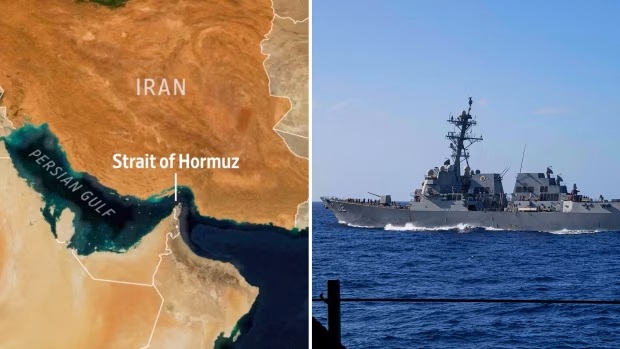
Iran Declares the Strait of Hormuz Closed Again After US Lifts Blockade
Iran abruptly reimposed its closure of the Strait of Hormuz on Friday rather than proceeding with planned nuclear negotiations in Switzerland, blaming Israel’s continued military presence in southern Lebanon and the ongoing deployment of American forces throughout the region.
In a message broadcast over maritime communications channels, the Islamic Revolutionary Guard Corps announced that Washington had failed to uphold commitments outlined in the memorandum of understanding signed Wednesday by President Donald Trump and Iranian President Masoud Pezeshkian.
“Since Israel’s withdrawal from Lebanon, the complete lifting of the naval blockade, and the withdrawal of American terrorist forces from the Persian Gulf and the region are among the main conditions of the agreement between Iran and the United States, the Strait of Hormuz will remain closed until these conditions are met,” it said. “All ships are requested, for the sake of their security and safety, not to approach the Strait of Hormuz. Any vessel that defies this directive will be targeted.”
The announcement came despite U.S. Central Command’s declaration on Thursday that the two-month blockade of Iranian ports had officially been lifted. Iranian officials did not immediately clarify why they believe the removal of the restrictions remains incomplete.
Moments after Tehran’s announcement, an American official asserted that Israel and Hezbollah had reached a ceasefire arrangement. The claim appeared to conflict with remarks made a day earlier by Israeli Prime Minister Binyomin Netanyahu, who indicated that military operations would continue.
“We will restore security and prosperity to northern towns,” Netanyahu said. “That requires maintaining the security zone in southern Lebanon.”
The Israel Defense Forces also released an updated operational map showing a widened area under Israeli control inside Lebanon. According to the map, Israeli troops are now positioned more than six miles beyond the border, including locations north of the Litani River.
The memorandum signed earlier this week stated that the United States and Iran, “along with their allies,” would respect Lebanon’s sovereignty and territorial integrity while bringing military hostilities there to an end.
Simcha Brodsky, president of the intelligence research group OSINT613, told The Post that Tehran appears to be exploiting both the language of the agreement and the phased timetable for implementing its provisions.
“What we’re seeing is a direct result of the wording in the US-Iran MoU. The deal lifts the US blockade in phases (‘fully within 30 days’), so the US is mid-process by design,” he said. “Iran is using that gap: it says the Strait stays closed until the blockade is ‘completely lifted,’ so it can claim the lift isn’t done and call this a re-closure.”
“Iran has now bolted the Israel-Lebanon fighting onto that pretext to hard-stop the whole deal., roping Israel into an agreement it never approved or negotiated.”
The renewed tensions emerged only hours after the first round of nuclear negotiations between Washington and Tehran, which had been arranged under the new memorandum and scheduled for Friday, was canceled.
American officials have not publicly explained the reason for the postponement.
A regional source said Wednesday that hardline factions within the Iranian government had opposed participation in a now-canceled signing ceremony planned for Friday, insisting that Israel first remove its forces from southern Lebanon.
At the same time, Iran’s newly established Persian Gulf Strait Authority, known as the PGSA, issued a fresh set of regulations governing maritime traffic through the strategic waterway. The authority was recently created by Tehran to oversee operations in the strait and, according to critics, potentially generate revenue through future transit charges.
Although the memorandum bars Iran from collecting fees from shipping companies during the next 60 days, the agreement also specifically notes that Tehran “reserves the right to introduce” such charges at a later date.
The new regulations further require all vessels seeking passage through the Strait of Hormuz to obtain authorization from the PGSA beforehand—a requirement that did not exist before the conflict began on February 28, as the strait has traditionally been regarded as international waters.
{Matzav.com}