
 Matzav
“It’s Been a Pretty Long Run”: Rabbi Menachem Genack Retiring from OU Kosher After 45 Years
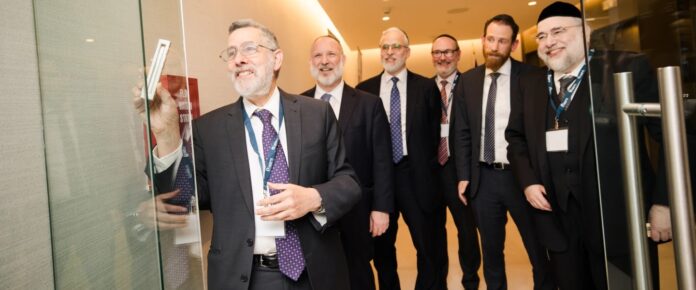
Rabbi Menachem Genack, 78, had been speaking to JNS for about 45 minutes when, with a smile, he recalled a story about the Ponevezher Rav, who often received backlash for his dream of rebuilding the famed Ponevezh yeshiva after the Holocaust.
“People would tell him, ‘You’re dreaming,’” Genack told JNS. “‘Yes,’ he would reply. ‘But I’m not sleeping.’”
The longtime chief executive officer at OU Kosher, the Orthodox Union’s kashrus division, spoke to JNS two weeks before his planned retirement on July 1 after 45 years at the kosher certifier.
As his time at the OU winds down, Rabbi Genack has been thinking about Rav Kahaneman’s remark about being awake, he told JNS at OU headquarters in lower Manhattan.
“His vision, his determination, what he built,” Rabbi Genack said. “It’s very inspiring.”
The story has stayed with him as he transformed the OU kashrus division from a one-man operation into a global enterprise that today supervises and certifies more than 1.3 million products developed in 105 countries worldwide.
The division also now funds much of the organization’s broader work, including its youth outreach programs and publishing arm, OU Press.
But when Rabbi Genack arrived at the OU in 1980, the organization employed just a handful of people in kashrut. At the time, he was the department’s sole full-time rabbi.
“I wouldn’t say something had to be fixed” at the OU, he told JNS. “It needed to be built.”
Rabbi Genack determined that what the OU needed more than anything was “a clearer articulation of standards.” He assembled a small team to develop an ingredient-review department, establish consistent standards and expand the OU’s reach among major food manufacturers.
“We met regularly to discuss issues, write things down, formulate positions and define what the OU’s standards were,” he said. “At that point, I was the only one. Today, we have more than 50 rabbinic coordinators.”
Growing up, Rabbi Genack didn’t have a dream job, but in high school, and later as a student of Rav Yoshe Ber Soloveitchik, he discovered a love of Torah learning that would help shape the course of his life.
“There was no one like the Rav,” Rabbi Genack said. “He was an extraordinary pedagogue. He was so generous.”
He recalled spending summers learning with Rav Soloveitchik in Onset, Mass., on Cape Cod after the death of the rabbi’s wife.
“There were just a handful of us there—maybe six or seven,” he said. “I used to stay with one of his daughters, and the Rav would come for the weekend. He’d usually give a shiur and then go back to Boston or Brooklyn.”
Rav Soloveitchik “was just in a class by himself,” Rabbi Genack said, and was someone who could “hold a crowd of well over 1,000 people in the palm of his hand for three or four hours.”
He was not involved personally at the OU but mentored Rabbi Genack as the latter built the organization into what it is today.
“The Rav gave me direction and guided me toward this path,” he said. “One of the things he told me was that he didn’t want to see the OU become an absolute monopoly. He wanted to see the ‘little brothers’ succeed as well.”
“There was a communal responsibility, and we did that,” he told JNS. “If other agencies met high halachic standards, we accepted them.”
Politics, too, was part of Rabbi Genack’s inheritance.
Raised in Forest Hills, Queens, by Holocaust survivors and fervent Zionists, Rabbi Genack grew up in a home where Israel and public affairs were constant subjects of conversation.
When he was 4, his family moved to Israel, but his parents decided that the hardships of the state’s early years made life too difficult.
“There simply wasn’t enough food to go around,” Rabbi Genack said. “It was a difficult time.”
Though his family returned to the United States, his father’s “dominant interests” remained “Israel, Zionism and politics,” Rabbi Genack said.
“Politics was something that was discussed in our house a lot,” he told JNS.
“Especially for Jews,” he came to realize, “we have to have a voice.”
In 1994, he founded NORPAC, a bipartisan political action committee that strengthens support for Israel on Capitol Hill. He also developed a close relationship with former President Bill Clinton, the subject of his 2000 book, “Letters to President Clinton: Biblical Lessons on Faith and Leadership.”
About halfway through the conversation, Rabbi Genack recalled seeing President John F. Kennedy as a child. In September 1963, just two months before Kennedy was assassinated, he said that he saw the president drive near Flushing Meadows Park, where Rabbi Genack was playing.
“They stopped all the traffic on Main Street,” he told JNS. “I was standing on the side of the highway when the president’s car passed by. We waved to him.”
As the OU expanded over the decades, Rabbi Genack said that the organization faced countless challenges, from losing access to its offices after 9/11 to adapting to remote work during the Covid pandemic.
One of the ways he kept the organization together, he said, was through a careful and deliberate hiring process.
“The OU was viewed as Orthodox, but limited to a particular constituency,” he said. “I wanted it to speak to the entire Orthodox community, so when I hired people, I looked across different communities—many different yeshivot and backgrounds.”
“I wanted the OU to look like the Orthodox world, so that it could speak to and communicate with the broader American Jewish community and beyond,” he told JNS.
He also focused heavily on establishing trust and credibility.
“Through the quality of the people we worked with, through integrity, through implementing standards consistently,” Jews around the world began to trust the organization’s certifications and decisions, he said.
“Mistakes were undoubtedly made, but you build trust on that basis,” he told JNS.
Although he had a consistent vision for the OU from his first day on the job, Rabbi Genack said that he had no idea it would grow so much.
“I couldn’t imagine from where it was when I arrived,” he said. “What I thought about initially was creating a staff that would have credibility beyond a single community. That was the goal.”
Since then, Orthodox Jewry has grown, in his view, “both in strength and in numbers.” But alongside that growth have come challenges for American Jewry that he never expected to confront.
“Especially when you look at places like Lakewood and the yeshiva world, the Orthodox community has become much stronger,” he said. “But the challenges facing American Jewry are also very profound. The risk of rapid assimilation. The level of antisemitism that we’re seeing. The security challenges facing the State of Israel.”
“These are things I never imagined seeing in my lifetime,” he said.
Rabbi Genack told JNS that it wasn’t hard to reach a decision to retire.
“Why not?” he told JNS, when asked for a reason. “It’s been a pretty long run. It’s time.”
Rabbi Moshe Elefant, chief operating officer and executive rabbinic coordinator of OU Kosher, is slated to succeed Rabbi Genack. He told JNS that the transition has been in the works for five years.
“The OU administration has done it in a most sensitive manner,” Rabbi Elefant said. “This whole year, as we lead up to July 1, has really been a year of transition.”
The two first met 39 years ago, when Rabbi Genack interviewed Rabbi Elefant for a position at the organization.
“I thought Rabbi Genack would ask a lot of questions about kashrus, about my knowledge of kashrus, which wasn’t very extensive other than that I ate kosher my whole life,” Rabbi Elefant told JNS.
“But he really wasn’t focused on testing me in kashrus. He was trying to figure out who I am, what kind of personality I had, whether I’d fit in with the organization,” he said. “I guess he decided I did.”
Rabbi Genack said identifying a successor was one of the most important responsibilities of his career.
“From the beginning, I always used to say, ‘There’s no success without succession,’” he told JNS. “Early on, I identified someone I thought had real talent—someone accomplished, someone with vision.”
Rabbi Elefant is “absolutely the right person” to lead the organization forward, Rabbi Genack said.
Though the two have drastically different personalities—Rabbi Elefant noted that Rabbi Genack is much more reserved and “scholarly” than he, while he is more “out there”—their relationship has been strong from the beginning.
“I would say, in most of those years, certainly the last 20-plus years, there isn’t a day that we don’t speak multiple times,” Rabbi Elefant told JNS. “Sometimes we may speak to each other more than we speak to our wives.”
Rabbi Elefant said that Genack’s vision from the start was that if “anybody, for whatever reason, wants to keep kosher, wherever they are in the world, because of the OU they’ll be able to do so.”
“That was his vision,” Rabbi Elefant said. “He built it, literally, brick by brick.”
For Rabbi Genack, the work was never only about food certification. It was about making Jewish life easier to sustain in an era of assimilation.
“The OU should be an eloquent spokesman for the principles we represent,” he told JNS. “I hope it continues to grow.”
“Part of the OU’s mission is contained in the word itself—union, unity,” he said. “To promote unity within Orthodox Jewry. That’s something that unfortunately is often lacking.”
“The money we make from kashrut should be used to help people, promote Torah and strengthen Jewish life,” he told JNS. “If kosher products are available in every store with an OU, at the same price, that makes it possible to live as a Jew in the United States.” JNS
{Matzav.com}