
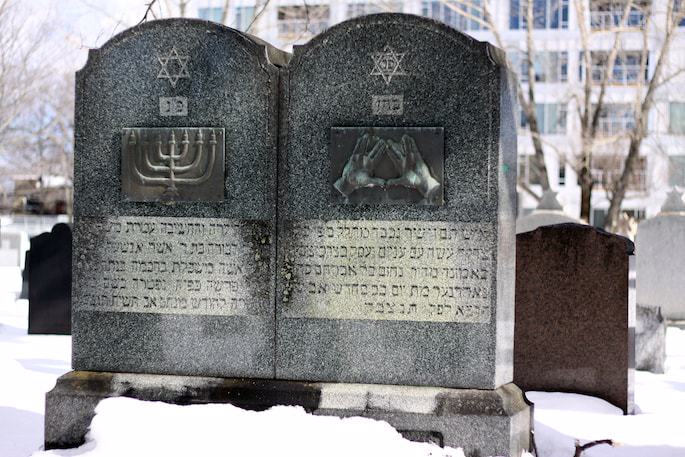

New York (VINNEWS/Rabbi Yair Hoffman) A matzeivah (gravestone) does a number of things: It promotes and guards the Kavod of the one that has passed on, points the way for those who come to ask Hashem for things in the zchus of the mais, it protects the living from tumah, and it brings comfort and benefit to the neshama that has moved on.
The Origins of the Matzeivah
The earliest Matzeivah recorded is the one Yaakov Avinu set up at the grave of Rachel Imeinu. The Torah testifies to this directly: “And Yaakov set up a pillar upon her grave; that is the pillar of Rachel’s grave unto this day” (Bereishis 35:20). (See also Shach YD 339)
The word matzeivah literally means a “standing-up” — the stone that stands erect to mark and make plain the place of burial. In TaNach we also see another name. The prophet Yechezkel calls a matzeivah a tziyun, a “marker”: “And when they that pass through shall see a man’s bone, then shall he set up a sign by it” (Yechezkel 39:15). Chazal add yet a third name, nefesh, a “neshama-stone.”
How Rachel Imeinu’s Matzeivah Was Built
For Rachel Imeinu’s matzeivah, Yaakov Avinu brought eleven stones and put them on her grave, then added a twelfth stone of his own, so that there were twelve stones in all, and these fused together into a single stone. This is the explanation found in the Zohar.
Why We Build a Matzeivah
There are five reasons found for building a matzeivah (See Teshuvos Divrei Yatziv Yoreh De’ah siman 227).
- To preserve the honor of the Mais. The matzeivah keeps the deceased from being disgraced or degraded, and keeps the dust from simply covering him over.
- To mark the place for prayer. It lets people know where the burial place is, so that one may come to pray there.
- To preserve the memory of the deceased. The stone keeps his memory alive for a long span of time.
- To warn of ritual impurity. It marks the spot as a source of tumah, so that the unwary are not defiled.
- To benefit the neshama. There is a benefit to the neshama of the departed in the very building of the matzeivah.
This is also why a matzeivah is called a nefesh, a “soul.” As explained in connection with the Mishnah in Shekalim (ch. 2, mishnah 5), when a person dies and is forgotten, it is the matzeivah that keeps the memory of his or her place from being lost.
The Obligation and the Material – A Duty on the Children
Erecting a matzeivah is an obligation that rests upon the children, and in fulfilling it they perform the mitzvah of honoring father and mother — and this is so even though the matter is also a halacha. Because the duty falls on the children, they should not be neglectful about setting up the stone. The custom is to make the matzeivah out of stone.
The Specially Righteous That Have No Stone Matzeivah
Not every grave bears a carved stone. Certain righteous men have no matzeivah at all — only a mound of stones. The grave of Rabbi Pinchas ben Yair, in Tzfas, has no matzeivah but only a mound of stones. The Shivchei HaAri (p. 54a) relates that the Arizal wished to set up a matzeivah for him, but a voice from heaven held him back.
What to Inscribe on the Matzeivah
The Basic Rule: Restraint
One should not heap many praises upon the matzeivah, for excessive praise arouses heavenly accusation against the departed. In fact, many Gedolim asked in their wills that no title at all be written upon their matzeivos. The standard practice is to write the name of the deceased, the family name, the names of the father and mother, and the date. These guidelines appear in the Responsa Be’er Mordechai (Yoreh De’ah siman 56). The masters of Kabbalah read deep meaning into every word inscribed on a matzeivah (See Chayei Adam klal 154, letter 1, and Sefer Chazon Ovadiah Aveilus, vol. 1, p. 257).
The Closing Inscription
It is customary to add the abbreviationתנצב”ה tenatzba”h (“May his (or her) neshama be bound up in the bond of life”). The Responsa Maharam Schick (Yoreh De’ah siman 171) explains that this alludes to both the World to Come and to the Resurrection.
Special Questions of Wording
Avoiding a Gentile Date
As a rule, one should not inscribe a foreign (gentile) date upon the matzeivah. The Sefer Metzudas Tziyon (p. 67) records that many great and important communities had the custom of writing nothing at all upon the matzeivah, and the Responsa Mishivas Nefesh (siman 17) explains the same. The Metzudas Tziyon notes that this custom prevailed in Chevron, beginning after an incident at the grave of the Sdei Chemed, Rabbi Chaim Chizkiyahu: during the night, gentiles gathered at the burial plot, uprooted the matzeivah, removed the stone, and threw it aside. Afterward the community enacted that no particular detail be written on the matzeivah, so as to prevent the taking of vengeance.
On the custom of Chevron, see further the Responsa Da’as Kohen (siman 210), which discusses the obligation to engrave names so that the Ishmaelites not erase the names of the righteous, and rules that since the Chevron custom of not engraving names arose from this circumstance, there is no concern of improperly changing the custom. The Shach (Choshen Mishpat siman 37:38) likewise explains at length that a custom which arose only out of an impediment to action is not a binding custom.
Whose Names to Include
Minhagim vary as to which parent’s name is recorded. The Sefer Gesher HaChaim (p. 45) brings that some wrote the father’s name, some the mother’s, and some both. The governing principle, as the Responsa of the Shach (vol. 3, siman 91) state, is that in every place the local custom is not to be set aside. The Sefer Nit’ei Gavriel (ch. 76, note 11) brings a custom of also writing the date of birth and the date of the eulogy.
The Three Concerns With a Foreign Date
Not using a foreign date has three concerns:
First, the mitzvah to count months from Nisan. As it says, “This month shall be unto you the beginning of months; it shall be the first month of the year to you” (Shemos 12:2). See further rhe Minchas Chinuch (mitzvah 311, letter 5).
Second, the prohibition of mentioning the name of an idol. As it says, “And make no mention of the name of other gods, neither let it be heard out of thy mouth” (Shemos 23:13), established in the Gemara in Sanhedrin (63b) and ruled in the Shulchan Aruch (Yoreh De’ah 147) — and the names of the secular months are clearly drawn from the names of idols. There is room to clarify, however, for according to authorities brought by Yosippon (ch. 43), some month-names are not names of idols at all but names of kings, leaving room for leniency.
Third, “In their statutes you shall not walk.” This is brought in the Shulchan Aruch (Yoreh De’ah siman 178). Where a danger to life is involved, see the Responsa Be’er Sarim (vol. 1, siman 47), the Responsa Teshuvos V’Hanhagos (vol. 1, siman 681), and the Responsa Shevet HaLevi (vol. 7, siman 194), which was lenient in a place where the practice was already to write in the holy tongue, to write the name of the departed in the holy tongue and also in the foreign tongue.
Names, Nicknames, and the Sick
A Name Added During an Illness
When a person was given an additional name because he was ill, and he then passed away, one writes on the matzeivah only his principal name and not the added name — unless the change of name proved effective and he recovered, in which case the second name is written as well. This is the view of the Maharit (siman 25).
Some, however, look instead to how long the person held the added name. The Responsa Avnei Tzedek (Orach Chaim siman 28) writes that if the sick person lived thirty days and then passed away, the added name is inscribed. So too the Responsa Lvushei Mordechai (Yoreh De’ah vol. 1, siman 75) holds that whenever one has held the added name for thirty days, that name is written on the matzeivah. The Sefer Orchos Rabbeinu (vol. 1, p. 358) quotes the Chazon Ish that where the added name did not prove effective, it is not written on the matzeivah.
Adding a Nickname
It is customary to add a person’s nickname (kinui) upon the matzeivah. If the departed had both a Jewish name and a foreign one, and the Jewish name has been forgotten, one inscribes the Jewish name with the foreign name in parentheses. See the Sefer Darkei Chaim (p. 235) and the Responsa Aphrekasta D’Anya (vol. 3, Yoreh De’ah siman 233).
A Simple Matzeivah Is Best
It is not seemly even for the wealthy to make an ornate and lavish matzeivah, for there is no aspect of hiddur mitzvah (beautifying the commandment) in extravagance. Rather, one should build a simple matzeivah; indeed, many of the great ones of the world asked in their wills for a simple stone.
When to Set Up the Matzeivah
The Range of Minhagim
Minhagim differ as to the proper time to erect the matzeivah. The most fitting and proper time is immediately after the seven days of mourning; and if that is not possible, then after the twelfth month. See the Sefer Darkei Chaim (p. 235 and Sefer Chazon Ovadiah Aveilus, vol. 1, pp. 252–253).
Those who wait until after the twelfth month rely on the Rema (Yoreh De’ah siman 380.
The Kabbalistic View: The Seventh Day
According to the masters of Kabbalah, the ideal is to set the stone immediately upon leaving the seven days of mourning — on the seventh day itself — and not later. The Arizal explains the reason in his Sha’ar HaMitzvos (Parshas Vayechi, p. 10b): the matzeivah serves as a kind of throne and seat for the lights that hover over the grave for the sake of the neshama. So long as the seven days of mourning are not complete, those lights do not yet surround the place. If a matzeivah is set up before the days of mourning are finished and before those lights arrive, then the spirit of impurity that clings to the neshama of the dead settles on the stone, grows strong there, and is not removed — so that whoever later comes to that grave cannot draw down the lights of heaven upon it.
This view is shared by Rabbeinu Avraham Azulai in his Sefer Chesed L’Avraham (Ma’ayan, nahar 31), the Sefer Lechem Min HaShamayim (p. 42a), the Responsa Minchas Elazar (vol. 3, siman 36).
A Temporary Marker on the Seventh Day
Where a full matzeivah cannot be set up on the seventh day, one may place a large stone at the grave as a temporary matzeivah, satisfying the kabbalistic concern until the permanent stone is ready (see Sefer Ganzei Eretz (siman 20) and Sefer Nishmas Yisrael vol. 2, p. 656). Much of this material is based on Sefer Iliu HaNeshamos by Rabbi Melamed).
The author can be reached at [email protected]