
 Matzav
Iranian Lawmaker Sparks Uproar After Reading Alleged Secret Khamenei Letters on Live TV
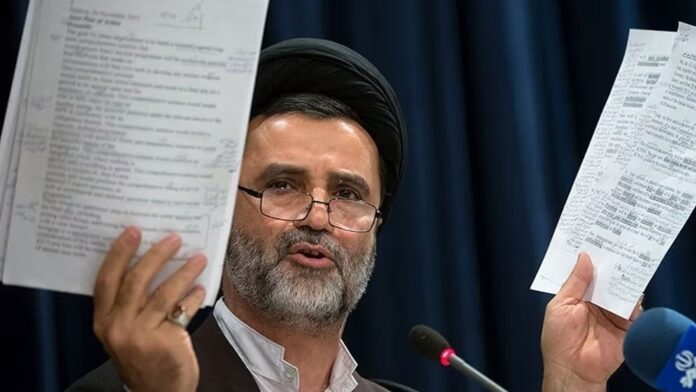
Political turmoil erupted in Iran after a hardline member of parliament publicly read excerpts from what he claimed were highly classified communications from Supreme Leader Mojtaba Khamenei during a live state television broadcast, alleging that the Iranian leader opposed negotiations with the United States. The program was abruptly cut off moments later.
Mahmoud Nabavian, a member of the Iranian Parliament’s National Security and Foreign Policy Committee, claimed during the broadcast that Khamenei repeatedly objected to the ongoing negotiations with Washington and had established conditions that were ultimately omitted from the memorandum of understanding recently signed between Iran and the United States.
The comments came as Iran’s negotiating team traveled to Switzerland for another round of technical talks with American officials, days after Tehran and Washington signed an agreement intended to end the conflict between the two countries and pave the way for broader negotiations.
According to Nabavian, Khamenei privately expressed dissatisfaction with the direction of the talks and questioned why his demands had not been met.
“The Supreme Leader explicitly expresses his dissatisfaction,” Nabavian said during the program. “He asks, ‘Why were the conditions not met?’”
Nabavian further claimed that Khamenei wrote that Iran “is neither in a hurry nor under any pressure to negotiate or reach an agreement,” and insisted that any discussions should focus on ending the war and securing compensation rather than addressing Iran’s nuclear program.
He also alleged that Khamenei instructed negotiators not to discuss what he described as “the central issue,” an apparent reference to Tehran’s nuclear activities.
At one point, Nabavian told viewers he intended to reveal a portion of the alleged correspondence.
“I will read one sentence. There is no other choice,” he said before quoting what he claimed was a message from Khamenei: “What took shape in the negotiations with Pakistan is fundamentally different from what was supposed to happen and from what constituted the condition for the legitimacy of the negotiations.”
According to Nabavian, Khamenei subsequently called for negotiations to be halted.
The lawmaker further asserted that Khamenei repeated his position on multiple occasions throughout April, insisting that Iran must emerge victorious by forcing the United States to fully recognize Tehran’s right to enrich uranium or remove the nuclear issue from future negotiations permanently.
Nabavian also claimed that Khamenei views the Strait of Hormuz as one of Iran’s most powerful tools of leverage against Washington.
“Strait of Hormuz is a very important key,” Nabavian quoted him as saying. “If the Americans want to remove pressure from their throat, they must first implement prerequisites, foremost among them the payment of compensation and debts.”
He argued that none of those conditions were incorporated into the memorandum signed with the United States.
According to Nabavian, Khamenei insisted that control over the Strait of Hormuz must remain exclusively in Iranian hands and not be shared with Oman or any other country.
He further alleged that Khamenei outlined a system under which some ships would be completely barred from transit, others would be required to pay fees, and vessels belonging to Iran’s allies would be allowed to pass freely.
As Nabavian continued discussing the alleged documents, the state television broadcast was suddenly interrupted and brought to an abrupt end, according to reports from Iran International.
Iran’s state broadcaster later condemned the lawmaker’s actions, describing them as a legal violation that could warrant prosecution.
The network said Nabavian’s references to classified documents and confidential communications between senior officials violated Iranian law. Officials also announced that one senior executive had resigned following the incident and that disciplinary measures would be taken.
The episode quickly triggered criticism even among conservative circles in Iran, with some accusing Nabavian of selectively presenting portions of a much larger body of correspondence in order to support his political arguments.
“Why don’t you say that these selective excerpts of yours were taken from about 20 communications and, in fact, from the earliest ones?” wrote prominent Iranian media figure Hossein Soleimani in a public rebuke directed at Nabavian. “Since you exposed and published the secret and top-secret documents of the system, you should at least have revealed them correctly and accurately.”
Nabavian and other hardline figures have sharply criticized the U.S.-Iran memorandum of understanding in recent days, accusing President Masoud Pezeshkian, Parliament Speaker Mohammad Bagher Ghalibaf, and Foreign Minister Abbas Araghchi of making dangerous concessions to Washington during the negotiations.
{Matzav.com}