
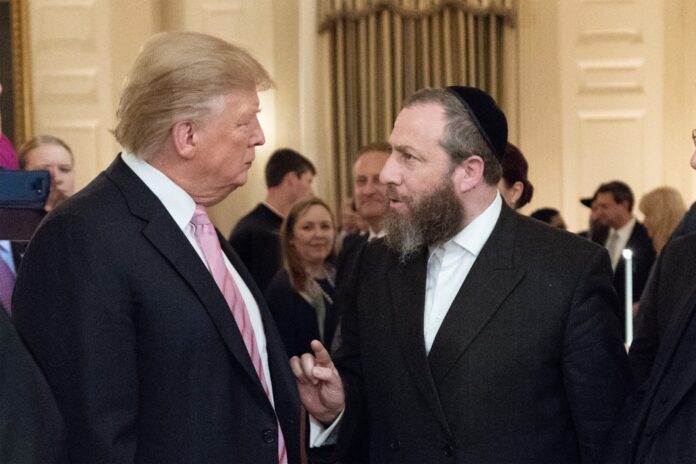

NEW YORK (VINnews/Post Guest – Chaim Kauffman) – They owe Ezra Friedlander an apology.
Not because he was right.
Because if he was wrong, then many of his critics have some explaining to do.
Back in 2015, when President Barack Obama pushed the Iran nuclear deal and Congressman Jerry Nadler supported it, parts of the Orthodox political world erupted.
Nadler was denounced.
Obama was portrayed as gambling with Israel’s future.
And Ezra Friedlander, who defended Nadler’s position, became one of the most visible targets.
The speeches were passionate.
The op-eds were relentless.
The radio shows sounded like emergency broadcasts.
Community leaders warned that the stakes could not be higher.
This was not politics, they told us.
This was not Democrat versus Republican.
This was not Obama versus Netanyahu.
This was Israel.
This was survival.
This was Iran.
Fine.
So where are those voices now?
Where are the men who insisted Iran could never be trusted?
Where are the activists who argued that no American president had the right to gamble with Israel’s security?
Where are the communal warriors who treated support for the Obama deal as a historic mistake?
Because today, as President Donald Trump explores possible negotiations with Tehran, many of those same voices have become remarkably restrained.
Suddenly there is a call for patience.
Suddenly there is a desire for context.
Suddenly there is a willingness to wait and see.
That is not what happened in 2015.
Nobody waited.
Nobody asked for nuance.
Nobody urged caution before speaking.
People made up their minds quickly and loudly.
They condemned.
They mobilized.
They demanded that everyone choose a side.
And that is why the contrast is impossible to ignore.
Whatever one thought of Obama’s agreement, it at least came with a framework.
Supporters pointed to inspections.
They pointed to international oversight.
They pointed to mechanisms designed to slow Iran’s nuclear ambitions.
Critics rejected those arguments, but the arguments existed.
Today, we are not discussing Iran in 2015.
We are discussing Iran after years of regional aggression.
After Hezbollah.
After the Houthis.
After attacks throughout the Middle East.
After October 7 reminded Israel and the world what happens when dangerous enemies are underestimated.
If Iran could not be trusted then, why should anyone trust Iran now?
If the threat was existential then, why is the language suddenly softer today?
Those questions deserve answers.
The issue is not whether Trump is right or Obama was wrong.
The issue is consistency.
A principle that changes with the occupant of the White House is not much of a principle.
If Iran is dangerous, it remains dangerous regardless of which party controls Washington.
If negotiating with Tehran is reckless, it remains reckless regardless of who is conducting the negotiations.
A bad idea does not become a good idea because a different politician is promoting it.
That is why the silence matters.
Because the community remembers.
It remembers the rallies.
It remembers the speeches.
It remembers the pressure campaigns.
It remembers the certainty.
It remembers the way anyone who defended the Obama deal was treated.
Including Ezra Friedlander.
The question now is simple.
Were the Iran deal warriors opposed to Iran deals?
Or were they opposed to Obama’s Iran deal?
Were they defending Israel?
Or were they fighting a political battle through the language of national security?
Because if the principles were real, they should apply equally today.
If the warnings were sincere, they should be repeated now.
And if the dangers are as obvious as they once claimed, this should not be a moment for silence.
It should be a moment for consistency.
That is what credibility demands.
That is what leadership requires.
And that is what the Jewish community deserves.
Not selective outrage.
Not partisan loyalty dressed up as principle.
Just one standard.
Applied equally, no matter whose name is on the deal.