
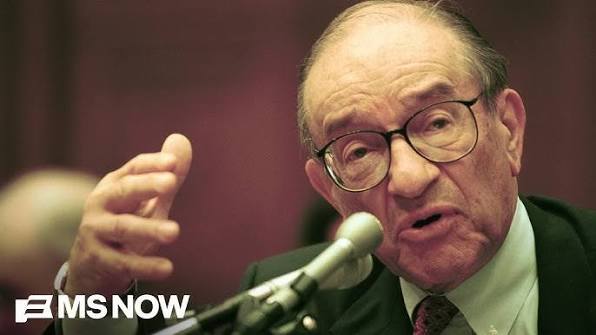

Alan Greenspan, the influential former chairman of the Federal Reserve whose nearly two decades at the helm of America’s central bank helped shape the modern economy, has died at the age of 100.
Greenspan passed away Monday due to complications related to Parkinson’s disease, according to his wife of 29 years, NBC News correspondent Andrea Mitchell.
Few economic figures wielded as much influence as Greenspan. During his 18½-year tenure leading the Federal Reserve, he oversaw an era of remarkable economic expansion, low inflation, and surging financial markets. Yet his legacy became deeply contested after the 2008 financial crisis, which erupted just two years after his departure from the Fed.
By the time he stepped down in 2006, Greenspan had attained near-legendary status among investors, economists, and policymakers. Admiring supporters referred to him as the “Oracle” and the “Maestro,” reflecting the enormous confidence placed in his judgment.
That reputation suffered significant damage when the collapse of the housing market triggered a global financial meltdown, nearly crippling the American banking system and producing the deepest recession since the Great Depression.
Many critics argued that Greenspan’s long period of low interest rates, combined with his faith in lightly regulated financial markets, helped create the conditions that led to the crisis.
In later years, Greenspan himself acknowledged at least part of that criticism, admitting, “I made a mistake” in assuming the nation’s banks, whose stability undergirds the financial system and the entire economy, could essentially regulate themselves.
During his years as chairman, Greenspan presided over soaring stock markets and a decade-long economic expansion that began in March 1991. Investors closely analyzed virtually every public comment he made for clues about the future direction of interest rates and economic policy.
His influence became so immense that it even spawned a form of Wall Street folklore known as the “Briefcase Indicator.” Market observers scrutinized the size and appearance of the briefcase he carried into Federal Reserve meetings, believing it might signal whether important policy changes were imminent.
The collapse of Greenspan’s standing began shortly after he left office. Housing prices, which had climbed dramatically during his tenure, began to fall and eventually plunged, causing massive losses throughout the financial system.
As the housing bubble burst, millions of Americans lost their homes to foreclosure. The resulting financial panic pushed the United States into the Great Recession of 2007–2009, the most severe economic downturn since the 1930s.
The crisis quickly spread beyond American borders, contributing to sovereign debt problems in Europe and prompting China to launch massive government stimulus programs to stabilize its economy.
Looking back, many economists concluded that Greenspan’s policies, his confidence in market self-regulation, and his failure to curb excessive risk-taking played important roles in creating the environment that led to the collapse.
Years later, Greenspan reiterated that “I made a mistake” in believing that banks and financial institutions would adequately police themselves without stronger oversight.
Before the crisis, however, Greenspan enjoyed a level of global respect rarely achieved by a central banker. Financial markets often reacted instantly to his comments, and many observers worried about what would happen when he eventually left office.
One of his most famous interventions came on December 5, 1996, when he warned of possible “irrational exuberance” in the stock market, a brief phrase that sent investors scrambling and became one of the most quoted remarks in financial history.
Greenspan was well aware of his ability to move markets and often spoke in deliberately complex language. He once joked about his reputation for ambiguity while testifying before Congress.
“I know you believe you understand what you think I said, but I am not sure you realize that what you heard is not what I meant,” Greenspan once told a befuddled congressional committee.
Born in Manhattan’s Washington Heights neighborhood, Greenspan displayed exceptional mathematical ability from a young age. His mother frequently showcased his talents to guests.
“I was a prop at parties,” he said in a 2007 interview with PBS NewsHour.
Before becoming an economist, Greenspan briefly pursued a musical career. A dropout from the Juilliard School, he played clarinet and saxophone professionally as a teenager alongside future jazz legend Stan Getz. The experience ultimately convinced him that his future lay elsewhere.
Greenspan went on to study economics at New York University, earning advanced degrees and eventually a doctorate. He later spent decades running a successful economic consulting firm.
In the 1950s, he became closely associated with libertarian philosopher Ayn Rand, who nicknamed him the “Undertaker” because of his reserved personality and preference for dark clothing. When he was sworn in as President Gerald Ford’s chief economic adviser in 1974, Rand stood beside him.
President Ronald Reagan selected Greenspan to lead the Federal Reserve in 1987, and he was immediately confronted with a historic challenge.
Just two months after taking office, the stock market suffered the catastrophic crash known as Black Monday. On October 19, 1987, the Dow Jones Industrial Average plunged 22.6 percent in a single day, the worst one-day percentage decline in U.S. history.
Greenspan won widespread praise for helping stabilize the financial system. By assuring Wall Street that the Federal Reserve would provide sufficient liquidity, he helped restore confidence and prevent broader economic damage.
His crisis-management skills were tested again during the Asian financial crisis of 1997 and 1998. Under his leadership, the Federal Reserve worked with international partners to prevent the turmoil from spreading further across the global economy.
Greenspan also received considerable acclaim for overseeing what was then the longest economic expansion in American history. Between March 1991 and March 2001, unemployment fell to levels not seen in decades while inflation remained unusually subdued.
He argued that technological innovation had fundamentally improved economic efficiency, allowing the economy to grow more rapidly without generating inflationary pressures. That belief helped justify keeping interest rates relatively low throughout much of the boom.
Known for his obsessive attention to detail, Greenspan spent countless hours studying obscure economic indicators ranging from rail freight data to industrial production figures. He often began each day with a lengthy soak in the bathtub, using the time to review statistics and policy memoranda.
Throughout his career, Greenspan remained committed to the belief that markets generally function best with limited government intervention. He played a key role in opposing efforts by federal regulators during the 1990s to impose stricter oversight on the growing derivatives market.
History ultimately proved less kind to that philosophy. The expansion of complex financial instruments, combined with loose lending practices and soaring home prices, contributed significantly to the crisis that followed.
The low-interest-rate environment Greenspan helped create fueled the housing bubble, while the deregulatory approach he supported allowed major financial institutions to assume enormous risks. Some of those risks ultimately led to massive taxpayer-funded bailouts, including the rescue of insurance giant AIG.
The Financial Crisis Inquiry Commission, which was assigned to investigate the debacle by Congress, concluded:
“More than 30 years of deregulation and reliance on self-regulation by financial institutions, championed by former Federal Reserve chairman Alan Greenspan and others … had stripped away key safeguards, which could have helped avoid catastrophe.”
After leaving the Federal Reserve in 2006, Greenspan remained active as a consultant, author, and public commentator. Through Greenspan Associates, he advised financial firms and continued to command significant speaking fees.
He maintained a busy schedule well into his nineties, publishing books, analyzing economic developments, and appearing frequently in the media.
In his later years, Greenspan also became an outspoken defender of the Federal Reserve’s institutional independence. In January 2026, he joined other former economic officials in criticizing the Trump administration’s investigation of Federal Reserve Chairman Jerome Powell.
The statement described the probe as “an unprecedented attempt to use prosecutorial attacks to undermine” the Fed’s independence and warned that it could have “highly negative consequences for inflation.”
Greenspan’s 18½ years as chairman made him one of the longest-serving leaders in Federal Reserve history, trailing only William McChesney Martin.
Even after years of criticism, Greenspan continued defending key aspects of his record. In his 2013 book The Map and the Territory, he argued that conventional economic models were poorly equipped to predict the irrational behavior that fuels speculative bubbles.
Reflecting on the boom-and-bust cycle that transformed his legacy, Greenspan remarked:
“Bubbles go up very slowly as euphoria builds,” Greenspan said in a 2013 interview with The Associated Press. “Then fear hits, and it comes down very sharply. When I started to look at that, I was sort of intellectually shocked.”
{Matzav.com}