
 Matzav
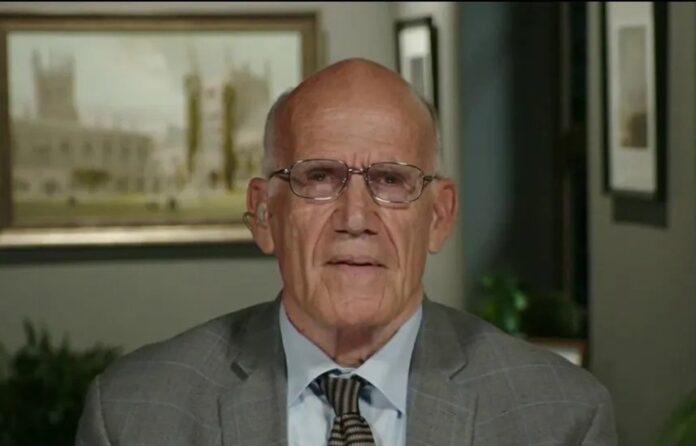
Victor Davis Hanson Dissects How Critics Completely Misread the Iran Deal
Historian Victor Davis Hanson is pushing back against criticism of the newly signed U.S.-Iran framework agreement, arguing that many opponents are overlooking how much leverage Washington gained through the recent conflict and how weakened Iran has become.
Appearing on Fox News’ “Jesse Watters Primetime,” Hanson challenged claims that Tehran emerged from the war in a stronger position and said the destruction inflicted on Iran has dramatically altered the balance of power.
“They’ve suffered probably a half a trillion dollars to their nuclear military industrial complex that took them 50 years to build,” Hanson said in response to what he called “unhinged” arguments that Iran is better off now than before the conflict.
His remarks came days after the Trump administration released the memorandum of understanding it signed with Iran, outlining a 60-day ceasefire and establishing a framework for broader negotiations.
The agreement has sparked criticism from both supporters and opponents of the administration, with detractors arguing that it does not immediately eliminate Iran’s nuclear infrastructure or require the removal of its stockpile of enriched uranium.
Hanson also rejected arguments that the United States effectively gave up ground by negotiating over access to the Strait of Hormuz after Iran disrupted shipping in the region.
“They keep saying, ‘Well, the strait was open before, and now it was closed, and now we had to negotiate to get it open.’ It was only open because they chose not to cause trouble,” he said.
According to Hanson, Iran enjoyed freedom of action for years because previous administrations were unwilling to confront its nuclear ambitions directly.
“They chose to not cause trouble because the last seven presidents said, ‘We don’t dare touch you. We’re not [going to] interfere with your nuclear programs.'”
He maintained that sanctions and restrictions on Iranian oil exports continue to place significant economic pressure on the regime and strengthen America’s bargaining position.
“They think time is on Iran’s side. Time is not on Iran’s side,” Hanson said, referencing the burden imposed by sanctions.
Hanson further argued that Tehran’s leaders are closely watching political developments in the United States, including upcoming midterm elections and celebrations marking America’s 250th anniversary.
In his view, Iranian officials fear that President Trump could have even greater freedom of action if he emerges politically strengthened after the midterms.
“They are terrified that if he wins the midterms and the price of gas goes down, he’s got a free hand, and he already has a free hand now,” Hanson said.
He concluded by arguing that Iran—not the United States—is under the greatest pressure from the passage of time.
“They are afraid that Donald Trump is [going to] drag it out because if he drags it out after the midterm, after the 250th anniversary, he’s [going to] have a lot more options than he does now when he’s worried about gas and the midterm. So the dynamic is all upside down. They are the ones that have the time clock.”