
 Matzav
ELECTION TO BE DELAYED? Justice Solberg Reveals Secret Planning for Election Delays During National Crises
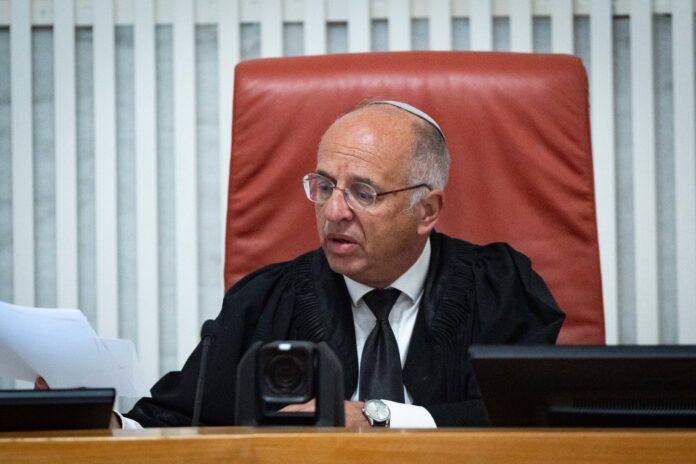
Supreme Court Deputy President and Central Elections Committee Chairman Justice Noam Solberg said that postponing national elections during an extreme emergency could be justified under certain circumstances, while emphasizing that any such move would require strict safeguards and oversight.
Speaking at a closed conference hosted by Hebrew University, Solberg disclosed that election officials are actively examining emergency scenarios in which free and accessible elections may become impossible to conduct. In such cases, he said, a limited and carefully supervised postponement of elections could be warranted.
The remarks came during a presentation of a joint academic paper authored by Solberg and Central Elections Committee Acting Director-General Attorney Din Livneh. The paper examines how democratic elections should be managed during severe national crises and emergency situations.
According to Solberg, any decision to postpone elections must be governed by six strict principles designed to ensure that such an extraordinary measure cannot be exploited for political purposes. He stressed that the primary objective is to prevent election delays from becoming a tool that allows a government to prolong its time in power.
Under the first principle, which Solberg referred to as the “principle of necessity,” the burden of proof rests entirely on those seeking to postpone elections. He explained that the existence of a national crisis alone would not be sufficient justification. Rather, it would need to be demonstrated that the emergency substantially impairs the ability to hold free, fair, and equal elections.
Solberg also outlined what he called the “principle of temporariness,” under which any postponement would have to be limited in duration and accompanied by a specific and clearly defined replacement election date.
One of the most important standards, according to Solberg, is the “principle of last resort.” Before considering a postponement, authorities would be required to exhaust every available alternative, including early voting, mobile polling stations, and special voting arrangements for soldiers, evacuees, and other affected populations.
He emphasized that because delaying elections is such a significant step, any decision would have to be accompanied by complete transparency, including publicly available facts and explanations that would allow for rigorous public and judicial scrutiny.
Toward the end of his remarks, Solberg revealed that the Central Elections Committee has already begun preparing for a range of emergency scenarios behind the scenes.
“To minimize harm and prepare properly, we are thinking in the committee, and practicing, different scenarios and responses, including elections during an emergency.”
He explained that the committee is examining some of the most complex constitutional and logistical questions that could arise during a national crisis. At the same time, Solberg expressed hope that Israel would never find itself in a situation requiring such contingency plans to be implemented.
{Matzav.com}