
 Matzav
Sen. Rand Paul Says Dr. Anthony Fauci’s Power Abuse Has ‘Nothing On’ J. Edgar Hoover With COVID ‘Cover Up’
Sen. Rand Paul is intensifying his long-running battle with Dr. Anthony Fauci, accusing the former top federal health official of wielding extraordinary influence over government research, scientific publications, and intelligence assessments during a decades-long tenure in Washington that Paul says amounted to a massive abuse of power.
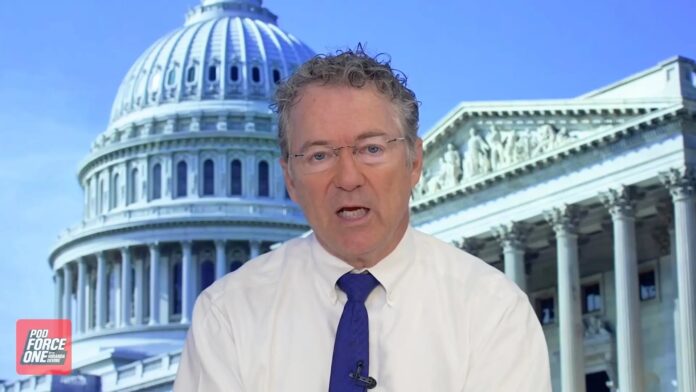
Speaking with Miranda Devine on “Pod Force One” in an interview released Wednesday, the Kentucky Republican argued that Fauci built an extensive network of allies throughout the federal government during his more than four decades at the National Institutes of Health and related agencies.
According to Paul, Fauci’s reach extended far beyond overseeing medical research grants. The senator pointed to whistleblower accounts and internal government communications that have emerged since the COVID-19 pandemic, alleging that Fauci played a significant role in shaping scientific discourse surrounding the coronavirus and influencing government efforts to determine how the outbreak began.
“People talk about J. Edgar Hoover,” Paul said. “J. Edgar Hoover has nothing on Anthony Fauci — 40 years of placing all his lieutenants in all the positions, and then after 9/11, the funding for bio-research and bio-terrorism went through the roof, and he became the kingpin that had access to all of that money.”
Fauci previously told lawmakers that he maintained a “pretty high level” security clearance beginning in 2004 while helping establish federal biodefense programs following the anthrax attacks. He also acknowledged that, during his tenure as director of the National Institute of Allergy and Infectious Diseases from 1984 through 2022, he possessed broad authority to approve thousands of government-funded research grants each year.
One of the central disputes between Paul and Fauci has involved research conducted at China’s Wuhan Institute of Virology and whether U.S.-funded experiments there constituted gain-of-function research that could have contributed to the COVID-19 pandemic.
Fauci has consistently rejected suggestions that American-funded research in Wuhan triggered the global outbreak and has maintained that the virus most likely emerged naturally through animal-to-human transmission.
During a contentious Senate hearing in May 2021, Fauci firmly rejected Paul’s allegations, stating: “The NIH has not ever and does not now fund gain-of-function research in the Wuhan Institute.”
That assertion later became the subject of renewed scrutiny during a May 2024 House hearing, when NIH Principal Deputy Director Lawrence Tabak offered a different assessment of the issue.
“It depends on your definition of gain-of-function research,” Tabak answered. “If you’re speaking about the generic term, yes, we did.”
“This is research, the generic term [gain-of-function], is research that goes on in many, many labs around the country. It is not regulated. And the reason it’s not regulated is it poses no threat or harm to anybody,” he added.
Supporters of the lab-leak theory have argued that such distinctions are significant. Among them is former CDC Director Dr. Robert Redfield, who has contended that even projects that do not receive direct funding can sometimes be pursued under broader grants that receive federal support. Redfield made those remarks during a biosecurity panel discussion in October 2024.
Paul has repeatedly maintained that Fauci misled Congress during their early exchanges over gain-of-function research. The senator has twice referred Fauci to the Department of Justice for possible prosecution, alleging both false testimony and improper handling of federal records.
When Fauci appeared before a House subcommittee in June 2024, he again rejected the characterization that certain NIH- and USAID-funded experiments met the definition of gain-of-function research, which generally refers to work that increases a virus’s transmissibility or infectiousness.
Paul’s allegations regarding federal records stem from emails he obtained showing Fauci directing then-NIH Director Francis Collins to “delete this e-mail after you read it.”
“I referred him twice to the DOJ under Biden for criminal prosecution. They never acted on it. I referred him twice to the Trump DOJ without action on it,” Paul said.
Despite his frustration with the lack of action, Paul indicated that questions remain about whether Fauci could still face legal jeopardy because of a pardon granted by President Joe Biden shortly before leaving office.
“They may say because of his pardon, they can’t prosecute him. I think that’s an open question. I think the courts, in all likelihood, probably will side with the pardon, but there are some questions.”
On his final day as president, Biden granted Fauci a sweeping pardon, praising him as a dedicated public servant and shielding him from prosecution for potential federal offenses dating back more than a decade.
The pardon provided Fauci with a “full and unconditional pardon” covering “for any offenses against the United States which he may have committed or taken part in” between Jan. 1, 2014, and Jan. 19, 2025.
Paul questioned whether such a broad grant of clemency could withstand legal scrutiny.
“Can you pardon somebody for a nonspecific crime? Is it too vague to say, ‘I’m going to not prosecute you and pardon you for anything you did in the last ten years?’ I think there’s a possibility the court says that’s vague and not specific, and you can’t give people some kind of pardon for everything and over such a long period of time,” Paul mused.
“I think there’s a chance we’d win that. I think it ought to be fought,” he added.
The senator is now pressing forward with additional congressional scrutiny. On Monday, Paul issued a subpoena compelling Fauci to testify before the Senate Homeland Security Committee, which Paul currently chairs.
The move followed the release of a collection of internal government emails by Paul and outgoing Director of National Intelligence Tulsi Gabbard. According to Paul, the communications suggest Fauci worked alongside scientists and senior government officials to minimize discussion of the lab-leak theory and suppress concerns raised by a whistleblower.
Paul argued that the newly disclosed records reinforce his belief that Fauci played a central role in shaping both scientific and intelligence narratives surrounding the pandemic.
“Anthony Fauci has been influencing the process, and from the very beginning, it looks like his interference in a lot of different segments — his interference in the scientific journal articles, interference in intel — but he had a 40-year abuse of power career,” Paul said.
“Really, he orchestrated a cover-up that involved, if not dozens, hundreds of people in government that were loyal to him that went to bat because they also were part of the funding stream going to Wuhan, China, and they would suffer the same sort of culpability.”
{Matzav.com}