
 JBizNews
Fire at Delta’s Pennsylvania Refinery Injures Three and Tests an Already Tight Fuel Market
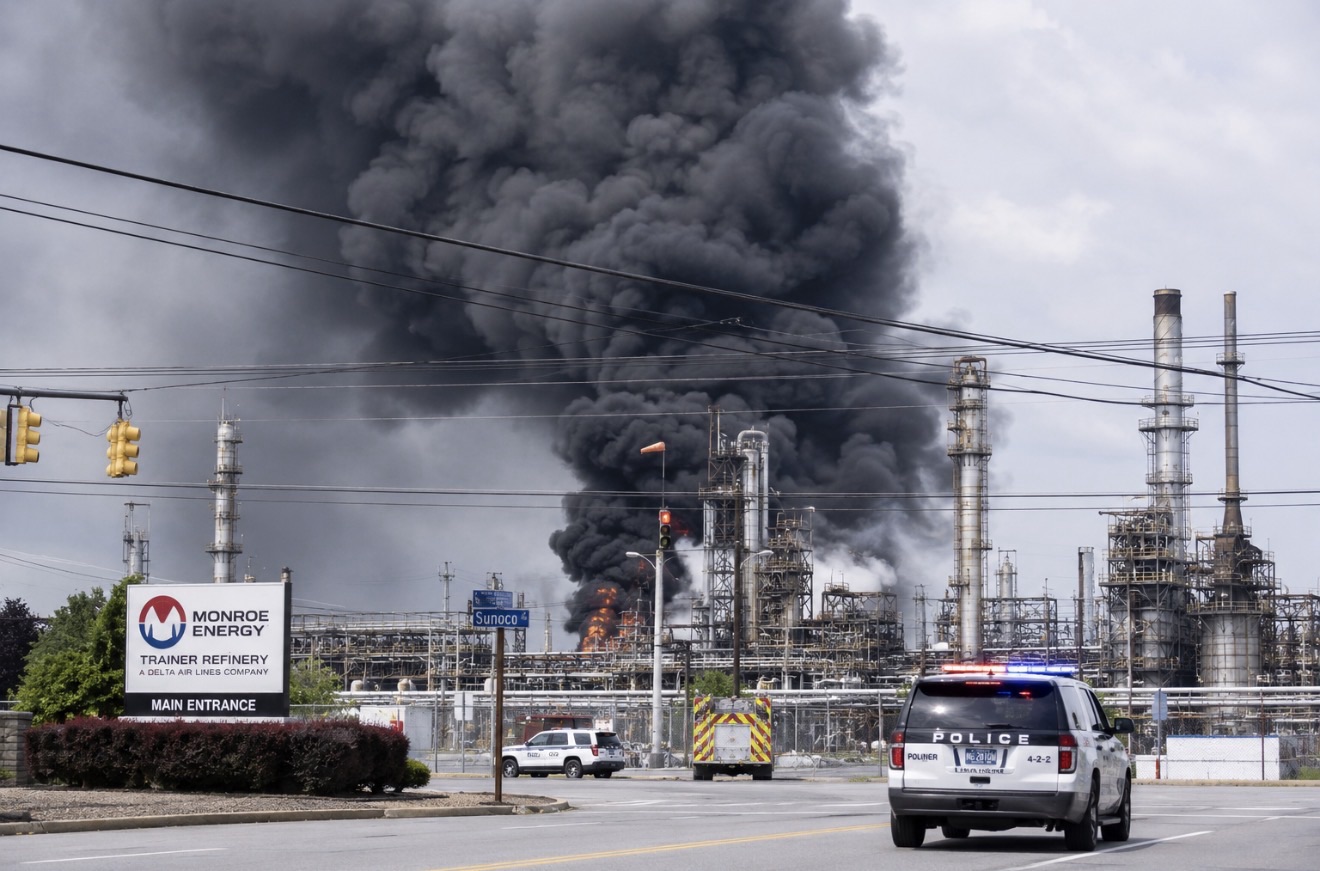
A fire broke out Thursday at the Trainer Refinery in Pennsylvania, owned by Delta Air Lines through its Monroe Energy subsidiary, the company said in a statement, sending a towering column of black smoke over Delaware County and prompting a shelter-in-place advisory for nearby residents. Monroe Energy said the blaze began around 11:30 a.m. in a process unit pump room, and on-site firefighters responded immediately.
The fire was brought under control within hours. By about 2:30 p.m., Monroe Energy said crews had extinguished the blaze and issued an “under control” declaration. Delaware County officials said three people were injured: two with heat-stress-related injuries not expected to be critical, and a third who suffered a burn injury and was airlifted to Thomas Jefferson University Hospital. Reuters reported the injured worker’s injuries were non-life-threatening.
The company moved quickly to reassure the surrounding community. Monroe Energy said it deployed air monitoring when the fire began, in coordination with the Delaware County Local Emergency Planning Committee, and that while smoke was visible, monitoring showed no risks to human health. Officials confirmed the fire did not reach the unit containing hydrogen fluoride, one of the most dangerous chemicals used in refining and a substance integral to producing high-octane gasoline.
The plant is a significant piece of regional fuel supply. Monroe Energy employs nearly 500 people and processes an average of 185,000 barrels per day, producing jet fuel, gasoline, diesel and home heating oil. The refinery straddles the communities of Trainer, Marcus Hook and Chester along the Delaware River. Its output matters not only to Delta, which uses much of the jet fuel for its own fleet, but to drivers and homeowners across the Philadelphia region.
The timing is delicate. A source familiar with the matter said the fire occurred while the refinery was restarting its 68,000-barrel-per-day fluid catalytic cracker after an outage last week. Just last week, the refinery stopped its two 100,000-barrel-per-day crude-oil distilleries because of a leak, though Delta said at the time there was no danger to the public. A second disruption in as many weeks raises questions about the plant’s near-term reliability.
Delta’s ownership of a refinery is itself unusual, and it explains why an airline sits at the center of a fuel-supply story. Delta acquired the Trainer facility through Monroe Energy in 2012 as an “innovative approach” to managing fuel expenses, spending around $100 million to shift roughly 40% of production to jet fuel for its commercial fleet. The strategy was meant to hedge the airline’s single largest variable cost, making any interruption at the plant a direct concern for Delta’s bottom line.
The broader market context cuts both ways. U.S. jet-fuel prices jumped after the start of the U.S.-Israeli war on Iran, as attacks disrupted crude and fuel exports from the Middle East, and prices are now set to ease as crude falls and more tankers move through the Strait of Hormuz. However, any further disruptions could tighten the already constrained fuel market and push prices higher again. A refinery outage on the East Coast is exactly the kind of supply shock that can interrupt that downward trend in pump and ticket prices.
For now, the immediate danger has passed. Towns across the river in New Jersey were not impacted by the smoke but were monitoring conditions, and the shelter-in-place advisory was tied to a nuisance-level air-quality reading within a half-mile of the refinery. Monroe Energy said the exact cause of the fire is unclear and that the incident will be fully investigated. The financial and operational fallout will depend on how much of the plant’s production is affected and how long repairs take, a question that matters for Delta’s fuel costs and for prices across the Mid-Atlantic heading into the busy July 4 travel and driving weekend.
JBizNews Desk
© JBizNews.com All Rights Reserved. Reproduction or distribution without written permission is prohibited.