

New York (VINNEWS/Rabbi Yair Hoffman) This week, the Israel State Archives released thousands of previously classified documents marking fifty years since Operation Entebbe. The release included government protocols, Security Cabinet deliberations, recordings of phone calls, and the Israeli government’s correspondence with foreign governments.
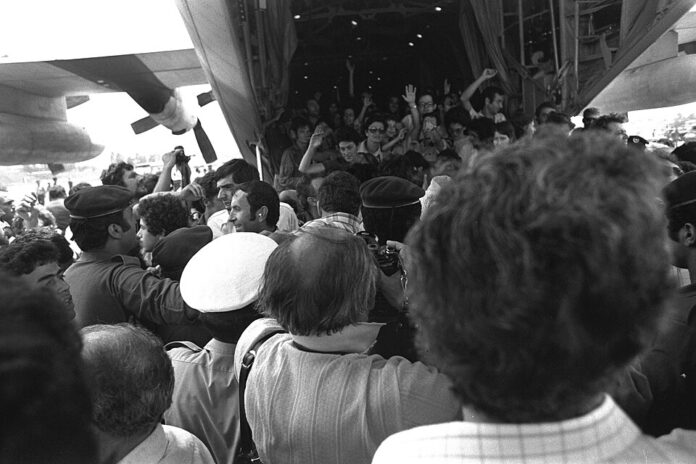
On the night of the fourth of July, 1976, a transport of IDF commandos flew some 2,500 miles to a hostile African airfield, stormed a terminal held by terrorists and Ugandan soldiers, and brought home more than a hundred Jewish hostages.
The newly released transcripts include a fascinating vignette: Colonel Baruch Bar-Lev, attempted to reach the conscience of Idi Amin. He told the Ugandan dictator that he had “a G-d-given opportunity to save the lives of human beings.”
It was a correct response to try to reach Idi Amin in such a way, somewhat reminiscent of Yehudah standing before Tzafnas Paneach in Parshas Vayigash – which has served as a model for askanus for thousands of years. Ultimately, it did not work for Colonel Bar-Lev and military action was the next step.
But what was it that soured Idi Amin onto Israel?
Before we continue, let’s get some background:
In 1996, it was revealed that Colonel Bar Lev, who had headed a military mission in Kampala, had helped make Gen. Idi Amin President of Uganda in 1971.
At the time the head of Uganda was President Milton Obote, who was hostile to Israel. And was planning to expel Israeli forces from Uganda. According to a 1996 New York Times article General Idi Amin had become chief of staff of armed forces. Shortly after, Colonel Bar‐Lev was made head of the Israeli mission to Kamplas and became Idi Amin’s confidant and their families actually became close friends.
He said General Amin once confided that he was concerned because his main supporters were outside Kampala and the President could arrest and execute him before they could reach the capital.
Colonel Bar‐Lev advised the general to station a military force from his own tribe in Kampala. The force would include paratroopers, armor and jeeps. Its mobility and firepower would be such that 600 to 800 men could overcome 5,000, he said. Trained by Israelis, this force thwarted an Obote effort to oust General Amin, the colonel said, and played a key role in defeating the President’s forces.
Colonel Bar‐Lev said that in January 1971, President Obote, who was attending a conference in Singapore, decided to remove General Amin and sent orders to have him arrested. A batallion commander loyal to President Obote called a meeting in the officers club to make plans for the arrest. Four Uganda paratrooper instructors loyal to General Amin learned of the plan and killed those at the meeting.
General Amin then telephoned Colonel Bar‐Lev announcing, “The revolution has started.” Idi Amin defeated Obote.
But then, after Idi Amin took power, Israeli Defense Minister Moshe Dayan called the colonel home and reneged on promises to extend his tour of duty for two more years.
This was followed by an Israeli decision to cancel a visit by President Amin late in 1971 to attend ceremonies marking the completion of training courses by 200 Uganda soldiers.
President Amin had planned to film the event and to bring a national dance troupe to Israel. Colonel Bar‐Lev said that he warned Israeli leaders President Amin would be deeply offended but was ignored.
The former colonel recalled that after Ambassador Dan Laor explained the reasons for the cancellation, President Amin asked his friend to remain nonetheless. Idi Amin then made arrangements to travel to Libya and met with President Muammar el‐Qaddafi, one of Israel’s bitterest enemies. According to Colonel Bar Lev, President AMin was not the same man after that.
Colonel Bar — Lev returned home as instructed, violating a previous promise by the Israeli government and President Amin soon announced a rupture of relations between the countries and the expulsion of all Israelis. He became one of Israel’s bitterest critics in Africa and provided Arab terrorists with bases and training facilities.
It was a sheker – and on account of this lie – the entire affair happened in the first place.
The Torah states (Shmos 23:7): “Midvar sheker tirchak” — distance yourself from a false matter. This is the only prohibition regarding which the Torah uses the language of distancing oneself, underscoring how severe it is (see Shvuos 30b).
The Maharal (Nesivos Olam, Nesiv HaEmes) explains that sheker has no place in the natural order of creation, for Hashem’s seal is emes (Shabbos 55a). A falsehood is thus a breach in the very fabric of the world — and as the Entebbe saga demonstrates, a single sheker five years earlier set in motion a chain of events that endangered over a hundred Jewish lives.
Would the hijackers have taken their victims elsewhere – like Libya? Likely they would not have.
Firstly, the operation was organized around Uganda from early on. The hijacking was led by members of the PFLP-External Operations (Wadie Haddad’s faction) together with German revolutionaries, and they had arranged Idi Amin’s cooperation in advance. Amin welcomed them, provided Ugandan troops to guard the hostages, and gave the hijackers a secure, friendly base. The pre-arranged host relationship was the entire plan. Amin was personally sympathetic and theatrical about his support, lending the hijackers legitimacy and physical protection while keeping up the falsehood, so common in our times of being a “mediator.”
Secondly, Uganda was also far from Israel and seemingly beyond its reach, which the planners assumed made rescue impossible. And thirdly, there’s also the political calculation. Gaddafi supported Palestinian militancy, but hosting the climax of a hijacking of a French airliner full of hostages including many Israelis would have put Libya at the center of an international crisis with France and others, with less deniability.
Notwithstanding all of this, the rescuers were true heroes. They fulfilled no less than 8 different Mitzvos of Pidyon Shvuyimaccording to the Rambam, (and also a few more such as v’ahavta l’rayacha kamocha)!
- Lo saametz es Levavcha— Do not tighten your heart (Devarim 15:7).
- VeLo Sikpotz es yadcha — Nor shall you tighten your hand (Devarim 15:7).
- Lo saamod al dam rayacha — Do not stand idly by your brother’s blood (VaYikra 19:16).
- Lo yirdeno beferech leainecha — Do not let him go down in excessive labor in front of your eyes (VaYikra 25:53).
- Pasoach tiftach es yadcha lo — You shall surely open your hand for him (Devarim 15:8).
- Vechai achicha imach — And your brother shall live with you (VaYikra 25:36).
- Veahavta lerayacha kamocha — Love your friend as yourself (VaYikra 19:18).
- Hatzel lakuchim lemavais — Save those taken toward their death (Mishlei 24:11).
The author can be reached at [email protected]