
 Vos Iz Neias
New Study Seeks To Determine Where Dead Sea Scrolls Were Produced And By Whom And
JERUSALEM (VINnews) — The European Research Council (ERC) has awarded Professor Mladen Popović of the University of Groningen in the Netherlands a €2.5 million grant for a five-year study, in cooperation with the Israel Antiquities Authority and research laboratories in Europe, according to a Yisrael Hayom report.
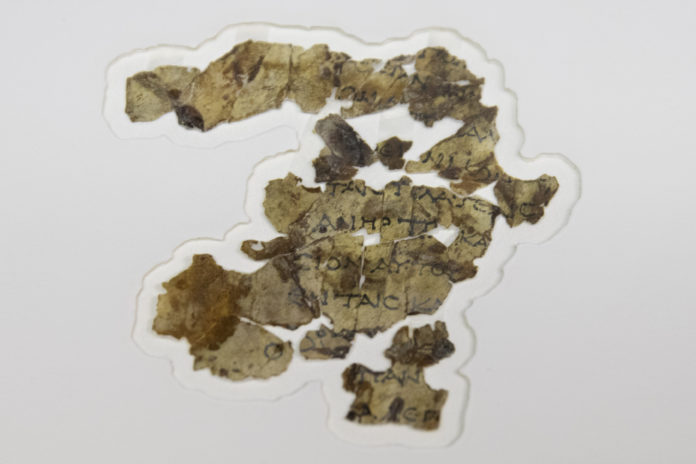
The study will seek to identify where the Dead Sea Scrolls were produced and written, and to shed new light on the world of the scribes who wrote them, the centers of knowledge and the dissemination of texts in ancient Judea. The Dead Sea Scrolls, which are preserved and treated in the Israel Antiquities Authority laboratories in Jerusalem, include, among other things, the oldest known written editions of the Bible.
One of the great questions in Dead Sea Scrolls research, which has occupied scholars for more than 70 years, is where the ancient writings found in the desert caves were produced and written.
Were at least some of them written in Qumran by a Jewish community that lived there in isolation? Were other scrolls brought from additional writing centers in Judea, perhaps from Jerusalem, and hidden in the caves in a time of danger? Or did the caves also serve as a library or as an ancient genizah, a repository for sacred texts?
The new study seeks to examine this question from a broad angle: not only what is written in the scrolls and how they were written, but also what they are made of and how they were prepared. Through chemical testing of the ink, parchment and papyrus, handwriting analysis, examination of the scrolls’ structure and artificial intelligence tools, the researchers will try to identify the material and stylistic “fingerprints” of the scrolls, and to determine whether they were produced in one place, in several production centers, or brought to the Judean Desert from different locations.
The European Research Council has awarded Popović, a world-renowned Dead Sea Scrolls scholar from the University of Groningen in the Netherlands, an Advanced Grant of €2.5 million for the project, titled “Tracing Scribes and Scrolls.” The ERC is one of Europe’s most prestigious grants, awarded to leading researchers with outstanding academic achievements, allowing them to lead innovative, large-scale scientific research. Over the next five years, Popović will head a multidisciplinary team of humanities scholars, scientists and artificial intelligence experts, with the aim of tracing the origins of the Dead Sea Scrolls.
Despite the immense importance of the scrolls, scientific knowledge about the precise location where they were produced, processed and written remains partial. The new study seeks to address this gap through a combination of chemical testing, artificial intelligence and paleography, the study of ancient handwriting.
As part of the project, and in cooperation with the Israel Antiquities Authority, some 250 parchment and papyrus samples from the Dead Sea Scrolls collection held by the authority will be examined. For the first time in the history of the research, papyrus samples from Egypt will also be analyzed, in order to compare them with samples from Qumran and other sites in the Judean Desert. Comparing the chemical composition of the materials could help identify the sources of the raw materials, possible production routes and links between different writing regions.
The data collected in the laboratory will be processed using artificial intelligence tools, which will search for complex patterns in the chemical information. The results will then be combined with handwriting analysis and codicological analysis, the study of how the scrolls were prepared and arranged, including the structure of the sheets, the layout of the columns, the margins and the joining marks between parts of the scroll. Linguistic and literary features will also be added to the analysis.
In this way, the researchers hope to build a model that will help map the vast collection of scroll fragments held by the Israel Antiquities Authority, which includes more than 25,000 manuscript pieces, making it possible to place the different scribes and scrolls in time and space. In addition, the researchers hope to point to centers where writing, study, creativity and the transmission of knowledge took place in ancient Judea, and perhaps beyond.
Professor Mladen Popović of the University of Groningen in the Netherlands, who is leading the study, said, “The research we are about to conduct is the largest ever carried out with the help of AI to understand the cultural background of the Dead Sea Scrolls. These scrolls are extraordinary testimony to a rich intellectual world that operated in ancient Judea. The combination of advanced laboratory testing and manuscript research with artificial intelligence, which has become so much more sophisticated in recent years, allows us to ask questions that could not be answered in the past: not only who wrote them, but where the texts were written, through which knowledge networks they were disseminated, and what place they held in the society of the period.”
The study also builds on the knowledge accumulated in a previous ERC project led by Popović, “The Hands That Wrote the Bible,” which focused on identifying handwriting and scribes in the scrolls. Now, the new project seeks to broaden the perspective: from the writing hand to the place where it worked, the materials it used and the cultural networks in which the texts were created.
Dr. Ilit Cohen-Ofri, the Israel Antiquities Authority’s partner in the study, said, “The study will create an unprecedented database on the chemical composition of the Dead Sea Scrolls. The Israel Antiquities Authority, which is responsible for preserving, documenting and making knowledge about the Dead Sea Scrolls accessible, invests enormous efforts in researching the scrolls.
“In recent years, we have come to recognize the great importance of understanding the materials from which the scrolls are made, especially the parchment, papyrus and ink, and these may reveal secrets hidden within the fragments that have survived for hundreds and thousands of years. Participation in an international study of this scale allows the Israel Antiquities Authority to harness its expertise in the study of archaeological materials to address the central questions that concern scrolls researchers and the interested public in Israel and around the world.”
Researchers and laboratories in Jerusalem, Pisa, Naples and Odense, Denmark, will take part in the study, including Ilaria Degano, Laila Birò, Kaare Rasmussen and Frank Kjeldsen. At the University of Groningen, Dr. Maruf Dhali plays a central role in developing and implementing the artificial intelligence methods that will make it possible to analyze all the chemical data and identify patterns of origin and affiliation within it. The project is also being carried out in cooperation with the Egyptian museums in Berlin and Turin, as well as the University of Leuven, for the purpose of comparing papyri from Egypt and the Judean Desert.